Helium is made two ways: by nuclear reactions in the early universe and inside stars, and on Earth by the radioactive alpha decay of uranium and thorium in crustal rocks. Commercial helium is never synthesized — it is recovered from natural gas wells where geological conditions have allowed it to accumulate over millions of years. Helium makes up a significant portion of the universe’s mass yet exists at only about 5 parts per million by volume in Earth’s atmosphere, which tells you immediately why supply is tight.
The three practical contexts for understanding where helium comes from are:
- Cosmic formation: Big Bang nucleosynthesis and ongoing stellar fusion account for virtually all helium in the universe.
- Terrestrial radiogenic formation: Alpha decay of uranium and thorium in basement rocks generates helium-4 over geological timescales, which then migrates into natural gas reservoirs.
- Commercial recovery: Helium is extracted and purified from natural gas streams — it is separated, not manufactured.
For analytical labs, the implication is direct: helium is nonrenewable on any human timescale. Supply chains, pricing, and instrument uptime all depend on a finite geological resource, and that reality should shape procurement decisions today.
Table of Contents
- How helium forms in the universe: Big Bang nucleosynthesis and stellar fusion
- How helium is produced on Earth: radioactive alpha decay and isotopes
- What helium scarcity means for your lab: mitigation, alternatives, and SLI guidance
- Key Takeaways
- Helium’s origin story is also a procurement story
- Southern Laboratory and Industrial (SLI) can help you reduce helium dependency
- Useful sources and further reading
How helium forms in the universe: Big Bang nucleosynthesis and stellar fusion
Most helium in existence was produced in the first few minutes after the Big Bang, and stars have been adding to that supply ever since. According to Wikipedia’s helium entry, helium-4 formed during Big Bang nucleosynthesis when the universe was hot and dense enough for protons and neutrons to fuse, and it remains the second most abundant element in the cosmos after hydrogen.
Big Bang nucleosynthesis lasted roughly three minutes. During that window, about 25% of all baryonic matter was converted into helium-4. The conditions — temperatures above 10⁹ Kelvin and extreme density — will never be replicated on Earth at any useful scale.
Stars continue producing helium through two fusion pathways:
- Proton–proton (p–p) chain: The dominant process in lower-mass stars like the Sun, where four hydrogen nuclei fuse stepwise into one helium-4 nucleus, releasing energy.
- CNO cycle (carbon–nitrogen–oxygen cycle): Dominant in more massive, hotter stars; uses carbon, nitrogen, and oxygen as catalysts to fuse hydrogen into helium-4.
Key distinctions worth keeping in mind:
- Helium-4 (two protons, two neutrons) is by far the more abundant isotope, produced in both stellar fusion and terrestrial alpha decay.
- Helium-3 (two protons, one neutron) is far rarer; it originates primarily from primordial Big Bang processes and from tritium decay, not from standard stellar fusion.
- Helium accounts for approximately 24% of the universe’s mass, almost entirely as helium-4.
- Stars are essentially helium factories — the Sun converts roughly 600 million metric tons of hydrogen into helium every second, though none of that helium reaches Earth.
How helium is produced on Earth: radioactive alpha decay and isotopes
On Earth, helium does not arrive from space and is not left over from the planet’s formation in any recoverable form. It is generated continuously, though slowly, by the radioactive alpha decay of heavy elements — primarily uranium-238, uranium-235, and thorium-232 — embedded in crustal and basement rocks. Geology.com’s helium overview confirms that radiogenic helium can reach high concentrations in some natural gas fields, a figure that makes those deposits commercially significant.
The mechanics are straightforward. When a uranium or thorium nucleus undergoes alpha decay, it ejects an alpha particle: two protons and two neutrons bound together, which is structurally identical to a helium-4 nucleus. That particle quickly captures two electrons from the surrounding material and becomes a neutral helium-4 atom. Over millions of years, these atoms accumulate in the pore spaces of surrounding rock and, where geology permits, migrate upward into natural gas reservoirs.
Helium-4 vs. helium-3: different origins, different applications
- Helium-4 is the terrestrial isotope. Every commercial helium cylinder, every MRI magnet, and every GC carrier gas application uses helium-4. It is abundant relative to helium-3 but still finite.
- Helium-3 is cosmogenic and primordial. It exists in trace amounts in natural gas and is also produced by the decay of tritium (hydrogen-3). Its scarcity makes it extremely valuable for specialized cryogenic applications (dilution refrigerators reaching millikelvin temperatures) and for nuclear fusion research. The U.S. Department of Energy manages helium-3 as a strategic material separately from the commercial helium supply.
Pro Tip: If your lab uses a dilution refrigerator or any instrument requiring helium-3, treat that supply chain as entirely separate from your helium-4 procurement. The two isotopes are not interchangeable, and helium-3 availability is governed by different policy and pricing dynamics.
The timescale for generating commercially useful quantities of helium-4 runs into the tens of millions of years. That single fact is why helium is classified as nonrenewable: the rate of geological production is negligible compared to the rate of industrial consumption.
What helium scarcity means for your lab: mitigation, alternatives, and SLI guidance
Treat helium as a finite commodity with price and availability risk, not as a utility gas you can order on demand. Industrial researchers are explicit: labs should evaluate substitution and on-site generation for workloads where it is technically feasible, and build procurement resilience for workloads where it is not. A supply interruption that grounds your GC fleet for two weeks carries costs that dwarf the price of proactive planning — a lesson that applies broadly to any precision operation where a single input can halt production, as illustrated by real-world shutdown scenarios in industrial settings.
A practical checklist for lab managers:
- Audit current helium consumption. Identify every instrument using helium, its flow rate, and whether the application is carrier gas, purge gas, or cryogenic coolant. Quantify monthly usage in cubic feet or liters.
- Evaluate instrument compatibility for carrier gas substitution. Many GC columns and detectors support validated hydrogen carrier gas methods. Review your method requirements and detector types (FID, TCD, MS) before committing to a switch. SLI’s GC carrier gas switching guide covers the technical steps in detail.
- Implement recovery for cryogenic equipment. If your lab operates superconducting magnets or cryostats, evaluate closed-loop reliquefaction. The capital cost is justified at consumption rates above a few hundred liters per year.
- Negotiate supply contracts with force-majeure provisions. Spot-market helium pricing is volatile. Long-term contracts with defined allocation and clear force-majeure language reduce exposure to allocation cuts during shortage periods.
- Maintain emergency cylinder reserves. A 30–60 day buffer of helium cylinders, sized to your critical instrument requirements, provides operational continuity during supply disruptions.
- Invest in on-site generation for substitutable gases. Where GC methods can be validated on hydrogen, on-site hydrogen generation via PEM electrolysis eliminates carrier gas supply risk entirely for those instruments. Southern Laboratory and Industrial (SLI) supplies and installs hydrogen, nitrogen, and zero air generators from LNI Swissgas and Nel Hydrogen, with turnkey installation and local technical support along the Gulf Coast. The lab solutions page covers the full range of on-site generation options.
Pro Tip: When sizing an on-site hydrogen generator for GC carrier gas, calculate your total flow demand across all instruments that will convert, then add 20% headroom for future instrument additions. Undersizing the generator is the most common integration mistake, and it is avoidable with a straightforward usage audit before purchase.
For ICP-MS and ICP instruments that use helium as a collision/reaction cell gas, substitution is generally not possible — helium’s inertness and mass are part of the measurement physics. Those applications require a dedicated procurement strategy, not a substitution plan. SLI’s ICP and ICP-MS application guidance addresses the gas purity and supply requirements specific to those instruments.
Key Takeaways
Helium is a nonrenewable geological resource formed by stellar nuclear fusion and terrestrial alpha decay; commercial supply depends entirely on recovery from natural gas, making procurement resilience a technical necessity for any lab that depends on it.
| Point | Details |
|---|---|
| Two origins, one supply chain | Helium forms via Big Bang/stellar fusion and terrestrial alpha decay; all commercial supply is recovered from natural gas, not manufactured. |
| Economical recovery threshold | Natural gas fields need at least ~0.3–0.4% helium concentration to justify extraction; very few fields qualify. |
| Atmospheric escape makes it nonrenewable | Released helium rises and escapes Earth’s gravity; the ACS classifies it as an endangered element with no recovery mechanism. |
| No on-site generation exists | Unlike hydrogen (PEM) or nitrogen (PSA), there is no practical technology to produce helium on-site; labs must manage it as a finite commodity. |
| SLI on-site generation reduces exposure | Southern Laboratory and Industrial (SLI) supplies hydrogen, nitrogen, and zero air generators that eliminate supply risk for substitutable GC and lab gas applications. |
Helium’s origin story is also a procurement story
Understanding the physics of helium formation is not an academic exercise for lab managers — it is the foundation of a sound supply strategy. The same properties that make helium irreplaceable in MRI magnets and GC carrier gas applications also make it impossible to manufacture on demand. Every cubic foot your lab consumes was formed over millions of years and will not be replaced on any timescale that matters to your operating budget.
What I find underappreciated in most lab procurement conversations is the asymmetry between helium and every other gas in the lab. Hydrogen, nitrogen, and zero air can all be generated on-site from water or ambient air, which means their supply risk is essentially zero once a generator is installed. Helium has no equivalent. That asymmetry should drive a clear operational posture: aggressively substitute where technically valid, recover where economically justified, and treat the remaining helium demand as a strategic exposure that needs active management, not passive reordering.
The 2025 Journal of Natural Gas Industry analysis gives labs a reasonable planning horizon — no supply collapse before 2060 under current models — but that window is not a reason to defer action. It is the time available to convert instruments, install recovery systems, and negotiate better contracts before the next shortage cycle tightens allocation again.
Southern Laboratory and Industrial (SLI) can help you reduce helium dependency
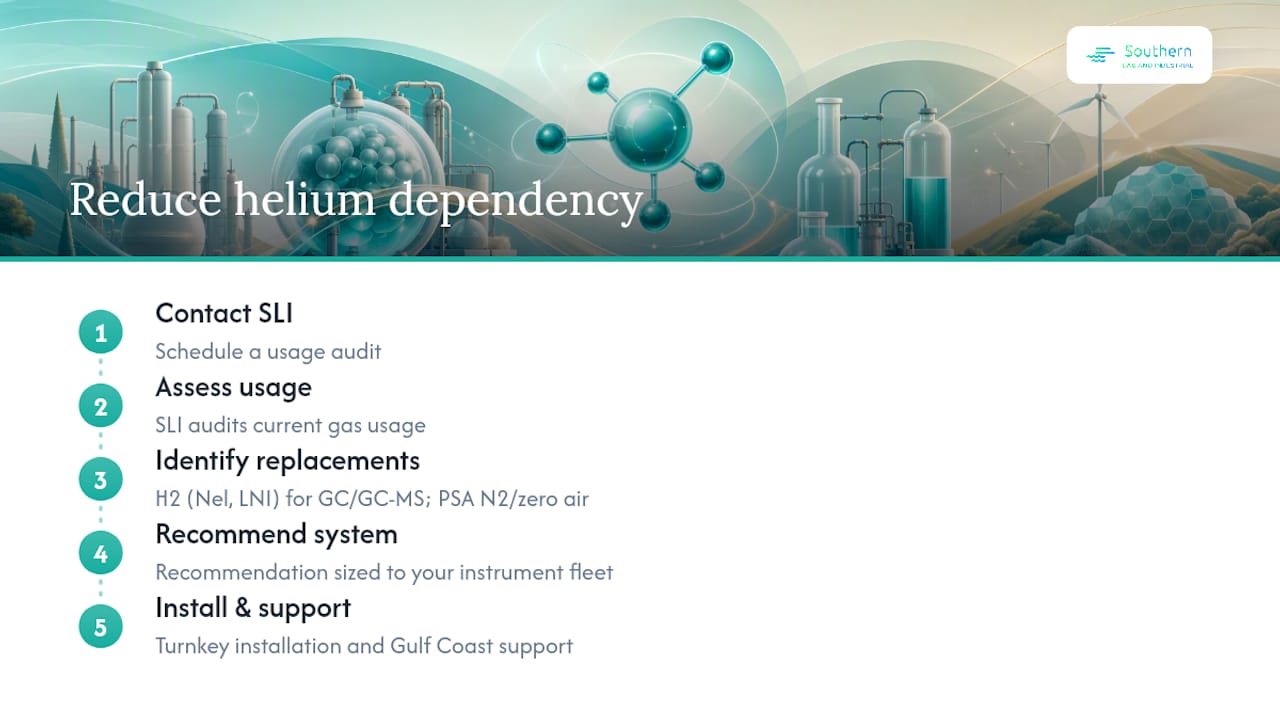
If helium supply risk is affecting your lab’s uptime or budget, Southern Laboratory and Industrial (SLI) offers a direct path to reducing that exposure. SLI assesses your current gas usage, identifies instruments where on-site hydrogen or nitrogen generation is a validated replacement, and handles turnkey installation with local technical support along the Gulf Coast.

On-site hydrogen generators from Nel Hydrogen and LNI Swissgas eliminate carrier gas supply risk for GC and GC-MS instruments that can run validated hydrogen methods. Nitrogen and zero air generators via PSA handle purge gas, detector gas, and instrument air requirements without cylinders or delivery schedules. For labs that have already done the math on helium costs and volatility, the lab gas generator solutions page is the practical next step. Contact SLI to schedule a usage audit and get a system recommendation sized to your instrument fleet.
Useful sources and further reading
The sources below cover helium’s science, geology, industrial production, and U.S. policy in depth. Each is worth bookmarking if you manage helium-dependent instruments or procurement.
- 2025 study — Journal of Natural Gas Industry (helium supply analysis)
- Springer chapter: industrial researchers on helium supply (excerpt)
- Helium Fast Facts — BLM New Mexico Amarillo Field Office
- Helium: A Natural Gas Byproduct with Unique Properties and Uses – Geology.com
- Helium: An Endangered Element – American Chemical Society (ACS)
- How helium is made – MadeHow
- Helium | Britannica
- Helium – Wikipedia