📍 Houston, TX  |  Serving Laboratories Nationwide
✆ 713-653-3424 | Sales@getsli.com
New LNI Swissgas CASTORE XL iQ — NGA 250 · NGA 350 · NG 350  ·  Free LC-MS Nitrogen Assessment

One cabinet. Nitrogen and dry air for the whole LC-MS floor.

The newest LNI Swissgas generators deliver 100 to 350 L/min of LC-MS grade nitrogen from a single floor-standing cabinet, with 150 L/min of dry instrument air alongside it on the NGA models. A multi-instrument LC-MS/MS suite runs on one supply instead of a rotation of dewars.

LNI Swissgas, a Velaris brand New for 2026
LNI Swissgas NGA CASTORE XL iQ 350 nitrogen and dry air generator
NGA CASTORE XL iQ 350
N₂ 200 L/min Dry air 150 L/min LC-MS grade 116 psi <−60°C dew point
100–350 L/minLC-MS grade N2 outlet
150 L/minDry air outlet, same cabinet (NGA)
Parallel pairing for load share and backup
1 dayQuote turnaround
Where multi-instrument labs run out

Dewar rotations do not scale with the bench

Every LC-MS/MS source you add is another 16 to 32 L/min of nitrogen, plus dry air for curtain or drying gas on top of it. At three, four, six instruments, a liquid nitrogen supply stops being a utility and becomes a delivery schedule the lab lives around: boil-off whether or not the instruments run, rental and demurrage per vessel, and a source that drops if one tank runs dry mid-batch.

The symptom you actually see

A queue that clears on the driver's schedule, not yours

A dewar rated for a week runs dry sooner when six sources pull from it. An LC-MS/MS source starved of nebulizing or curtain gas stalls the run, and the Q4 backlog behind it keeps growing while the next delivery is scheduled.

16–32 L/minper LC-MS/MS source
Boil-offeven when idle
One tankone point of failure

Q4 is the worst quarter to be short

Pharma, clinical, and tox labs push year-end sample volume through the same LC-MS/MS bench a dewar swap just took offline.

A generator per instrument is not the only answer

Bench-top units are right for one or two instruments. Past that, one central supply with a manifold is simpler to run, simpler to service, and easier to grow.

New · NGA CASTORE XL iQ

Three configurations, one supply for the suite

All three units combine an inverter-driven scroll compressor, membrane nitrogen separation, refrigerated drying, and carbon polishing in a single floor-standing cabinet — no external compressor, no cryogenics, no cylinders. The two NGA models add a second outlet for dry instrument air; the NG model puts the whole cabinet to work on nitrogen and delivers the highest flow of the three.

LNI Swissgas, a Velaris brandDesigned and built by LNI Swissgas in Italy. Specified, commissioned, trained, and maintained by SLI, its authorized US distributor, serving laboratories nationwide.
New

NGA CASTORE XL iQ 250

LNI Swissgas · Nitrogen + dry air · 6920.70.251
NGA CASTORE XL iQ 250
100 L/minLC-MS grade N2
150 L/minDry air (free air delivery)
  • Combined outputN2 + air up to 250 L/min
  • N2 outlet pressure8 bar (116 psi)
  • N2 dew point (ADP)<−60°C (<−76°F)
  • Dry air dew point<−20°C (<−4°F)
  • Noise at 1 m<60 dB(A)
  • Nominal power5.5 kW, three-phase
  • Footprint (W×D×H)49.2" × 32.3" × 49.6"
  • Net weight330 kg (~728 lb)
New

NGA CASTORE XL iQ 350

LNI Swissgas · Nitrogen + dry air · 6920.70.351
NGA CASTORE XL iQ 350
200 L/minLC-MS grade N2
150 L/minDry air (free air delivery)
  • Combined outputN2 + air up to 350 L/min
  • N2 outlet pressure8 bar (116 psi)
  • N2 dew point (ADP)<−60°C (<−76°F)
  • Dry air dew point<−20°C (<−4°F)
  • Noise at 1 m<69 dB(A)
  • Nominal power7.5 kW, three-phase
  • Footprint (W×D×H)49.2" × 32.3" × 49.6"
  • Net weight340 kg (~750 lb)
New

NG CASTORE XL iQ 350

LNI Swissgas · Nitrogen only · 6920.70.350
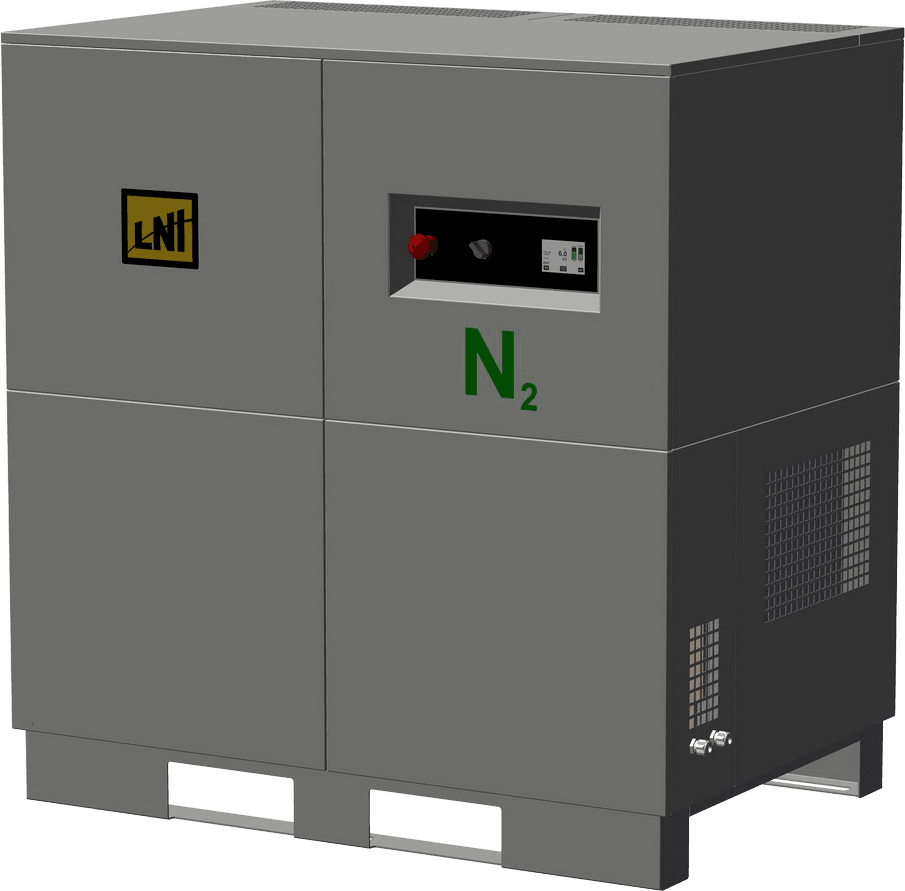
NG CASTORE XL iQ 350 nitrogen generator
350 L/minLC-MS grade N2
N2 onlyNo dry air outlet
  • Highest N2 flow of the three350 L/min
  • N2 outlet pressure8 bar (116 psi)
  • N2 dew point (ADP)<−60°C (<−76°F)
  • N2 purityLC-MS grade (up to 99.9%)
  • Noise at 1 m<69 dB(A)
  • Nominal power7.5 kW, three-phase
  • Footprint (W×D×H)49.2" × 32.3" × 49.6"
  • Net weight330 kg (~728 lb)
Which one?

If your lab already has clean instrument air, the nitrogen-only NG CASTORE XL iQ 350 puts the entire cabinet to work on nitrogen and gives you the most flow per square foot. If you are supplying both gases, an NGA model does it from one unit. A 350.480 build of the nitrogen-only unit is offered for buildings with a different three-phase service — we confirm the electrical match for your building before anything is quoted.

Built for a central supply, not a bench top

From the LNI operating manual, 05/2026
Two outlets

Nitrogen and dry air from one cabinet

Separate 1/2" N2 and dry-air outlets feed a manifold, so source gas and curtain or drying gas for every instrument come from the same unit. The scroll compressor inside supplies its own feed air; no house compressed air is required.

Parallel mode

Runs in pairs for load share and backup

Two units link over RS-485 and share the load proportionally and alternately. If one generator is down for service, the other keeps supplying the line; together they meet demand a single unit cannot.

Demand-following

Compressor speed tracks your pressure

In PID Pressure mode the inverter-driven compressor speeds up or slows down with the gap between set and measured pressure, resting in stand-by above the setpoint. The controller accounts for an external buffer tank up to 2,500 L.

Auto Run

Restarts itself after a power interruption

When power returns after an outage, the generator comes back in the same state it was in before, working or off, without someone walking to the gas room.

Building I/O

Talks to your facility

Voltage-free contacts signal on, ready, and alarm status to a BMS or alarm panel; an opto-isolated input allows remote start and stop. RS-485 is standard for supervision.

Service counters

Maintenance you can see coming

The touch-screen shows hours to Service 1, 2, and 3 (2,500 h, 5,000 h, 10,000 h). Pre-alarms flag due maintenance while nitrogen keeps flowing. SLI preventive maintenance is scheduled against those counters.

One or two instruments, not a suite?

The bench-top NG CASTORE XS and XL iQ line (15 to 70 L/min) and seven instrument-specific NGA variants still cover single-platform labs — start with our nitrogen generator for LC-MS overview, or see full specifications for every model on the NG Series nitrogen generators page. The assessment tells you which side of that line your lab is on.

Sizing a central supply

How many sources does one unit carry?

LNI's instrument-specific units draw 16 to 32 L/min of nitrogen per LC-MS/MS source depending on the platform. The illustration below uses 20 L/min per source with 25 percent headroom. Your assessment replaces it with the OEM figures for your exact instruments and your real peak, not the average.

ConfigurationN2 availableDry air availableIllustrative LC-MS/MS sourcesTypical fit
NGA CASTORE XL iQ 250100 L/min150 L/minup to ~4Growing lab consolidating from bench units
NGA CASTORE XL iQ 350200 L/min150 L/minup to ~8Core LC-MS/MS suite on one manifold
2× NGA CASTORE XL iQ 350, parallel400 L/min300 L/minup to ~16Central supply with service backup
NG CASTORE XL iQ 350 (N2 only)350 L/minup to ~14Suites with existing instrument air
What your facility needs to support it

A three-phase supply (the unit ships with a 32 A industrial plug on a 3 m cable; we confirm the electrical match for your building during the assessment), an indoor location between 36 and 95°F, a floor rated for more than 1,000 kg, roughly 8 in. of clearance at the sides and 4 in. behind, and ventilation for 18,800 to 25,600 BTU/h of heat. Placement and utility connections stay with your facility; SLI specs them so there are no surprises.

Dewars vs a central generator

What actually changes on the floor

The purchase price is the visible number. These are the ones that show up in your week.

Liquid N2 dewars / cylindersNGA CASTORE XL iQ central supply
SupplyBoil-off, rental, delivery, demurrage per vesselA three-phase outlet, nothing to schedule
Adding an instrumentMore vessels, more swaps, same delivery cadenceAnother drop on the manifold, inside the unit's headroom
Mid-batch riskSource can drop if a tank runs dryContinuous while powered; parallel pair covers service downtime
Dry airSeparate compressor or separate cylindersSame cabinet, second outlet
Cost shapeRecurring and inflatingCapital once, then a fixed utility cost
Who supports itA delivery driver and a phone queueAn SLI Sales Engineer, on site, with PM on the service counters
Honest payback, from your numbers.

On-site nitrogen commonly pays for itself within a couple of years for labs with steady consumption, after which gas becomes a fixed utility cost instead of a recurring, inflating bill. A central unit feeding several sources gets there sooner than one generator per bench. We build your ROI from your actual gas usage, not industry averages.

How it goes

Five steps, one local engineer

National suppliers drop a crate at your dock and leave the rest to you. Here is what working with SLI actually looks like.

01  Assess

A Sales Engineer reviews every MS platform on the floor, your current N2 and air sources, and peak demand.

02  Spec

We size the 250, the 350, or a parallel pair that covers it with headroom, and write up what your facility needs.

03  Commission

We commission the unit on site, set pressure and control modes, and bring it up to spec with you.

04  Train

Your team is trained on the touch-screen, counters, and alarms before we leave the building.

05  Support

Preventive maintenance scheduled to the service counters, calibration, and parts for laboratories nationwide.

SLI provides consulting, commissioning, training, and preventive maintenance. Physical placement, plumbing, and electrical connection stay with your facility, and your lab re-establishes its own methods. We share the best practices that make that easier.

Free LC-MS Nitrogen Assessment

A specification for your suite, yours to keep

A Sales Engineer reviews every LC-MS/MS platform on your floor and your gas setup, then writes you a nitrogen and dry-air specification. Not a brochure and not a sales call: a document you can budget from, compare suppliers against, and keep, whether or not you buy from us.

  • A written N2 and dry-air specification matched to your instruments, yours either way
  • Peak demand per source from OEM sheets, not a lab-wide average
  • Whether a 250, a 350, or a parallel pair covers it with headroom, and what your facility needs to support it
  • An itemized quote alongside it, within one business day
  • ROI built from your actual gas usage, not industry averages
  • Our Laboratory Gas Requirements by Instrument guide, emailed with your assessment — gas flows and pressures for the instruments on your floor
On screen the moment you submit, plus a guide in your inbox

The six numbers a Sales Engineer needs to size a central supply appear immediately, and your Sales Engineer emails you the Laboratory Gas Requirements by Instrument guide so you can look up each platform on your floor.

🔒 Your information stays private. A Sales Engineer responds within 1 business day.

Request received

Thank you. A Sales Engineer will be in touch within one business day.

Your Sales Engineer will email you our Laboratory Gas Requirements by Instrument guide — nitrogen, hydrogen, and zero-air requirements for analytical instruments from Sciex, Agilent, Shimadzu, Thermo, Waters and others, with the matching generator for each. In the meantime, here is the LC-MS Suite Sizing Checklist: the six numbers we will ask for, so the specification is right the first time.

  1. Make and model of every MS on the floor, including any planned within 12 months.
  2. Nitrogen flow and pressure each OEM sheet calls for at peak (source gas, curtain or drying gas, collision cell if separate).
  3. Which instruments also need dry air, and at what pressure.
  4. Your longest realistic run at full load, so headroom is sized to peak, not average.
  5. The gas room or corner it will live in: three-phase supply available, ventilation, floor, and clearances.
  6. What you pay per month today for dewars or cylinders, rental, and delivery, for the ROI.
✉  Laboratory Gas Requirements by Instrument — emailed with your assessment

Prefer to talk it through now? 713-653-3424

Questions, answered

Central LC-MS nitrogen, straight answers

Is membrane nitrogen pure enough for LC-MS?
Yes. All three CASTORE XL iQ models produce LC-MS grade nitrogen, the grade LC-MS source and curtain gas is specified at. Purity refers to residual oxygen and depends on flow and working pressure, which is why the assessment confirms each instrument's requirement before any spec.
Do I need house compressed air to run it?
No. A built-in scroll compressor supplies the feed air, and on the NGA models a second outlet delivers 150 L/min of dry air for the instruments as well. The unit needs a three-phase electrical supply and ventilation, not a compressor.
Can one unit feed instruments from different manufacturers?
Yes. Standard nitrogen and dry-air outlets feed a manifold with a regulator per line, so a SCIEX, a Waters, and a Shimadzu can share one supply. The assessment checks each platform's pressure and flow so the manifold and headroom are right. Labs standardized on one platform can still choose an instrument-specific NGA variant.
What if one generator is not enough, or we need backup?
Two units run in parallel mode, linked over RS-485. They share the load proportionally and alternately, and if one is taken down for service the other keeps supplying the line. Two 350s together provide up to 400 L/min of nitrogen.
What does the electrical supply look like?
These are three-phase units at 5.5 kW (250) and 7.5 kW (350), supplied at 400 VAC Y three-phase with a 32 A industrial plug on a 3 m cable. Most US buildings run 208 V or 480 V, so the electrical match — a step-up or step-down transformer, or the alternate 350.480 build — is something we confirm for your building during the assessment, before anything is quoted. It is the single most common surprise on a first install, and it is the reason we ask about your service early.
How loud is it, and where does it live?
Under 60 dB(A) for the 250 and under 69 dB(A) for the 350, measured at 1 m. That is a floor-standing utility unit, not a bench-top: most labs place it in a gas room, utility corner, or corridor near the suite and run a line to the manifold. It needs roughly 8 in. of clearance at the sides and 4 in. behind.
What does maintenance look like?
Service 1 every 2,500 hours or six months, Service 2 every 5,000 hours or a year, Service 3 every 10,000 hours or two years, with the air intake filter checked after the first 400 hours. The touch-screen counts down to each one and pre-alarms while nitrogen keeps flowing. SLI preventive maintenance is scheduled against those counters.
What happens if we lose power?
The generator stops producing nitrogen, the same as a dewar delivery would stop. Unlike a dewar there is no boil-off loss while it is offline, and with Auto Run enabled it returns to its previous state the moment power is restored. A buffer tank on the manifold carries the instruments through short interruptions.
We can't get capital approved before year-end. Any other path?
Yes. We work with a leasing partner that can structure a generator as a monthly operating expense, which often bypasses the capex approval process entirely, and the payment is frequently less than a multi-dewar rental and delivery bill.
Does SLI commission and service nationwide?
Yes. SLI commissions, trains, and services LNI Swissgas hydrogen, nitrogen, and zero-air systems for laboratories nationwide from our Houston, TX headquarters as an authorized LNI Swissgas distributor.

Stop rotating dewars. Put the suite on one supply.

Tell us what is on your floor and a Sales Engineer will write you a specification for it, with an itemized quote alongside, within one business day.

Book My Free Assessment →