ASTM Type I water is ultrapure reagent water defined by ASTM D1193 with strict numeric ceilings for ionic, organic, particulate, and microbiological contamination. If your lab runs HPLC, LC-MS, ICP-MS, PCR, or mammalian cell culture, Type I is not optional — it is the minimum water grade your methods require. Before you read further, take three immediate steps:
- Check your instrument manufacturer’s water specification and confirm whether resistivity alone or a full multi-parameter spec (TOC, endotoxin, bacteria) is required.
- Run a feed-water assessment on your tap or RO supply to understand what your purification train must remove.
- Request vendor proposals that include test data demonstrating compliance with Type I numeric limits, not just marketing claims.
Key Takeaways
ASTM D1193 Type I water requires resistivity ≥18.2 MΩ·cm, TOC <50 µg/L, and full microbiological control — no single parameter or technology alone is sufficient to confirm compliance.
| Point | Details |
|---|---|
| Multi-parameter verification is mandatory | Resistivity confirms ionic purity only; TOC, bacteria, and endotoxin testing are required for full Type I compliance. |
| Sub-classification A for biological work | Cell culture and IVF workflows require sub-class A with endotoxin <0.03 EU/mL — specify this upfront. |
| TCO dominates capital cost | Operational costs over a 3–5 year lifecycle typically exceed the purchase price; model consumable and service costs before selecting a system. |
| Feed-water assessment is non-negotiable | Municipal water quality varies seasonally; size the purification train against worst-case feed conditions, not average values. |
| SLI for Gulf Coast labs | SLI provides turnkey installation, feed-water surveys, and Houston-based service for ASTM Type I water systems. |
Table of Contents
- What an ASTM Type I water system must deliver: the D1193 numeric limits
- Why certain lab workflows cannot tolerate lower water grades
- How a purification train produces Type I water
- How to specify and size a system for your lab
- Verifying and maintaining Type I water quality over time
- Troubleshooting common Type I system failures
- What to budget for: timeline and cost drivers
- What labs consistently get wrong when specifying Type I systems
- SLI provides turnkey Type I water systems with local service support
- Sources
What an ASTM Type I water system must deliver: the D1193 numeric limits
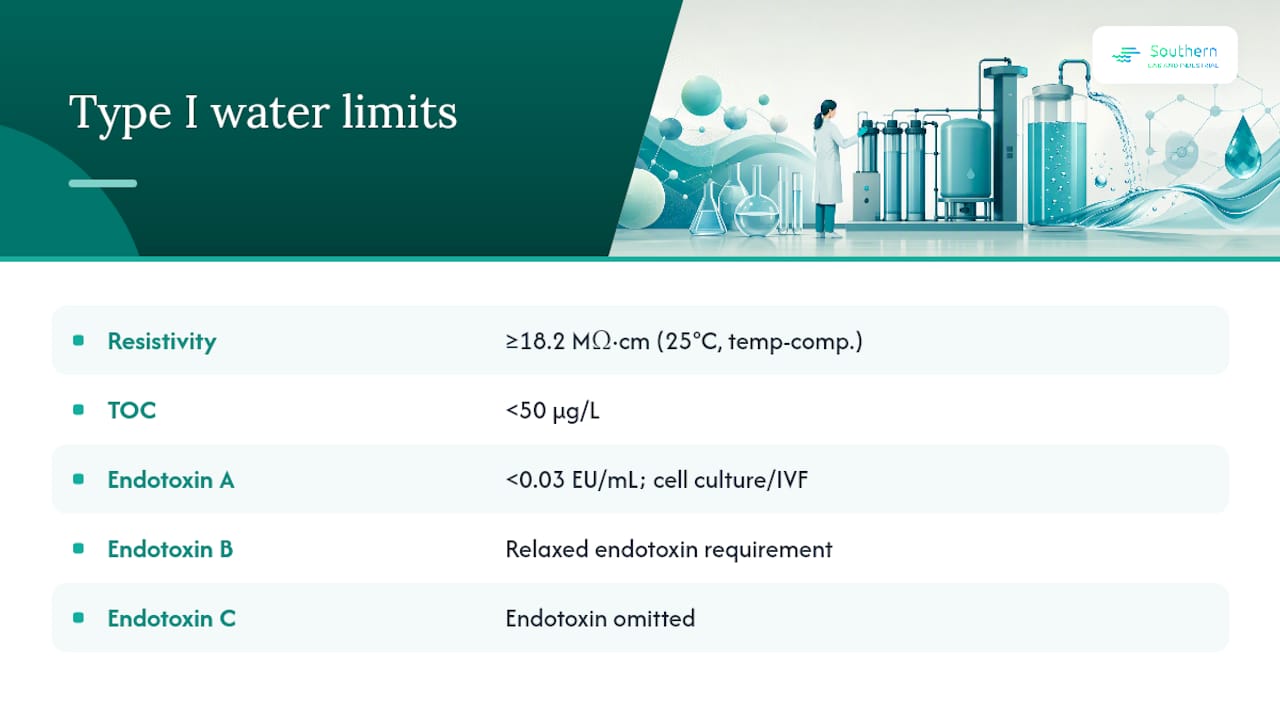
ASTM D1193 sets the following Type I ceilings. Every parameter matters; resistivity alone is not sufficient for complete verification.
D1193 sub-classifications A, B, and C apply microbial and endotoxin controls on top of the base ionic and organic limits. Sub-class A carries the strictest endotoxin ceiling (<0.03 EU/mL) and is required for biological workflows such as mammalian cell culture and IVF. Sub-class B relaxes the endotoxin requirement, and sub-class C omits it entirely. If your lab runs both analytical chemistry and cell biology, specify sub-class A from the start.
Resistivity must be measured at 25°C with temperature compensation active. A reading taken at ambient room temperature without correction will overstate purity. More critically, a resistivity meter reading 18.2 MΩ·cm tells you nothing about TOC, endotoxin, or bacteria. Sigma’s technical guidance is explicit: resistivity confirms ionic purity only, and complete Type I verification requires supplemental TOC analysis and microbiological testing.
ASTM D1193 Appendix X1 offers practical guidance on preparation, monitoring, storage, and validation of reagent water which should be consulted during procurement and validation processes.
Since 2018, D1193 has been a constituent-based standard. It permits any production technology provided the finished water meets the numeric ceilings. That flexibility shifts verification responsibility to the buyer — you must require test data, not just a product datasheet.
Why certain lab workflows cannot tolerate lower water grades
Ultrapure water is essential for the following instrument types and workflows. Using Type II or lower introduces specific, measurable failure modes:
- HPLC and LC-MS: Trace organics cause ghost peaks and baseline drift. Ionic impurities suppress ionization in electrospray sources, producing false-negative quantitation.
- ICP-MS: Sodium, chloride, and silica at even sub-ppb levels create spectral interferences and shift calibration curves. Type II water at 1–5 ppb sodium is not acceptable.
- TOC analyzers: The instrument measures dissolved carbon in the sample — if the water blank carries TOC above 50 µg/L, your results are compromised before the sample is introduced.
- PCR and sequencing prep: Nuclease contamination and ionic carry-over degrade primer binding and amplification efficiency. Sub-class A or equivalent nuclease-free water is standard practice.
- Mammalian cell culture and IVF: Endotoxin above 0.03 EU/mL triggers inflammatory responses in sensitive cell lines. Ionic impurities at ppb levels alter osmolality and affect viability.
The cost of under-specifying is concrete: failed runs, repeat analyses, instrument recalibration, and in cell culture, lost batches. Over-purifying (running Type I where Type II suffices) wastes consumables and increases operating cost. Match the grade to the method, and document that decision.
How a purification train produces Type I water
No single technology reaches Type I across all parameters. A validated production sequence combines multiple stages, each targeting a distinct contaminant class:
- Pretreatment (sediment and carbon prefiltration): Removes particulates, chlorine, and chloramines that would foul downstream membranes. Monitoring: inlet turbidity and chlorine residual.
- Reverse osmosis (RO): Rejects 95–99% of dissolved ions, most organics, and microorganisms. Recovery rates typically run 50–75%; the concentrate stream is a real water-loss cost. Monitor RO permeate conductivity continuously.
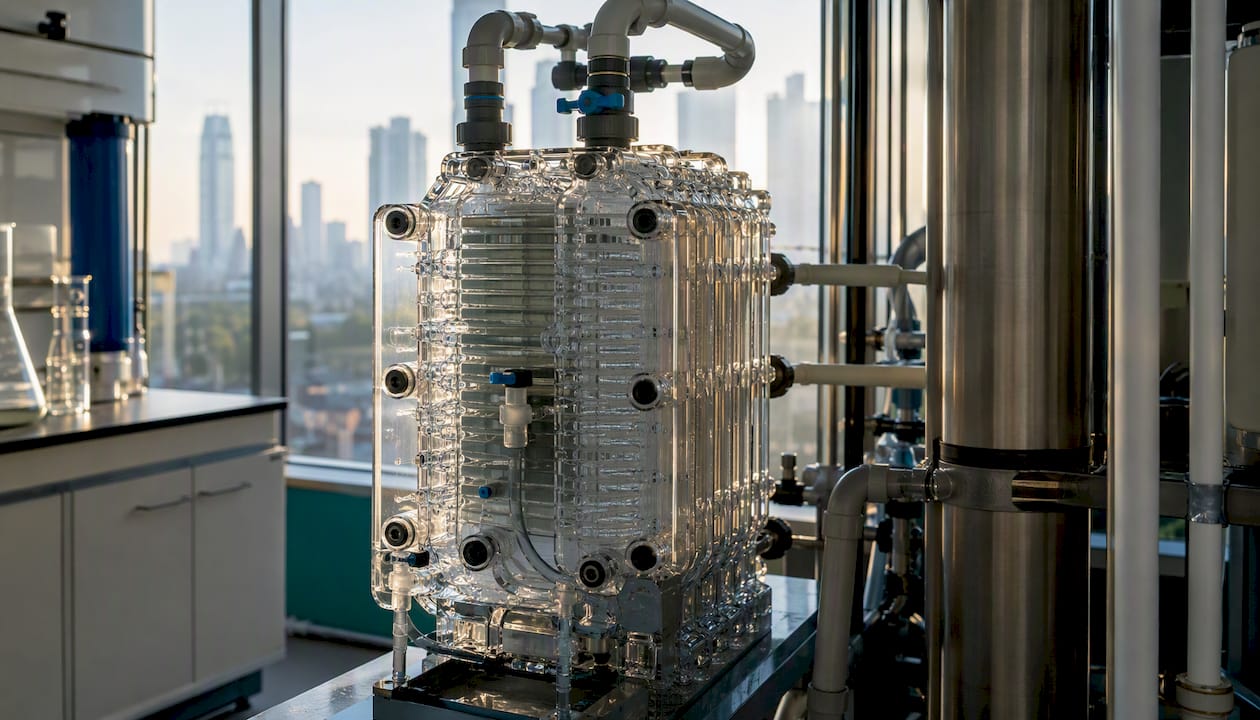
- Mixed-bed ion exchange or electrodeionization (EDI): Polishes RO permeate to 18.2 MΩ·cm. Mixed-bed cartridges are consumables with finite capacity; EDI uses continuous electrical regeneration and eliminates cartridge change-outs but requires stable RO feed quality to function correctly.
- 185 nm UV photo-oxidation: Breaks down dissolved organics to drive TOC below 50 µg/L. UV lamps degrade over time — output drops before the lamp visibly fails. Replace on schedule, not on failure.
- Ultrafiltration (UF): Removes bacteria, endotoxin, and particles above the membrane’s molecular weight cutoff. Required for sub-class A compliance.
- Terminal 0.2 µm point-of-use filter: Final barrier against particulates and microbial contamination at the dispense point. Replace per manufacturer interval regardless of flow rate.
Pro Tip: Install an on-line resistivity monitor with temperature compensation at the point of use, not just at the system outlet. Water picks up CO₂ from ambient air within minutes of leaving a recirculating loop, dropping resistivity measurably before it reaches your instrument.
EDI systems carry higher capital cost but lower long-term consumable spend compared to cartridge-based mixed-bed designs. For labs with high daily throughput (>10 L/day), EDI typically reaches payback within 18–24 months. For lower-volume labs, cartridge exchange may remain cost-competitive through the first equipment lifecycle.
How to specify and size a system for your lab
Sizing a Type I system on flow rate alone is a common and expensive mistake. Work through this checklist before requesting quotes:
- Map peak vs. average demand. Identify simultaneous point-of-use stations and peak hourly draw. A single ICP-MS may need only 1–2 L/day; a multi-instrument suite with a TOC analyzer and cell culture hood may need 20+ L/day.
- Assess feed-water quality. Hardness, TDS, chloramine levels, and silica in your municipal or well supply directly determine RO membrane sizing and pretreatment requirements. A feed-water report is not optional.
- Decide on storage and distribution architecture. Closed-loop recirculation with UV and UF in the loop maintains quality between draws. Single-pass systems are simpler but require dispensing immediately after production.
- Calculate recovery and water loss. At 60% RO recovery, producing 10 L of permeate consumes roughly 17 L of feed water. Factor that into utility costs.
- Define validation requirements upfront. If your lab holds ISO/IEC 17025 accreditation or follows USP/CLSI protocols, state that in the RFQ. Vendors must provide factory acceptance test (FAT) data and site commissioning test reports demonstrating Type I parameters.
Key vendor questions to ask:
- What is the guaranteed resistivity and TOC at the point of use under your expected feed-water conditions?
- What are the consumable replacement intervals and lead times for resin cartridges, UV lamps, and UF membranes?
- What is the service response time for on-site support, and is a local technician available?
- Does the system include on-line TOC monitoring, or is that a separate instrument?
Verifying and maintaining Type I water quality over time
Producing Type I water on day one is straightforward. Keeping it there over months of operation requires a structured monitoring and maintenance program. ASTM D6568 provides traceability and reporting guidance that aligns with ISO/IEC 17025 documentation requirements.
Routine monitoring matrix:
- Continuous (on-line): Resistivity at point of use, temperature-compensated.
- Daily: Visual check of system status indicators; log resistivity and TOC readings.
- Weekly: Collect samples for heterotrophic plate count (HPC); check UV lamp indicator hours.
- Monthly: TOC analyzer calibration verification; inspect prefilter pressure differential; review consumable status.
- Quarterly: Full microbiological panel including endotoxin (for sub-class A systems); particle count if instruments are particle-sensitive.
Maintenance schedule:
- Replace prefilter cartridges per pressure differential or manufacturer interval (typically every 3–6 months).
- Replace mixed-bed polishing resin when resistivity drops below 17 MΩ·cm at point of use.
- Replace UV lamps annually or per lamp-hour rating, whichever comes first.
- Replace UF membranes per manufacturer interval, typically annually.
- Perform full system sanitization and revalidation after any consumable replacement or service event.
The NIH Office of Research Facilities white paper specifically flags storage and distribution as recontamination risks. Stagnant water in storage tanks or dead-leg tubing supports biofilm growth even when the production unit is functioning correctly. Keep storage volumes minimal and recirculation continuous.
Calibrate resistivity meters and TOC analyzers against traceable standards at intervals your accreditation body requires — typically annually for the instruments, with verification checks each time a consumable is replaced.
Troubleshooting common Type I system failures
| Symptom | Likely Cause | Immediate Check |
|---|---|---|
| TOC spike (>50 µg/L) | UV lamp failure or degraded output | Check lamp hours; measure TOC at pre- and post-UV positions |
| Resistivity drop at point of use | CO₂ absorption or exhausted polishing resin | Measure resistivity at system outlet vs. point of use; check resin capacity indicator |
| Resistivity drop at system outlet | RO membrane fouling or exhausted mixed-bed | Check RO permeate conductivity; inspect resin color change |
| Elevated plate count | Biofilm in storage tank or distribution loop | Sanitize loop; check recirculation pump operation; replace UF membrane |
| Endotoxin exceedance | UF membrane breach or contaminated storage | Replace UF membrane; sanitize tank; retest before resuming biological use |
| Particle count increase | Terminal filter exhausted or bypassed | Replace 0.2 µm point-of-use filter; verify filter housing integrity |
Isolation protocol: Measure resistivity and TOC at three points — system outlet, loop return, and point of use. A gap between outlet and point of use points to distribution contamination. A gap between RO permeate and system outlet points to a polishing stage failure.
Call for field service when: resistivity does not recover after resin replacement, TOC remains elevated after UV lamp replacement, or plate counts persist after sanitization. These scenarios indicate either a membrane failure, a system design issue, or a feed-water change that exceeds the system’s design envelope. SLI’s Houston-based technicians carry common consumables and can run on-site diagnostics to isolate the root cause without extended downtime.
What to budget for: timeline and cost drivers
A realistic project timeline for a new Type I system installation:
- Feed-water survey and specification: 1–2 weeks.
- Procurement lead time: 2–8 weeks depending on system configuration and vendor backlog.
- Site work, plumbing, and electrical: 1–2 weeks.
- Commissioning and validation: 1 week.
Primary cost drivers to budget:
- System architecture: A dedicated Type I unit costs more upfront than a Type II system with point-of-use polishers, but the latter requires more frequent cartridge changes at each dispense point.
- Installation: Site plumbing, drain connections, and electrical supply are often underestimated in initial quotes.
- Consumables: Resin cartridges, UV lamps, prefilters, and UF membranes. Request modeled annual consumable costs from vendors before signing.
- Water loss: RO recovery rates of 50–75% mean real utility costs. Higher-recovery systems cost more upfront but reduce operating spend.
- Service contract: Preventive maintenance contracts reduce emergency callout costs and protect warranty coverage.
Operational costs generally exceed capital costs over the lifecycle of typical water purification systems. It is important to prioritize total cost of ownership (TCO) modeling over purchase price when comparing proposals.
What labs consistently get wrong when specifying Type I systems
The most common specification mistake is treating resistivity as the only acceptance criterion. A system reading 18.2 MΩ·cm at the outlet can still deliver water with TOC above 100 µg/L if the UV lamp has degraded, or with endotoxin above 0.03 EU/mL if the UF membrane has been skipped or bypassed. Resistivity is necessary but not sufficient.
The second most common oversight is ignoring feed-water variability. Municipal water quality shifts seasonally, and a system sized for summer TDS may struggle in winter when hardness increases. A one-time feed-water test is not adequate; request a 12-month water quality report from your utility if available.
Finally, labs routinely under-plan spare parts and service response. A resin cartridge on back-order means days of downtime for your LC-MS or ICP-MS. Confirm consumable lead times and local technician availability before committing to a vendor.
SLI’s approach addresses all three gaps: turnkey installation with a full feed-water assessment, on-line multi-parameter monitoring as standard, and Houston-based service support with local parts inventory. For labs integrating water systems alongside gas generators and power conditioning for their analytical instruments, that single-source accountability matters.
SLI provides turnkey Type I water systems with local service support
Labs running ICP-MS, LC-MS, or sensitive cell culture workflows need more than a water purifier — they need a validated system with documented commissioning, scheduled maintenance, and a local technician who can respond when something goes wrong.
Southern Laboratory and Industrial (SLI) supplies and installs laboratory water purification systems designed to meet ASTM D1193 Type I specifications, with turnkey installation and Houston-based service support for labs across the Gulf Coast. SLI’s service offering includes:
- Feed-water surveys and system sizing before procurement
- Factory and site acceptance testing with Type I parameter documentation
- Scheduled maintenance contracts covering resin, UV lamp, and filter replacement
- Rapid on-site response for diagnostics and consumable replacement
- Validation documentation aligned with ISO/IEC 17025 requirements
Contact SLI for a site survey and system quote — the first step toward a validated, low-downtime Type I water supply for your instruments.
Sources
Primary standards and references to cite in procurement and validation documents:
- D1193 Standard Specification for Reagent Water
- D1193 Standard Specification for Reagent Water
- Understanding water quality grades and laboratory applications (Sigma technical article)
- Laboratory Water – Office of Research Facilities
- Type 1 Water Specifications and Applications (Purific)