HPLC-grade water must be Type 1 ultrapure water — 18.2 MΩ·cm resistivity at 25 °C and TOC in the low single-digit ppb range. A standard deionized water system for HPLC that only removes ions will not meet that standard, and the consequences show up fast: ghost peaks on gradient runs, elevated UV baselines, and premature column fouling. The right procurement decision is a multi-stage on-site purifier (RO feed + EDI or mixed-bed polishing + UV TOC oxidation + 0.2 µm final filter) sized to your instrument count and peak flow demand.
Before you request quotes, confirm three things:
- The vendor can supply certified TOC and resistivity test reports at point of use
- The system includes continuous resistivity monitoring and TOC alarm capability
- A local service contract with Gulf Coast coverage is available, including scheduled consumable replacement
Southern Laboratory and Industrial (SLI) provides exactly this package, with Houston-based installation, validation documentation, and ongoing maintenance support for analytical labs across the Gulf Coast.
Table of Contents
- Why a deionized water system alone falls short for HPLC
- What specs to require from any HPLC water purification system
- Procurement checklist for evaluating vendor quotes
- Matching system configuration to your lab’s instrument mix
- What to expect from installation, validation, and ongoing maintenance
- Key Takeaways
- A procurement perspective from the Gulf Coast
- SLI provides turnkey HPLC water systems for Gulf Coast labs
- Authoritative references for specs and validation
Why a deionized water system alone falls short for HPLC
“Deionized” and “ultrapure” are not the same thing, and that gap costs labs real money. Standard deionization removes dissolved ions through ion-exchange resin, but it leaves behind dissolved organics, particulates, and microbial byproducts. Those contaminants are invisible to a conductivity meter yet fully visible to a UV detector or mass spectrometer.
Research links link an estimated majority of HPLC performance problems back to reagent water quality. Ghost peaks on gradient runs are the most common symptom. A second failure mode is rising column backpressure from particulate deposits, which shortens column life and forces unplanned replacements.
Type 1 ultrapure water targets solve both problems:
- Resistivity: 18.2 MΩ·cm at 25 °C (equivalent to 0.056 μS/cm conductivity)
- TOC: <5 ppb for standard HPLC; <2 ppb for LC-MS and high-sensitivity fluorescence work
- Particulates: none above 0.2 µm (final membrane filter required)
- Microbial control: UV bactericidal treatment plus final 0.2 µm filtration
Critically, TOC can break through a polishing cartridge even when resistivity reads 18.2 MΩ·cm. Resistivity alone does not confirm water quality for sensitive detectors. You need both metrics measured and reported.
Pro Tip: When reviewing vendor proposals, reject any spec sheet that lists resistivity only. Demand a TOC figure at point of use, not just at the cartridge outlet.
What specs to require from any HPLC water purification system
The purification chain matters as much as the final cartridge. A system that skips RO or relies on mixed-bed resin alone will exhaust consumables faster, produce inconsistent quality, and cost more to operate over a three-to-five year horizon.
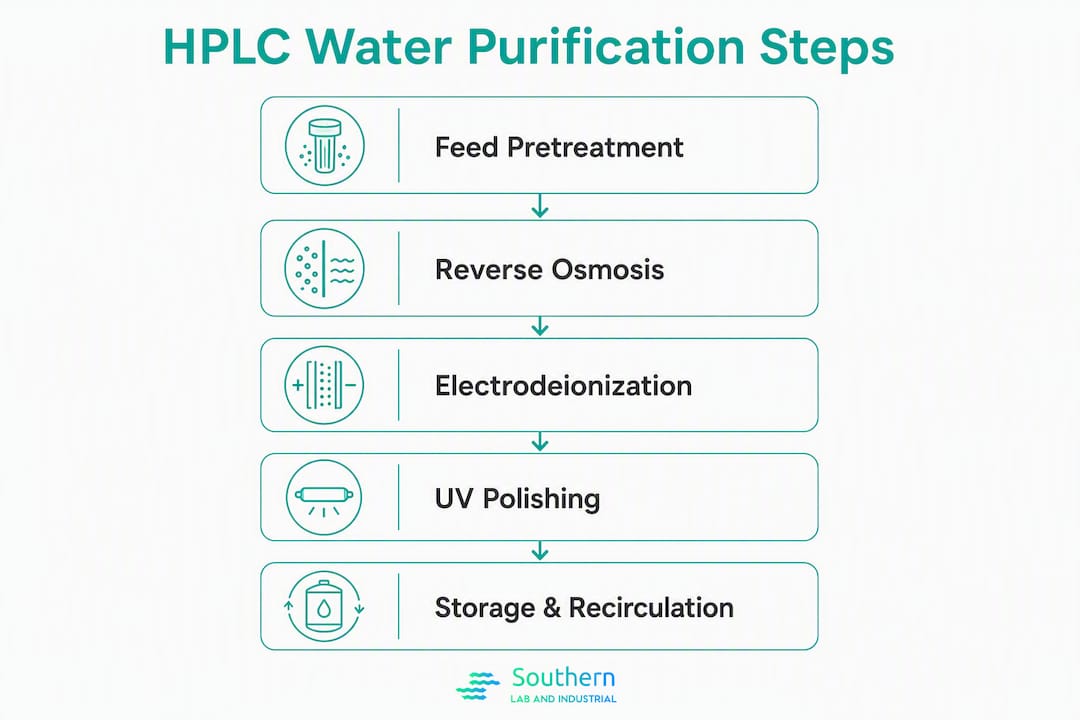
The recommended architecture runs: feed pretreatment → RO → EDI or mixed-bed polishing → dual-wavelength UV (185/254 nm) TOC oxidation → final ion-exchange cartridge → 0.2 µm point-of-use filter, with continuous recirculation for Type 1 output.
Dual-wavelength UV is not optional for sensitive work. The 185 nm wavelength oxidizes organics; 254 nm provides bactericidal action. Systems using only 254 nm UV will not achieve the low-ppb TOC levels that LC-MS and fluorescence detection require.
| Parameter | Standard HPLC target | LC-MS / high-sensitivity target |
|---|---|---|
| Resistivity at 25 °C | 18.2 MΩ·cm | 18.2 MΩ·cm |
| TOC at point of use | <5 ppb | <2 ppb |
| Particle retention | 0.2 µm final filter | 0.2 µm final filter |
| UV oxidation | 185/254 nm dual-wavelength | 185/254 nm dual-wavelength |
Monitoring and alarms to require:
- Continuous resistivity/conductivity display at the dispenser
- TOC monitoring or scheduled TOC measurement with alarm setpoints
- Sampling ports for independent QC verification
Storage handling: on-demand recirculating systems are preferable to stored reservoirs. If a reservoir is used, specify low-extractable polyethylene construction and flush at least 100 mL before collecting water for HPLC to clear atmospheric organics and reservoir-borne contaminants.
Pro Tip: EDI (electrodeionization) continuously regenerates resin electrochemically, eliminating the hazardous chemical regeneration that mixed-bed systems require. For labs running high daily volumes, EDI reduces both OPEX and chemical waste disposal costs.
Procurement checklist for evaluating vendor quotes
Every quote you receive should answer these questions before you sign anything.
Delivered water specs: Does the proposal state resistivity and TOC at point of use, not just at the cartridge? Confirm the TOC method used (online monitoring vs. grab-sample testing).
Flow and recovery: Match the system’s rated flow (L/hr production, L/min dispense) against your peak demand. For high-throughput labs, oversizing by 20–30% prevents running dry during peak shifts. Undersizing is the single most common cause of instrument downtime in multi-instrument labs.
Consumables: Get a full list of replaceable components (final filter, UV lamp, ion-exchange cartridge, RO membrane) with expected replacement intervals and current pricing. UV lamp life typically runs 8,000–10,000 hours; final filters and polishing cartridges depend on feed-water quality and daily volume.
Validation deliverables: Require factory calibration data, a two-point resistivity verification, a TOC report, and an installation IQ/OQ/PQ protocol or acceptance checklist at handover. Type 1 water systems used for LC-MS and regulated workflows need documented performance evidence, not just a verbal assurance.
Local service and SLA: Confirm the vendor has field engineers within same-day or next-day reach of your Gulf Coast facility. Ask specifically about emergency response time, spare-parts stocking, and whether the service contract includes scheduled preventive maintenance visits with consumable replacements.
Pro Tip: Ask the vendor to reproduce the TOC test method and resistivity measurement method from a published application note or manufacturer data sheet. A vendor who cannot cite their measurement methodology is a vendor who cannot defend their spec in an audit.
Matching system configuration to your lab’s instrument mix
Not every lab needs the same configuration. Buying too little creates downtime; buying too much wastes capital budget.
Single HPLC or single-user bench: A compact Type 1 on-demand dispenser with a small recirculating loop, dual-wavelength UV, and a 0.2 µm final filter covers most single-instrument needs. Look for units producing 5–10 L/hr with a dispense rate of at least 1–2 L/min.
Multi-instrument labs: A central RO unit feeding one or more Type 1 polishing loops is the most cost-effective architecture. Integrated dual-function units that produce both Type 2 pure water (for buffer prep and glassware rinsing) and Type 1 ultrapure water from a single system save bench space and eliminate duplicate equipment. Labs running HPLC alongside ICP-MS, GC-MS, or TOC analyzers benefit most from this configuration.
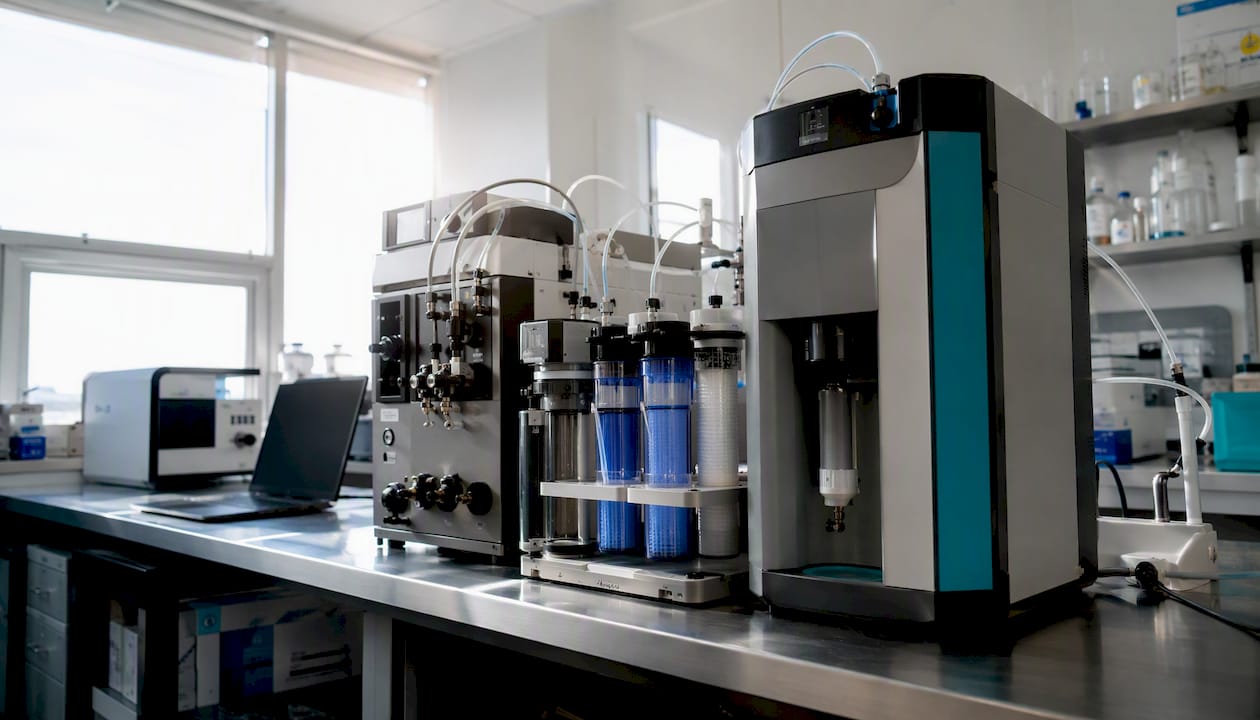
LC-MS, UHPLC, and fluorescence platforms: These instruments demand a dedicated Type 1 system with dual-wavelength UV TOC control, continuous recirculation, and point-of-use resistivity monitoring. The cost of a higher-quality purifier is typically recovered within months by avoiding failed runs and premature column replacements. SLI’s HLP Series systems are configured for exactly these high-sensitivity workflows, with modular options that allow remote placement to free up bench space near the instrument.
For labs running LC-MS or UHPLC, the nitrogen supply for the instrument and the water quality for the mobile phase are equally critical. Both need to be specified and validated together.
What to expect from installation, validation, and ongoing maintenance
A typical installation timeline from site survey to sign-off runs two to four weeks, depending on feed-water conditioning requirements and whether IQ/OQ/PQ documentation is included in scope.
Milestones: site survey and feed-water assessment → equipment delivery → installation and piping → IQ/OQ (2–5 days on site) → PQ water quality testing → handover and sign-off.
Maintenance cadence: Final filters typically require replacement every 3–6 months under normal HPLC load. UV lamps run 8,000–10,000 hours before output degrades. Mixed-bed cartridges exhaust faster in high-volume or high-TDS feed-water environments; EDI units require periodic membrane inspection but avoid full resin replacement. Schedule at least quarterly QC checks of resistivity and TOC for any system serving critical LC-MS workflows.
Service contract terms to require: emergency response SLA (same-day or next-day for Gulf Coast facilities), scheduled preventive maintenance with consumable replacements, routine water quality reporting (TOC and resistivity), and remote-monitoring setup where available. SLI’s service and support program covers all of these for labs along the Gulf Coast.
Validation documents to collect at handover: factory test report, as-installed performance test report, instrument acceptance checklist, and sample results for resistivity and TOC. These documents support both internal QA and any regulatory audit.
Pro Tip: Stock one full set of immediate consumables on site at installation: a spare final filter, a replacement UV lamp, and a polishing cartridge pack. Gulf Coast labs that stock spares on site cut unplanned downtime from days to hours when a component fails mid-run.
Key Takeaways
Type 1 ultrapure water (18.2 MΩ·cm, TOC <5 ppb) is the non-negotiable standard for HPLC mobile phases, and a multi-stage purification system with UV TOC control is the only reliable way to deliver it consistently.
| Point | Details |
|---|---|
| Type 1, not just DI | Demand 18.2 MΩ·cm resistivity and TOC <5 ppb at point of use — generic DI does not meet this standard. Vendor spec sheets often show <10 ppb as a baseline; require <5 ppb to match best-practice recommendations for sensitive detection applications. |
| Require both metrics | TOC can exceed limits even when resistivity reads correctly; always specify and monitor both. |
| Match flow to demand | Size the system to peak L/hr demand plus a 20–30% buffer to prevent instrument downtime. |
| Validate at handover | Collect factory calibration data, TOC report, resistivity verification, and IQ/OQ/PQ documentation before sign-off. |
| SLI for Gulf Coast labs | Southern Laboratory and Industrial (SLI) provides turnkey installation, local service, and maintenance contracts for HPLC water systems across the Gulf Coast. |
A procurement perspective from the Gulf Coast
The most expensive mistake Gulf Coast labs make with water systems is treating the purchase as a one-time equipment decision rather than an ongoing operational commitment. A system that produces 18.2 MΩ·cm water on day one can drift well outside spec within six months if consumables are not replaced on schedule or if feed-water quality shifts seasonally.
Gulf Coast feed water presents specific challenges. Municipal supply TDS and chloramine levels vary by season and by city, and high ambient humidity accelerates microbial growth in any system with stagnant storage. These are not hypothetical risks — they are the reason local service coverage matters more here than in a climate-controlled research campus in the Northeast.
The conventional wisdom is to buy the cheapest system that meets the spec on paper. The smarter approach is to buy the system whose vendor can prove the spec is maintained over time, with documented QC records and a service team that can respond the same day when something goes wrong. For labs already managing on-site gas generators and power protection equipment, adding a water purification system to the same service relationship reduces vendor complexity and keeps accountability in one place.
SLI provides turnkey HPLC water systems for Gulf Coast labs
Gulf Coast analytical labs running HPLC, LC-MS, ICP-MS, or TOC analyzers need a water system vendor who understands both the instrument requirements and the regional service realities. Southern Laboratory and Industrial (SLI) supplies, installs, and maintains laboratory water purification systems configured for Type 1 ultrapure output, with Houston-based field engineers available for same-day or next-day response.
SLI handles the full scope: equipment selection, site survey, installation, IQ/OQ/PQ documentation, and scheduled maintenance contracts with TOC and resistivity verification at each service visit. For labs that also operate on-site gas generators or power conditioning equipment, SLI consolidates all three service relationships under one local team. When you contact SLI, ask specifically for sample TOC/resistivity reports from installed systems, SLA response times for your location, consumable pricing, and an IQ/OQ/PQ plan scoped to your instrument count. Schedule a site survey or phone consult with SLI’s lab equipment team through the lab solutions page.
Authoritative references for specs and validation
The sources below are the ones worth citing in your RFQ documentation and asking vendors to reproduce when they submit performance claims.
“Reagent water quality is the most common root cause of HPLC performance problems — literature estimates that 70–80% of HPLC performance issues are attributable to water quality. TOC can break through polishing units even when resistivity reads 18.2 MΩ·cm, making dual-metric monitoring a requirement, not an option.” — ChromatographyOnline: The Misunderstood Laboratory Solvent
Key references to consult and cite in vendor evaluations:
- ChromatographyOnline: The Misunderstood Laboratory Solvent — Reagent Water for HPLC — purification chain architecture, TOC/resistivity dual monitoring, flush procedures
- Shimadzu: Water Used for HPLC — UV oxidation requirements, Type 1 metric definitions
- Sartorius application note: Ultrapure Water for HPLC — dual-wavelength UV + ion-exchange polishing performance data
- Merck Millipore: Milli-Q IQ 7005 product page — integrated Type 1/Type 2 system specs and flow rates
- Elga LabWater: HPLC guidance — LC-MS and fluorescence Type 1 requirements
- RephiLe: PURIST Ultrapure Water System — example vendor spec sheet showing achievable resistivity and TOC figures
- ResinTech: CLiR 5200 Ultrapure Lab Water System — dual-wavelength UV, Type 1 output at 2.5 LPM, HPLC-specific design
Ask any vendor to reproduce the TOC test method, resistivity measurement method, and recommended flushing procedures from these sources in their proposal. A vendor whose spec sheet aligns with published application notes is a vendor whose numbers you can trust.