A laboratory water purification system produces reagent-grade water on site, eliminating the variability of bottled or municipal supply and giving your instruments a consistent, traceable input. The single fastest procurement decision is this: identify the ASTM D1193 water grade your most demanding instrument requires, then buy a system certified to deliver it reliably. For most analytical labs running HPLC, LC-MS, or ICP-MS, that means Type I water at 18.2 MΩ·cm resistivity at 25°C. Southern Laboratory and Industrial (SLI) offers the HLP Series as a turnkey option for labs along the Gulf Coast that need Type I, II, or III water alongside on-site gas generation and NXT power protection.
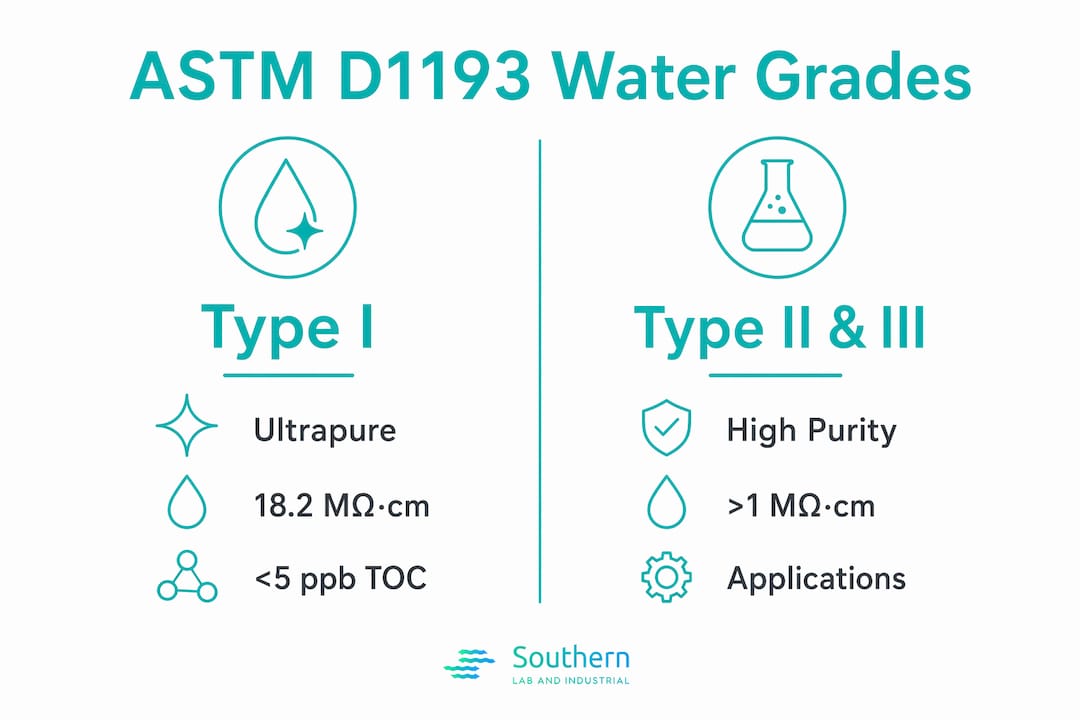
- Type I (Ultrapure): 18.2 MΩ·cm resistivity at 25°C and <5 ppb TOC — required for HPLC, LC-MS, ICP-MS, cell culture
- Type II (Pure): >1 MΩ·cm — buffer prep, media preparation, instrument feed
- Type III (RO permeate): Suitable for glassware rinsing, autoclave feed, and low-sensitivity tasks
Table of Contents
- What ASTM D1193 water grades mean for your instruments
- Key specs to request from vendors before you commit
- How to choose the right system for your lab
- Installation and site-prep checklist
- Consumables, maintenance cadence, and lifecycle costs
- Validation and routine QA for regulated labs
- Integrating water systems with on-site gas generation and power protection
- Common problems and how to triage them
- Recommendation and next steps for procurement
- Key Takeaways
- Why lab infrastructure deserves specialist handling
- SLI’s HLP Series: turnkey lab water systems for analytical labs
- Primary sources and further reading
What ASTM D1193 water grades mean for your instruments
ASTM D1193 defines three grades of laboratory water, and matching the grade to the application is not optional — it is the specification. Treat lab water as a reagent: inconsistent purity causes ghost peaks in chromatography and false positives in trace-metal analysis just as readily as a contaminated standard would.
Type I (Ultrapure) is water of very high resistivity and low TOC suitable for sensitive workflows. HPLC, LC-MS, ICP-MS, cell culture, and molecular biology all require this grade. Type II (Pure) is used for buffer and media preparation, general instrument feed, and reagent dilution where trace-level sensitivity is not the primary concern. Type III is RO permeate — adequate for glassware rinsing, autoclave feed, and any task where ionic or organic contamination at low ppb levels will not affect the result.
One important distinction: resistivity measures ionic content only. TOC monitoring is the metric that catches non-ionic organic contaminants, which can degrade HPLC columns and suppress LC-MS signal without triggering a resistivity alarm. Endotoxin limits (EU/mL) and bacteria counts (CFU/mL) matter separately for cell culture and pharmaceutical workflows.
| Parameter | Type I | Type II | Type III |
|---|---|---|---|
| Resistivity at 25°C | 18.2 MΩ·cm for Type I | >1 MΩ·cm for Type II | Not specified for Type III |
| TOC | <5 ppb for Type I | low TOC for Type II | Not specified |
| Bacteria | <0.001 CFU/mL for Type I | low bacteria for Type II | Not specified |
| Endotoxin | low endotoxin for Type I | Not specified | Not specified |
| Typical applications | HPLC, LC-MS, ICP-MS, cell culture | Buffer prep, media, instrument feed | Glassware rinse, autoclave feed |
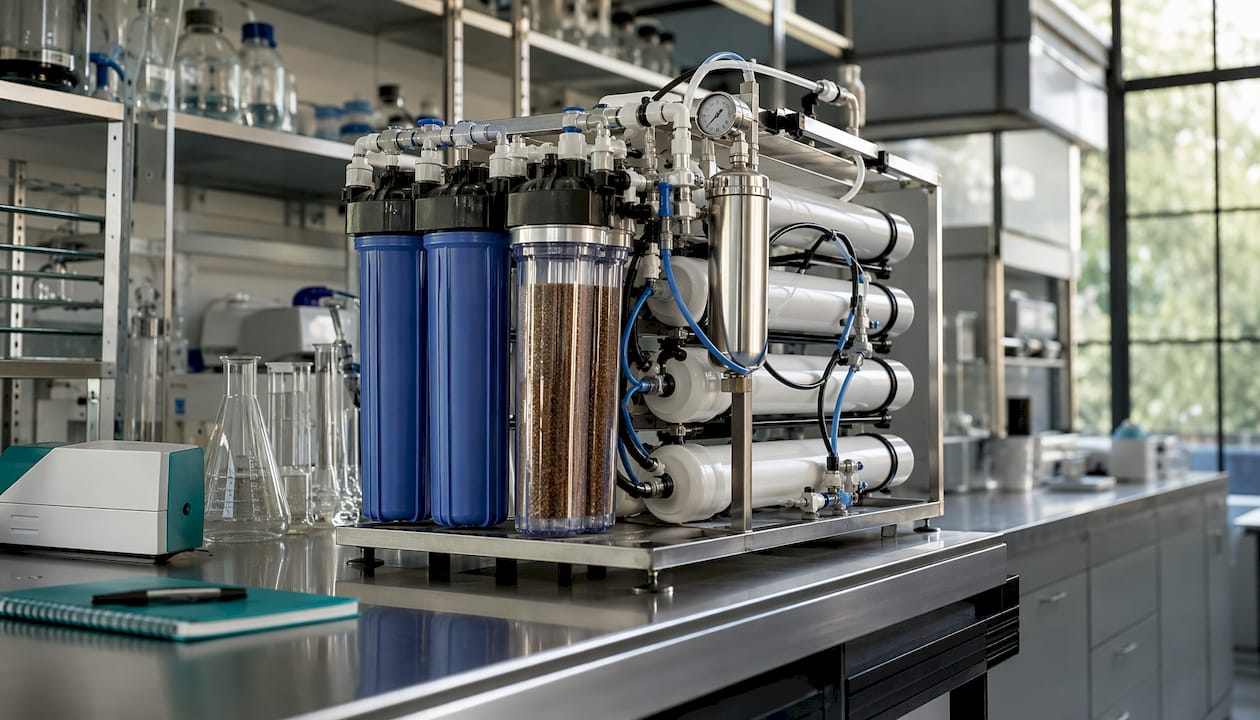
Modern systems reach Type I by combining RO upstream, UV photo-oxidation, and ion-exchange resins in a continuous recirculation loop, with ultrafiltration as a final polishing step for microbiological control.
Key specs to request from vendors before you commit
Vendor datasheets vary in what they volunteer. Ask for these metrics explicitly, and require them in writing before signing a purchase order.
| Spec | Why it matters | Minimum acceptance criteria |
|---|---|---|
| Resistivity at 25°C | Confirms ionic purity | 18.2 MΩ·cm for Type I |
| TOC (ppb) | Detects non-ionic organics | <5 ppb for HPLC/LC-MS |
| Bacteria (CFU/mL) | Microbiological safety | <0.001 CFU/mL for ultrapure |
| Endotoxin (EU/mL) | Cell culture and pharma workflows | — |
| Flow rate (L/h) | Matches peak lab demand | Size to peak draw, not average |
| Delivery pressure | Instrument compatibility | Confirm against instrument spec |
| IoT/remote monitoring | Reduces reactive service calls | Real-time alerts, exportable logs |
| Consumable intervals | Drives OpEx | Vendor-stated intervals in writing |
- Confirm feed-water requirements (hardness, chlorine, silica, conductivity) before sizing the system
- Ask for rated flow at the point of use, not just at the unit outlet
- Verify storage capacity and recirculation rate to prevent stagnation
- Request dispenser (POD) options if you need multi-bench delivery
How to choose the right system for your lab
Work through this checklist before requesting a quote. Skipping steps here is what leads to undersized systems and premature consumable exhaustion.
Define your applications. HPLC and LC-MS demand Type I. ICP-MS requires Type I with low TOC and particle counts. General prep work can run on Type II. Autoclave and glassware rinsing use Type III. A single system that produces both Type I and Type III from tap water — such as units with integrated RO and polishing stages — can cover all three grades.
Estimate peak and daily flow. Add up simultaneous draw from all instruments and prep stations. Size for peak demand, not average.
Assess feed-water quality. Request a municipal water report or run an in-house test for hardness, silica, chlorine, and conductivity. High silica or chlorine shortens consumable life significantly.
Confirm monitoring and validation features. Demand real-time TOC monitoring and resistivity display. For regulated environments, confirm IQ/OQ documentation is available from the vendor.
Calculate TCO, not just purchase price. Factor in consumable frequency, UV lamp replacement, service contract cost, and expected downtime. Systems with walk-away automation and scheduled sanitization cycles reduce manual labor and lower total cost of ownership despite higher upfront cost.
Pro Tip: Prioritize validated, real-time TOC monitoring and regional service coverage over the lowest purchase price. A system that goes offline during a critical run costs far more than the price difference between two quotes.
When evaluating vendors, ask specifically about service SLA response times in your region, spare-parts lead times, and whether IQ/OQ support is included or priced separately. For labs in the Houston and Gulf Coast area, local service availability is a meaningful differentiator.
Installation and site-prep checklist
Physical readiness determines whether a system performs to spec from day one. Coordinate with facilities before the equipment arrives.
- Feed-water: Confirm potable tap supply meets vendor hardness, chlorine, and silica limits. Install pre-treatment RO and softening when feed water exceeds those limits. Feed-water mismatches are the leading cause of premature consumable exhaustion.
- Plumbing and drainage: Install dedicated service valves. Use materials compatible with ultrapure water (PVDF or polypropylene preferred). Vented storage tanks require sterile vent filters. Review pipe material selection for ultrapure-compatible fittings.
- Electrical: Provide a dedicated circuit. Pair the system with NXT power conditioning to protect TOC analyzers and LC pumps from brownouts and surges.
- Space and mounting: Systems are available in bench, under-bench, and wall-mount configurations. Allow clearance for consumable replacement. Plan remote POD placement for multi-bench dispensing — modular POD dispensers let you position the outlet wherever it is most convenient.
Consumables, maintenance cadence, and lifecycle costs
Operational expenditure for a lab water system is driven almost entirely by consumable frequency and service labor. Budget for these before the system ships.
- Pre-filters: Replace regularly depending on feed-water particulate load
- RO membranes: Long service life but shortened by high-hardness or high-chlorine feed water
- Ion-exchange packs: Replacement intervals vary based on feed-water quality
- UV lamps: Some options last multiple years; confirm details with vendor
- Vent filters and ultrafilters: Replace following vendor’s recommended schedule
IoT-enabled remote monitoring alerts you to impending consumable exhaustion and exports performance logs for QA documentation, reducing the risk of an unplanned shutdown during a critical analytical run. Scheduled sanitization and recirculation cycles, when automated, cut technician time and prevent microbiological buildup in storage.
Real-time TOC monitors sample water quality every 2–3 seconds, catching organic contamination events before they affect analytical runs — a capability that manual grab-sampling cannot replicate.
Maintain storage tank hygiene through regular sanitization cycles and vent filter replacement. Neglecting the tank is the most common source of microbiological positives in otherwise well-maintained systems.
Validation and routine QA for regulated labs
GLP, ISO 17025, and FDA-regulated environments require documented evidence that the water system performs within specification. Build this into your procurement, not as an afterthought.
- Daily checks: Log resistivity and TOC at the point of use. Flag any reading outside acceptance criteria immediately.
- Weekly/monthly: Microbiological sampling per your SOP; particle monitoring for critical workflows such as cell culture or injectable prep.
- Acceptance criteria: Resistivity at 25°C = 18.2 MΩ·cm for Type I; TOC <5 ppb for HPLC/LC-MS; bacteria <0.001 CFU/mL for ultrapure-grade applications.
- Documentation: Request IQ/OQ templates, calibration certificates for TOC sensors, and traceable service records from your vendor. Many manufacturers provide optional IQ/OQ and service contracts to support installation qualification and ongoing compliance.
- Corrective actions: Document every out-of-spec event with root cause and corrective action. Auditors look for this record as evidence of a functioning QA system.
Integrating water systems with on-site gas generation and power protection
Water purity and gas purity affect the same instruments and the same baselines. Managing them under separate service plans creates scheduling conflicts and gaps in monitoring coverage.
- Shared monitoring: A coordinated dashboard covering water quality, gas generator output, and power conditioning status gives you a single view of instrument utility health.
- Synchronized service contracts: Aligning water system and gas generator maintenance windows reduces total downtime and simplifies scheduling for facilities.
- Utility zone planning: Locate water systems and gas generators (H₂, N₂, zero air) in the same utility zone to simplify plumbing, electrical, and ventilation requirements.
- Power protection: TOC analyzers, LC pumps, and detectors are sensitive to power fluctuations. NXT power conditioning and UPS protect these instruments from brownouts and surges that can corrupt a run or trigger a false contamination event.
For labs running ICP-MS or LC-MS, both gas and water purity feed directly into baseline stability. Coordinating procurement and service for both utilities under one specialist provider is the most practical way to reduce total risk.
Common problems and how to triage them
Most operational failures trace back to a small set of root causes. Work through this sequence before calling vendor support.
Rising TOC with stable resistivity points to non-ionic organic contamination — check UV lamp output and recirculation pump operation. Replace the UV lamp if it is near end of life.
Falling resistivity indicates exhausted ion-exchange resin. Check consumable age against vendor-stated intervals and replace the polishing pack.
Microbiological positives in storage usually mean a failed vent filter or a missed sanitization cycle. Run a full sanitization cycle, replace the vent filter, and retest before resuming critical work.
Reduced flow suggests a fouled RO membrane. Check feed-water pressure and pre-filter condition first, then assess membrane replacement.
Quick triage sequence:
- Check feed-water pressure and pre-treatment status
- Verify recirculation pump is operating
- Inspect and replace vent filters if overdue
- Confirm recent consumable replacements are correctly seated
- Run a scheduled sanitization cycle
Escalate to vendor service when TOC spikes persist after UV lamp replacement, when microbiological positives recur after sanitization, or when online monitors malfunction. Use bottled ultrapure water as a temporary supply for critical runs while the system is under service.
Recommendation and next steps for procurement
Buy to the instrument grade your most demanding workflow requires. For HPLC, LC-MS, and ICP-MS, that is Type I at 18.2 MΩ·cm resistivity at 25°C and <5 ppb TOC with real-time TOC monitoring. Prioritize validated TOC monitoring and regional service coverage over the lowest purchase price — the hidden cost of downtime and re-runs consistently exceeds the price difference between competing systems.
- Run a short internal needs assessment: list every application, instrument, and daily water volume
- Collect a feed-water test report before contacting vendors
- Request quotes that include IQ/OQ documentation and a service SLA with stated response times
- Schedule site-prep with facilities before the equipment delivery date
- Budget tip: Include first-year consumables, a service contract, and a contingency for feed-water pre-treatment in your procurement estimate — these three items routinely add 20–40% to the first-year cost beyond the system purchase price
Key Takeaways
Selecting the right laboratory water purification system starts with the ASTM D1193 grade your instruments require, then demands real-time TOC monitoring, regional service coverage, and full TCO accounting before any purchase decision.
| Point | Details |
|---|---|
| Match grade to instrument | Type I (18.2 MΩ·cm resistivity at 25°C, <5 ppb TOC) for HPLC, LC-MS, ICP-MS; Type II for prep; Type III for rinsing and autoclave feed. |
| Demand real-time TOC monitoring | Resistivity alone misses non-ionic organics; TOC monitors sampling every 2–3 seconds catch contamination before it affects runs. |
| Account for full TCO | Consumables, service contracts, and feed-water pre-treatment typically add 20–40% to first-year cost beyond purchase price. |
| Validate before going live | IQ/OQ documentation and traceable calibration records are required for GLP, ISO 17025, and FDA-regulated labs. |
| SLI HLP Series | SLI’s HLP Series covers Type I/II/III workflows with turnkey installation, IQ/OQ support, and coordinated gas and power service contracts. |
Why lab infrastructure deserves specialist handling
The labs that manage water, gas, and power as separate procurement events tend to discover the gaps at the worst possible moment — mid-run, during an audit, or when a consumable expires and no local service technician is available. The argument for treating these utilities as integrated infrastructure is not theoretical. When a TOC analyzer loses power during a brownout and the water system’s recirculation pump stops simultaneously, you are not dealing with two separate problems. You are dealing with one infrastructure failure that affects every instrument on that bench.
SLI’s position is straightforward: water purity, gas purity, and power conditioning are all instrument inputs. Managing them under coordinated service contracts, with a single local point of contact in the Houston and Gulf Coast region, reduces the administrative burden on lab managers and closes the service gaps that arise when three separate vendors each claim the other’s equipment caused the problem. The HLP Series fits directly into that model — it is not a standalone product but a component of a broader instrument-utility strategy that SLI designs, installs, and supports on site.
SLI’s HLP Series: turnkey lab water systems for analytical labs
Southern Laboratory and Industrial (SLI) supplies the HLP Series lab water purification systems for analytical labs that need Type I, II, or III water with validated performance and local service support. The HLP Series is designed to integrate with SLI’s on-site gas generators and NXT power conditioning, giving labs a single-source solution for the three instrument utilities that most directly affect analytical results.
SLI provides turnkey installation, IQ/OQ documentation, and ongoing service contracts covering water systems, gas generators, and power protection under one agreement. For labs in the Houston and Gulf Coast region, that means a local technician who knows your system, not a national call center. Contact SLI to request a quote for the HLP Series, discuss feed-water pre-treatment requirements, and schedule a site assessment.
Primary sources and further reading
- ASTM D1193 — Standard Specification for Reagent Water: the governing standard for Type I, II, and III laboratory water grades
- Merck Millipore — Milli-Q product information and procurement guidance: Type I/II/III specifications, TOC monitoring, and installation best practices
- ELGA LabWater — PURELAB Chorus 1 technical specifications: real-time TOC monitoring, microbiological specs, and purification technology overview
- ELGA LabWater — PURELAB Quest product page: feed-water requirements and pre-treatment guidance
- Sartorius — Arium lab water systems: IQ/OQ documentation and validation services for regulated labs
- US EPA — Overview of Drinking Water Treatment Technologies: background on RO, UV, and membrane purification methods
- SLI — HLP Series lab water purification systems: SLI product page for Type I/II/III systems with turnkey installation
- SLI — Service and support: service contracts, maintenance schedules, and regional support for the Gulf Coast