Managing nitrogen supply in an analytical laboratory or industrial facility along the Gulf Coast is rarely as simple as it looks on paper. Cylinder deliveries arrive late, bulk tank contracts lock you into pricing you cannot control, and a single supply disruption can idle instruments worth hundreds of thousands of dollars. The case for on-site nitrogen generation has never been stronger, and the data backing it up is increasingly hard to ignore. This article walks through the key selection criteria, the concrete operational benefits, a side-by-side comparison with traditional supply methods, and practical guidance for deciding whether on-site generation fits your facility’s needs.
Table of Contents
- Key criteria for evaluating nitrogen supply options
- Major benefits of on-site nitrogen generation
- Comparing on-site nitrogen generation vs. traditional methods
- Situational recommendations: Is on-site nitrogen right for you?
- A perspective: Why experts favor on-site nitrogen for critical labs
- Discover tailored gas solutions for your lab
- Frequently asked questions
Key Takeaways
| Point | Details |
|---|---|
| Cuts nitrogen costs | On-site nitrogen generation significantly lowers total supply expenses for laboratories and manufacturing. |
| Boosts lab safety | Eliminates high-pressure cylinders and minimizes risk, improving the workplace environment. |
| Delivers continuous supply | Prevents runouts and delays by producing nitrogen on demand for sensitive applications. |
| Improves workflow efficiency | Simplifies logistics and saves technician time so staff can focus on core operations. |
| Supports future readiness | On-site nitrogen generation is scalable and adaptable for changing instrument needs and sustainability goals. |
Key criteria for evaluating nitrogen supply options
Having set the stage for why rethinking nitrogen supply matters, the logical starting point is identifying the factors that actually drive the decision. Procurement officers and lab managers often focus on the unit price of nitrogen, but that number alone tells an incomplete story.
The following criteria give a more complete picture:
- Total cost of ownership (TCO): This includes capital equipment, consumables, service contracts, and the often-overlooked cost of supply disruptions. Nitrogen generator costs analyzed over a three-to-five year horizon consistently show that on-site generation outperforms cylinder or bulk delivery on a per-liter basis once the payback period is cleared.
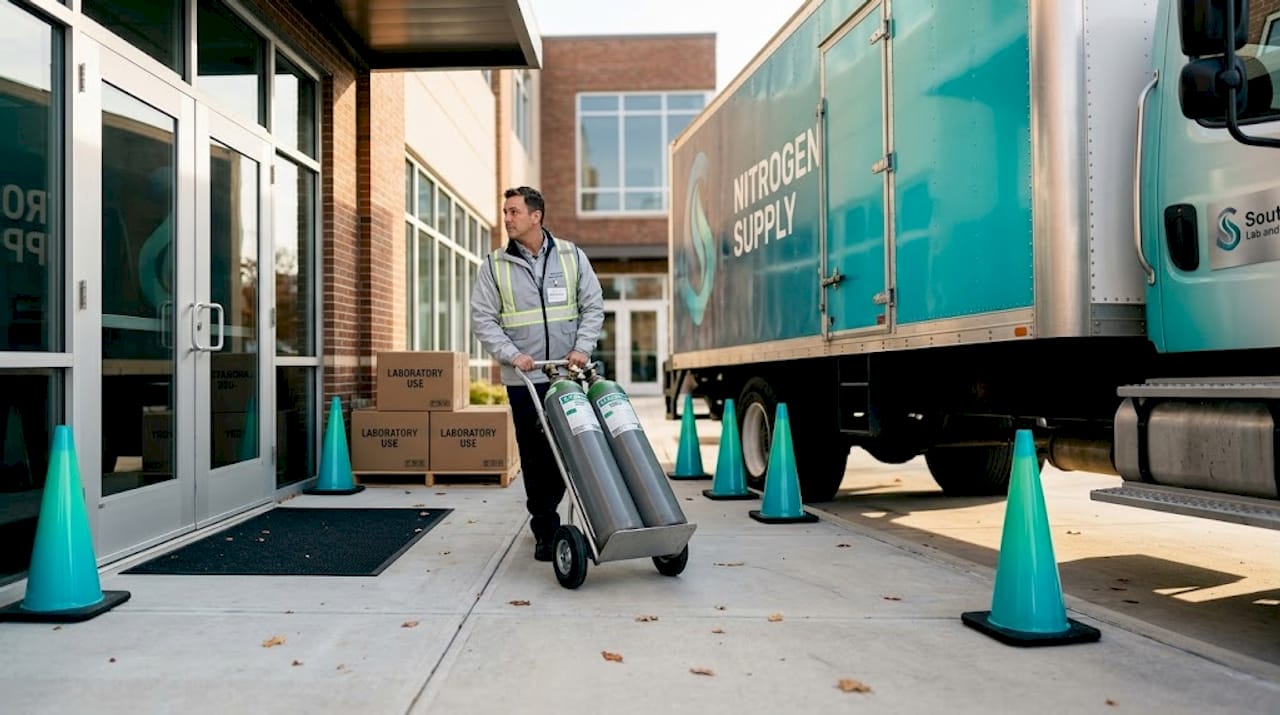
- Supply reliability: Cylinder deliveries depend on third-party logistics. A hurricane, a driver shortage, or a supplier backlog can leave your LC-MS or ICP-MS without carrier gas at the worst possible moment. On-site systems eliminate that dependency entirely.
- Lab safety: High-pressure cylinders require trained handling, secure storage, and regular inspection. Each cylinder swap introduces a point of failure. Reducing cylinder traffic directly reduces the probability of a pressure-related incident.
- Flexibility and scalability: Instrument fleets grow. A nitrogen generator sized appropriately today can often be upgraded or supplemented without the lead times associated with renegotiating a bulk gas contract.
- Purity requirements: Analytical instruments like LC-MS, ICP-MS, and FTIR demand consistent purity, often 99.5% to 99.999% depending on the application. On-site generators using pressure swing adsorption (PSA) or membrane technology can be specified to match those requirements precisely.
Pro Tip: When building your TCO model, include technician time spent managing cylinder inventory, scheduling deliveries, and handling emergency orders. These labor costs are real but rarely appear in a simple cost-per-liter comparison. Facilities that track this time carefully often find it adds 10 to 20 percent to their effective nitrogen cost.
Major benefits of on-site nitrogen generation
Now that you know what to look for, the concrete benefits of switching to on-site generation deserve a close look. These are not theoretical advantages. They show up in monthly operating budgets, instrument uptime records, and safety logs.
Operational cost savings. The most immediate benefit is the reduction in recurring gas costs. Industrial nitrogen generators convert ambient air into high-purity nitrogen on demand, using only electricity as a consumable. Once the capital investment is recovered, the cost per liter drops dramatically compared to cylinder or bulk delivery pricing, which includes transportation, rental fees, and hazmat surcharges.
Continuous, on-demand supply. On-site generation means your instruments never wait for a delivery. For facilities running 24/7 analytical workflows or continuous manufacturing processes, this is not a minor convenience. It is a fundamental shift in how you manage uptime. A single unplanned shutdown in a high-throughput lab can cost thousands of dollars in lost productivity and reruns.
Improved safety profile. Eliminating or dramatically reducing cylinder inventory removes a significant source of workplace risk. High-pressure cylinders stored in lab environments create hazards ranging from physical injury during handling to catastrophic pressure release if a valve is damaged. Lab nitrogen solutions that generate gas at or near point of use operate at much lower pressures, reducing that risk profile substantially. Facilities that have made this transition report measurable reductions in safety incidents related to gas handling.
Instrument-grade consistency. Sensitive instruments are not forgiving of purity variation. LC-MS baselines shift. ICP-MS detection limits degrade. For lab gas supply for incubators and bioreactors, nitrogen purity directly affects cell culture outcomes. On-site generators deliver consistent purity because the process is continuous and controlled, not dependent on the residual pressure in a cylinder that has been sitting in a storage room for two weeks.
Reduced carbon footprint. Every cylinder delivery involves a truck, fuel, and emissions. Bulk tank refills are no different. Eliminating or reducing those logistics trips contributes to sustainability goals that are increasingly part of facility procurement criteria, particularly for facilities operating under environmental management systems or reporting to corporate ESG (environmental, social, and governance) frameworks.
Pro Tip: Adding on-site nitrogen is typically faster than upgrading bulk storage infrastructure. A PSA generator can often be installed and commissioned in days, while expanding a bulk tank system requires engineering review, permitting, and longer lead times. If your facility is growing quickly, on-site generation scales with you more efficiently.
Statistic callout: Facilities that switch from cylinder-based nitrogen supply to on-site generation commonly report operational cost reductions of 30 to 50 percent or more over the life of the equipment, with payback periods ranging from 18 months to three years depending on consumption volume and local gas pricing. The shift toward future-ready hydrogen infrastructure in industrial settings underscores a broader trend: on-site gas generation is becoming the standard, not the exception.
Comparing on-site nitrogen generation vs. traditional methods
With the main benefits outlined, a structured comparison helps you weigh the options side by side. The table below summarizes the key metrics across three common nitrogen supply models.
| Metric | Cylinder supply | Bulk liquid tank | On-site PSA generator |
|---|---|---|---|
| Cost per liter (long-term) | High | Medium | Low |
| Supply interruption risk | High | Medium | Very low |
| Purity control | Variable | Consistent | Consistent and adjustable |
| Safety risk (handling) | High | Medium | Low |
| Setup time | Immediate | Weeks to months | Days |
| Scalability | Low | Medium | High |
| Carbon footprint | High | Medium | Low |
| Technician time burden | High | Low to medium | Very low |
The table makes the tradeoffs visible in a way that a narrative alone cannot. Cylinder supply scores well only on setup time, which matters for short-term or very low-volume applications. For any facility with sustained nitrogen demand, the economics and operational profile of on-site generation are difficult to argue against.
“Facilities that integrate on-site nitrogen generation report not only lower gas costs but also measurable improvements in instrument uptime and a reduction in safety-related incidents tied to cylinder handling and storage. The operational reliability gained is often cited as the primary reason managers would not return to cylinder-based supply.”
This observation reflects a pattern seen consistently across manufacturing and analytical lab environments. The safety improvements are not marginal. When cylinder handling is removed from routine lab operations, the frequency of pressure-related near-misses and minor injuries drops in proportion to the reduction in cylinder traffic.
Situational recommendations: Is on-site nitrogen right for you?
Understanding these comparisons is useful, but how they apply to your specific facility depends on several variables. Not every lab has the same consumption profile, instrument mix, or physical footprint.
Here is a practical framework for assessing fit:
- High nitrogen consumption (above 50 liters per minute sustained): On-site generation almost always delivers a faster payback and lower TCO. The break-even point arrives sooner, and the operational advantages compound over time.
- Multiple instruments sharing a common supply: A single generator can serve multiple instruments simultaneously, eliminating the need to manage separate cylinder contracts for each application.
- Facilities with limited storage space: Cylinders require dedicated, ventilated storage areas. A PSA generator occupies a smaller footprint and does not require the same safety infrastructure.
- Applications requiring consistent purity: Nitrogen for blow-down applications such as sample evaporators, and analytical workflows on LC-MS or ICP-MS, benefit most from the steady, controlled output of an on-site generator.
- Facilities with uptime-sensitive operations: If a nitrogen outage means halting production or invalidating a batch of analytical results, the cost of a single disruption can exceed the monthly savings from cylinder pricing. On-site generation eliminates that risk.
The table below maps common lab scenarios to the recommended nitrogen supply model.
| Facility type | Consumption level | Recommended supply model |
|---|---|---|
| Small research lab, 1 to 2 instruments | Low | Cylinders or small PSA generator |
| Mid-size analytical lab, 3 to 8 instruments | Medium to high | On-site PSA generator |
| Industrial QC lab, continuous operation | High | On-site PSA generator |
| Biotech facility with incubators and bioreactors | Medium to high | On-site generator with purity monitoring |
| Multi-site industrial facility | Very high | Distributed on-site generation |
For facilities that are on the fence, the complete gas generator solutions available today are modular enough to start at a scale that matches current demand and expand as consumption grows. The discussion on minimizing operational downtime through on-site nitrogen is particularly relevant for biotech and pharmaceutical facilities where instrument idle time translates directly to delayed results and revenue impact.
A perspective: Why experts favor on-site nitrogen for critical labs
Most cost comparisons between on-site generation and cylinder supply focus on the numbers that are easy to quantify: cylinder rental, delivery fees, and gas pricing per unit volume. Those numbers matter. But experienced lab managers and procurement professionals know that the hardest costs to capture are the ones that do not appear on an invoice.
Consider what happens when a cylinder runs out mid-run on an LC-MS instrument. The analyst stops work. The column may need to be re-equilibrated. The sample queue backs up. If the delivery cannot be expedited, the delay compounds. None of that shows up as a “nitrogen cost,” but it is absolutely a cost of nitrogen supply. A detailed cost analysis that accounts for technician time, emergency delivery premiums, and instrument re-qualification time after a supply interruption often reveals that the true cost of cylinder-based supply is 40 to 60 percent higher than the invoice total suggests.
There is also a reputational dimension that rarely enters the conversation. Labs that routinely meet turnaround commitments build credibility with internal stakeholders and external clients. Labs that miss deadlines because of supply chain problems erode that credibility, sometimes permanently. On-site nitrogen generation is not just an infrastructure decision. It is a statement about how seriously a facility takes its operational reliability.
The facilities that make this transition and then look back almost universally report the same thing: they wish they had done it sooner. The payback period is finite. The operational benefits are permanent.
Discover tailored gas solutions for your lab
If the analysis in this article has you reconsidering your current nitrogen supply arrangement, the next step is straightforward.
Southern Laboratory and Industrial specializes in on-site gas generation for analytical labs and industrial facilities along the Gulf Coast. Whether you are evaluating your first nitrogen generator or looking to consolidate multiple cylinder contracts into a single reliable system, the team at SLI can walk you through the options. Explore the full range of lab solutions, review the nitrogen generators available for LC-MS, ICP-MS, and other analytical applications, or learn more about gas supply for incubators and bioreactors. SLI provides turnkey installation, local technical support, and ongoing maintenance so that your gas supply is never the reason your instruments are not running.
Frequently asked questions
How much can on-site nitrogen generation save compared to cylinder delivery?
Switching to on-site nitrogen generation typically delivers operational cost reductions of 30 to 50 percent or more over gas cylinders, especially in high-use labs where consumption volume makes the payback period shorter.
Is on-site nitrogen generation safe for laboratory environments?
On-site nitrogen generators improve safety significantly by minimizing cylinder handling and reducing high-pressure gas storage, as documented in safety improvement analyses for manufacturing and lab facilities.
What types of lab instruments can benefit from on-site nitrogen?
LC-MS, ICP-MS, evaporators, incubators, and bioreactors all benefit from the purity and steady supply of on-site nitrogen generators, which can be specified to match the exact purity requirements of each application.
How quickly can on-site nitrogen systems be installed and operational?
Most on-site nitrogen systems using PSA technology can be installed and commissioned within days, making them a practical option even for facilities that need to move quickly on replacing a cylinder supply arrangement.
Does on-site nitrogen generation reduce supply interruptions?
Yes. On-site generation provides continuous, on-demand supply and eliminates the delivery-related runouts and delays that are an inherent risk of cylinder-based nitrogen supply models.