Last updated August 19, 2026 · Reviewed by Kris Andaur, Founder & President, Southern Laboratory and Industrial
Hydrogen generator systems have a reputation for reliability, and in most operating conditions, that reputation is earned. But even well-maintained systems carry risks that compliance checklists alone cannot fully capture. A 2025 study published in Nature Communications found that localized deflagration events can occur in PEM electrolyzers after weeks of normal operation when membrane damage allows hydrogen to permeate to the oxygen side under high pressure. That kind of failure doesn’t announce itself in advance. For facility managers and safety officers, understanding where the real vulnerabilities lie, and how regulations address them, is the foundation of a credible safety program.
Table of Contents
- Understanding hydrogen generator hazards
- Key safety standards and codes for hydrogen generator operations
- Best practices for risk assessment and safety planning
- Maintenance and reliability: The overlooked factor in hydrogen safety
- A fresh perspective: What most guides miss about hydrogen generator safety
- Upgrade your hydrogen safety and reliability
- Frequently asked questions
Key Takeaways
| Point | Details |
|---|---|
| Compliance is only a start | Meeting codes does not eliminate all practical risks in hydrogen generator operations. |
| Know your hazards | PEM and electrode boiler systems pose special risks that require targeted safeguards and advanced diagnostics. |
| Prioritize maintenance | Most safety failures come from neglected storage, compression, or ignored part shortages—not the generators alone. |
| Active safety culture prevents incidents | Effective safety planning relies on lessons learned and a workforce engaged in continuous improvement. |
| Stay proactive | Regularly review standards, adapt plans, and invest in staff training for ongoing reliability. |
Understanding hydrogen generator hazards
Hydrogen’s physical properties make it uniquely demanding to manage in an industrial setting. Its flammability range spans 4% to 75% by volume in air, far wider than natural gas or propane. Ignition energy requirements are extremely low, meaning a static discharge that would go unnoticed with other fuels can trigger ignition with hydrogen. These are not new facts, but they take on new significance when you consider the failure modes specific to modern generator technologies.
The hazard profile for industrial hydrogen generators includes several distinct risk categories:
- Explosion and fire risk from accumulated hydrogen in enclosed or poorly ventilated spaces
- Pressure-related failures in pressurized alkaline or PEM systems, including seal degradation and valve malfunction
- Membrane crossover events in PEM electrolyzers, where hydrogen migrates to the oxygen side under elevated pressure
- Electrical hazards from hydrogen contact with energized components
- Spillage and liquid electrolyte exposure in alkaline systems
The membrane crossover issue deserves specific attention. Research confirms that H2 permeation under high pressure, particularly above 3 MPa with membrane damage, creates conditions for localized deflagration that can develop after extended periods of apparently normal operation. This is not a startup failure. It’s a degradation failure, which means routine visual inspections and standard gas detection may not catch it in time.
Electrode boiler systems present a different but equally serious concern. Jet-type electrode boilers operating at high current density (approximately 2.5 A/cm²) produce hydrogen at 13 ppm, a level that contributed to the Leibstadt explosion in 1995. By contrast, immersion-type electrode boilers operating at much lower current density (around 0.13 A/cm²) produce hydrogen at 60 to 65 ppb, a fraction of the risk. The difference is not just a design preference. It’s a safety-critical distinction that affects detector thresholds, ventilation requirements, and emergency response planning.
Key takeaway: Routine monitoring can confirm that a system is operating within normal parameters. It cannot always detect the slow-developing failure modes that precede the most serious incidents. Technology-specific risk profiles must inform your detection and response strategy.
For fuel cell hydrogen generators and other advanced systems, understanding the specific failure modes of your technology type is not optional. It’s the starting point for every other safety decision.
With these hidden vulnerabilities in mind, it’s essential to understand how compliance standards address, and occasionally overlook, such risks.
Key safety standards and codes for hydrogen generator operations
The regulatory landscape for hydrogen generator safety involves several overlapping standards, each covering different aspects of the system lifecycle. Knowing which standard applies to which part of your operation prevents both compliance gaps and redundant effort.
The primary international standard is ISO 22734-1:2025, which governs water electrolysis hydrogen generators. It specifies requirements for fire and explosion protection, pressure safety, temperature controls, and spillage management. Critically, it applies across alkaline, acidic, PEM, and AEM electrolyte technologies, making it the most broadly applicable design and performance standard for the generators themselves.
In the U.S., NFPA 2 functions as the operational safety code. It covers generation, storage, piping, and handling, and it incorporates OSHA requirements in Annex G along with dedicated guidance for explosion protection in laboratory environments in Annex H. If you’re managing a facility that both generates and stores hydrogen on site, NFPA 2 is your primary operational reference.
OSHA 29 CFR 1910.103 establishes workplace safety requirements for hydrogen systems and compressed gases. It’s the enforcement mechanism, meaning it’s what inspectors cite when they find deficiencies.
| Standard | Scope | Primary focus | Who it applies to |
|---|---|---|---|
| ISO 22734-1:2025 | Generator design and performance | Fire, explosion, pressure, spillage | Equipment manufacturers and specifiers |
| NFPA 2 | Operations, storage, piping | Generation to end-use safety | Facility operators |
| OSHA 29 CFR 1910.103 | Workplace safety | Compressed gas and hydrogen systems | All U.S. employers |
The practical implication is that compliance with one standard does not equal compliance with all three. A generator that meets ISO 22734-1:2025 design requirements may still require additional safeguards under NFPA 2 based on your facility layout, ventilation design, or storage configuration.
Pro Tip: When reviewing your compliance posture, map each standard to a specific part of your operation: generator design and procurement (ISO 22734-1:2025), facility layout and operations (NFPA 2), and workplace safety documentation (OSHA 29 CFR 1910.103). Gaps almost always appear at the boundaries between these domains.
Three safeguards consistently appear as core requirements across all three frameworks: ventilation, hydrogen detection, and electrical isolation. If your facility has documented these three elements thoroughly, with specific setpoints, response protocols, and maintenance schedules, you are ahead of most operators in the field. If any of these three is handled informally or inconsistently, that’s where your next audit will find problems.
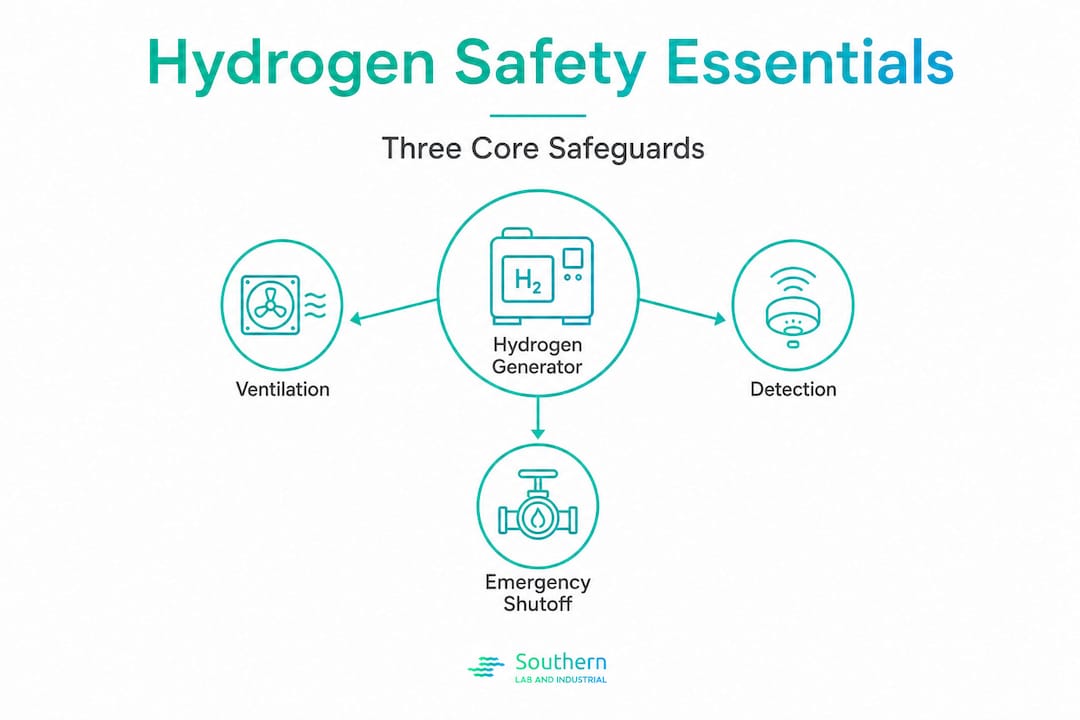
For hydrogen generator code compliance questions specific to your detector configuration and for ISO 22734 in practice applied to your generator selection, these details matter at the procurement and installation stage, not just during audits.
Understanding the standard landscape sets the stage for actionable safety planning, and that’s where real-world errors are most often made.
Best practices for risk assessment and safety planning
Compliance sets the floor. Safety planning determines how far above that floor your operation actually operates. The difference between facilities that experience incidents and those that don’t is rarely a single missing document. It’s usually a pattern of deferred reviews, informal practices, and lessons from other facilities that were never incorporated.
A structured approach to hydrogen safety planning includes these steps:
- Conduct a formal hazard identification and risk assessment (HIRA). Document every hydrogen source, flow path, accumulation point, and ignition source in your facility. Use quantitative risk assessment methods where possible, particularly for high-pressure PEM systems.
- Review incident data from comparable facilities. The H2Tools database and industry reports provide documented failure modes that your own system may share. Don’t wait to experience a near-miss before incorporating those lessons.
- Establish a safety culture baseline. This means defining what “safe behavior” looks like in daily operations, not just in emergency scenarios. Are technicians reporting near-misses? Are pre-shift checks documented and reviewed?
- Define a periodic review schedule. Risk assessments should be reviewed after any significant change to the system, after any incident or near-miss, and on a fixed annual or biannual schedule regardless of changes.
- Identify and close common pitfalls. The most frequent gaps include inadequate ventilation in generator enclosures, detector placement that doesn’t account for hydrogen buoyancy, and emergency shutdown procedures that haven’t been tested under realistic conditions.
A comprehensive safety planning framework covers all of these elements, from formal risk assessment through safety culture development and lessons-learned integration. The document is specific enough to be actionable, and it reflects real-world experience from hydrogen and fuel cell project deployments.
“The most effective safety programs treat hazard identification as an ongoing process, not a one-time document. Facilities that review and update their risk assessments after incidents, near-misses, and system changes consistently outperform those that treat the initial assessment as a permanent record.”
Pro Tip: Build a “lessons learned” log that captures near-misses, unexpected readings, and maintenance anomalies alongside formal incidents. Review it quarterly. The patterns that emerge often predict the next significant event before it happens.
For industrial PEM electrolyzer safety planning, the risk assessment must specifically address membrane degradation monitoring, pressure differential management, and the response protocol for unexpected oxygen purity drops, which can signal hydrogen crossover before a detector alarm triggers.
Best planning only gets you so far. Equipment reliability and maintenance are equally critical.
Maintenance and reliability: The overlooked factor in hydrogen safety
Most safety discussions focus on generator design and operational protocols. Maintenance gets less attention, and that gap shows up in incident data. Empirical data from the Jupiter 1000 industrial demonstrator project reveals that reliability failures occur primarily in compression, storage, and auxiliary systems rather than in the electrolyzers themselves. The generator is often the most robust component in the hydrogen production chain.
This matters for how you allocate maintenance resources. If your preventive maintenance program is heavily weighted toward the electrolyzer stack and light on compressor seals, storage vessel inspections, and auxiliary control systems, you may be protecting the wrong components.
| Maintenance area | Failure frequency | Common failure modes | Recommended interval |
|---|---|---|---|
| Electrolyzer stack | Lower than expected | Membrane degradation, seal wear | Manufacturer schedule plus condition monitoring |
| Compression systems | Higher than expected | Seal failures, valve wear | Quarterly inspection minimum |
| Storage vessels | Moderate | Pressure relief device testing, corrosion | Annual inspection, per code |
| Auxiliary controls | Higher than expected | Sensor drift, wiring degradation | Semiannual calibration |
The Jupiter 1000 data also highlights a supply chain problem that many facility managers have encountered firsthand. H2-adapted component shortages create maintenance delays that extend equipment downtime and, more critically, push operators toward improvised repairs using non-hydrogen-rated parts. That’s a safety failure waiting to happen.
Key maintenance priorities for reliability-focused operations:
- Scheduled vs. predictive maintenance: Scheduled maintenance prevents known wear failures. Predictive maintenance, using sensor data and trend analysis, catches degradation failures before they become safety events. Both are necessary.
- Staff training: Technicians working on hydrogen systems need training specific to hydrogen hazards, not just general mechanical maintenance. This includes purging procedures, leak detection methods, and emergency response.
- Parts inventory: Maintain a minimum stock of high-wear, hydrogen-specific components. Compressor seals, pressure relief devices, and membrane test kits should not require a multi-week procurement cycle.
- Documentation: Every maintenance action should be logged with enough detail to support trend analysis. A seal replacement that happens every six months is a data point. One that happens every two months is a warning.
For maintenance for lab generators, the same principles apply at smaller scale. Sensor calibration, tubing integrity, and purge cycle verification are the equivalent maintenance priorities in analytical and laboratory hydrogen systems.
With all factors covered, it’s worth re-examining common assumptions in the industry.
A fresh perspective: What most guides miss about hydrogen generator safety
Most hydrogen safety guides are written around the assumption that compliance equals safety. Follow the standards, document the procedures, pass the audit, and you’re protected. That assumption is worth examining critically, because the incident record doesn’t fully support it.
The PEM membrane crossover events documented in recent research occurred in systems that were operating normally by every standard metric. The Leibstadt electrode boiler explosion happened in a facility that was following accepted practices for its time. In both cases, the failure mode was not addressed by the applicable standards because it wasn’t fully understood yet. Standards are always written in response to what has already happened, not what hasn’t happened yet.
This creates a real responsibility for facility managers and safety officers. You cannot outsource your safety judgment entirely to a compliance framework. The question “are we compliant?” is necessary but not sufficient. The better question is “what could fail in our specific system, under our specific operating conditions, that our current monitoring wouldn’t catch in time?”
Supply chain gaps make this harder. When real-world hydrogen generator data from industrial demonstrators shows that auxiliary and compression systems fail more often than electrolyzers, and when H2-adapted parts are difficult to source quickly, the practical safety risk shifts to a domain that most compliance frameworks don’t address directly. You can be fully compliant with ISO 22734-1:2025 and NFPA 2 and still be running a compressor with a seal that’s two weeks past its replacement date because the part is on backorder.
Leadership’s role here is to move the culture from reactive compliance to proactive risk identification. That means investing in diagnostics beyond what standards require, building supplier relationships before you need emergency parts, and treating near-misses as high-value data rather than minor inconveniences. The facilities with the strongest safety records are not the ones with the most thorough compliance documentation. They’re the ones where the safety culture makes it easy to raise concerns and act on them quickly.
Upgrade your hydrogen safety and reliability
Facility managers who have worked through the standards, risk assessments, and maintenance priorities outlined here are in a much stronger position than those relying on compliance alone. The next step is ensuring your generator systems and support infrastructure are built to match that standard.

SLI works with industrial facilities and research operations along the Gulf Coast to specify, install, and support hydrogen generation systems that meet current safety codes and are designed for long-term reliability. Our portfolio of industrial hydrogen generator solutions includes systems from certified manufacturers with documented performance data, not just spec sheets. For facilities involved in advanced applications, our fuel cell testing generators are configured for the purity and pressure requirements those environments demand. Turnkey installation, local technical support, and ongoing maintenance mean you have a partner who stays engaged after commissioning, when the real reliability work begins.
Frequently asked questions
What is the main safety standard for industrial hydrogen generators?
ISO 22734-1:2025 governs water electrolysis hydrogen generators, setting requirements for explosion and fire protection, pressure control, and spillage management across alkaline, PEM, and AEM technologies.
How does NFPA 2 relate to OSHA requirements for hydrogen safety?
NFPA 2 incorporates OSHA requirements in Annex G and provides dedicated guidance for lab explosion protection in Annex H, making it the primary operational code for facilities that generate, store, and handle hydrogen on site.
Are there hidden risks with PEM or electrode boiler hydrogen systems?
Yes. Membrane crossover in PEM systems can cause localized deflagration after weeks of normal operation, and jet-type electrode boilers produce hydrogen at concentrations that have historically led to explosions, risks that standard monitoring may not catch before an event occurs.
What are the biggest obstacles to reliable hydrogen generator safety?
H2-adapted component shortages create maintenance delays that push operators toward improvised repairs, while gaps in advanced diagnostics for membrane degradation and compression system wear compound the risk.
Is hydrogen generator safety comparable to CNG or gasoline systems if codes are followed?
When applicable codes are rigorously followed, hydrogen systems can be as safe as compressed natural gas or gasoline, but that outcome depends on consistent code adherence, adequate training, and access to hydrogen-specific maintenance components.