Choosing the wrong gas generator or power protection distributor on the Gulf Coast is not just a procurement mistake — it is an operational liability. Labs and industrial facilities in this region face a unique combination of hurricane exposure, flood risk, high humidity, and demanding instrument uptime requirements that a generic national supplier simply cannot address from a distance. Local distributors are essential for industrial gas and power reliability along the Gulf Coast, and the process of selecting the right one deserves the same rigor you apply to qualifying any critical vendor. This guide walks you through assessment, evaluation, installation compliance, and ROI verification so you can make a confident, defensible decision.
Table of Contents
- What to consider before reaching out to distributors
- Step-by-step: How to evaluate local distributor options
- Installation and compliance: Getting it right the first time
- Verifying ROI, service, and reliability
- A hard-won lesson: Why local expertise is worth the premium
- Ready to upgrade your Gulf Coast lab or facility? Reliable solutions and support are local.
- Frequently asked questions
Key Takeaways
| Point | Details |
|---|---|
| Plan before you shop | Clarify your technical, safety, and redundancy needs before contacting any distributor. |
| Prioritize local expertise | Factory-trained local distributors shorten downtime and simplify compliance. |
| Install for Gulf Coast realities | Insist on flood elevation, vibration isolation, and code clearance during installation. |
| Verify ongoing support | A robust service contract is as crucial as the initial equipment purchase. |
| Prove ROI and reliability | Track uptime, energy savings, and operational resilience to justify your investment. |
What to consider before reaching out to distributors
Before you start vetting suppliers, it is crucial to get clear on what your lab or facility actually needs. Jumping into distributor conversations without a documented requirements list wastes time and exposes you to oversized or undersized systems that will cost you later.
Start with your instrument gas requirements. Every analytical instrument has specific demands for flow rate, delivery pressure, and purity grade. A GC-FID running hydrogen carrier gas has very different tolerances than an ICP-MS pulling argon or a LCMS system consuming nitrogen. Pull the instrument specs from your vendor documentation and build a consolidated demand table before any distributor conversation.
Key technical parameters to document upfront:
- Purity grade required (e.g., 99.999% for GC hydrogen vs. 95% for LC-MS nitrogen blanketing)
- Peak flow rate in liters per minute, accounting for all instruments running simultaneously
- Delivery pressure at the instrument inlet, not just at the generator outlet
- Ambient conditions at the intended installation site, including temperature range and humidity
The Lab Manager purchasing guide is clear on this point: match the gas generator type to your analytical instruments, account for future expansion with 20 to 30 percent capacity headroom, and evaluate redundancy and modularity from the start. That headroom matters. Labs that size to current demand often find themselves capacity-constrained within 18 months of adding a new instrument.
Site constraints are equally important. Measure available floor or bench space, confirm ceiling clearance for maintenance access, and check whether your HVAC can handle the heat load from a generator compressor. Noise is a real concern in shared lab environments — most facility standards cap ambient noise at 55 dBA or below, and some PSA nitrogen generators can exceed that threshold without proper acoustic enclosures.
For nitrogen generators used in LC-MS applications, flow requirements are often higher than labs initially estimate, especially when multiple instruments share a single supply manifold. Similarly, ICP-MS gas generation setups require precise purity control that not all generator technologies deliver consistently.
Document your power protection requirements separately. If your facility experiences frequent voltage sags, surges, or brief outages — common during Gulf Coast storm season — a UPS or power conditioner is not optional. Identify which instruments are most sensitive to power events and confirm whether they need online double-conversion UPS protection or a simpler line-interactive solution.
Pro Tip: Contact your instrument vendors directly before beginning distributor evaluation. Ask them for a written statement on generator compatibility, preferred purity specs, and any known issues with specific generator technologies. That documentation protects you during procurement and simplifies distributor conversations considerably.
| Parameter | What to document | Why it matters |
|---|---|---|
| Gas purity | Minimum % or grade by instrument | Determines generator technology |
| Peak flow | L/min at full instrument load | Sizes generator capacity |
| Expansion headroom | Projected 3-year instrument additions | Avoids premature upgrade |
| Site noise limit | dBA threshold for the space | Filters out noisy systems |
| Power events | Frequency and type of outages | Determines UPS class needed |
Step-by-step: How to evaluate local distributor options
With your requirements in hand, you can assess which distributors truly fit your situation. The evaluation process should be structured and documented, not a series of informal phone calls.
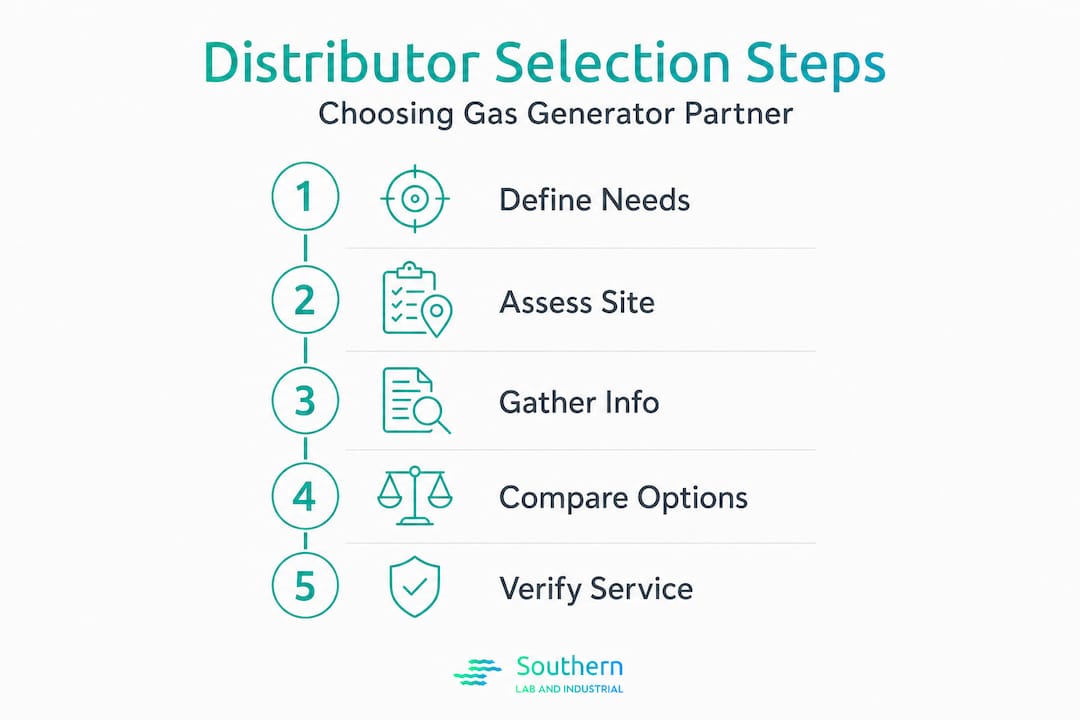
Step 1: Build a shortlist based on local presence and factory authorization.
A distributor who is factory-authorized by the generator manufacturer can access firmware updates, proprietary diagnostic tools, and warranty parts that third-party service providers cannot. Gulf Coast specialists with field-proven service and brand-specific training deliver measurably faster response times than firms managing your account from another region. For context, Houston-area distributors range from full-install generator firms to application-specific lab suppliers, and the differences in technical depth are significant.
Step 2: Score each distributor on four dimensions.
- Technical expertise — Can they demonstrate knowledge of your specific instruments and gas purity requirements? Ask for application references in your industry.
- Emergency response time — What is their guaranteed on-site response time during a weather event or system failure? Get this in writing.
- Compliance support — Can they provide documentation for NFPA, EPA, and local fire marshal requirements? Do they have experience with Gulf Coast-specific flood elevation requirements?
- Customer references — Ask for two or three local references from labs or facilities with similar applications. Call them.
Step 3: Request a formal proposal with service terms.
A proposal that includes only equipment pricing is incomplete. You need to see installation scope, commissioning procedures, warranty terms, and post-warranty service options in the same document.
For facilities managing gas supply for incubators and bioreactors, continuity of supply is non-negotiable, and service response terms carry as much weight as equipment specs. Reviewing lab gas generator solutions side by side with service documentation helps you see the full picture.
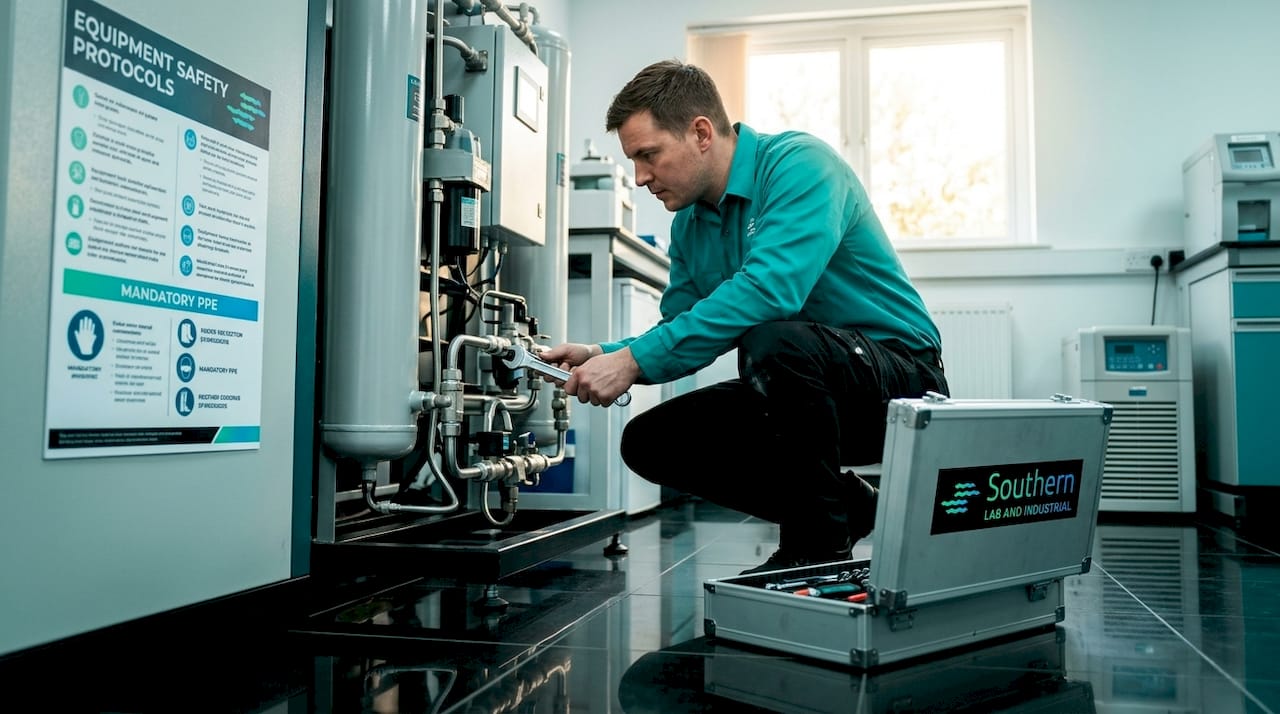
Pro Tip: Always ask for documentation on factory training certifications for the technicians who will service your account. A distributor may be factory-authorized at the company level but assign field work to technicians who have never attended a manufacturer training course.
| Evaluation criterion | Strong distributor | Weak distributor |
|---|---|---|
| Factory authorization | Documented, current | Claimed but unverified |
| Local presence | Office or warehouse within 100 miles | Regional hub only |
| Emergency response | Guaranteed SLA, documented | “Best effort” language |
| Compliance support | NFPA/flood code experience | Generic installation only |
| References | Local, same-application clients | Out-of-region or unrelated |
Installation and compliance: Getting it right the first time
Once you have found the right distributor, installation is your next potential pitfall or success point. A properly specified system installed incorrectly will still fail, and in the Gulf Coast environment, the failure modes are more severe than in other regions.
Siting decisions have long-term consequences. Place generators away from air intakes to prevent exhaust recirculation, away from vibration-sensitive instruments, and close enough to the electrical room to minimize voltage drop over long cable runs. For hydrogen generators, local fire codes require specific clearances from ignition sources and ventilation requirements that vary by jurisdiction.
Critical siting and compliance factors for Gulf Coast installations:
- Flood elevation — Generators and UPS systems must be elevated above the 100-year flood plain per FEMA guidelines. Many Gulf Coast facilities require equipment to be mounted on raised platforms or upper floors.
- Vibration isolation — Labs near vibration-sensitive instruments need isolation pads, and Gulf Coast sites require elevated generator foundations to mitigate flood risk alongside NFPA 110 fuel clearances.
- NFPA 110 compliance — This standard governs emergency and standby power systems and specifies fuel storage, transfer switch requirements, and load testing protocols. Non-compliance creates insurance and audit exposure.
- EMI shielding — In dense lab environments, generator electronics can introduce electromagnetic interference that affects sensitive analytical instruments. Pre-install EMI modeling is worth the time.
- Noise and vibration modeling — Conduct this before installation, not after. Retrofitting acoustic enclosures or anti-vibration mounts is expensive and disruptive.
“Compliance with FEMA flood elevation guidance and NFPA 110 is not optional for Gulf Coast lab facilities. Installations that skip these steps create uninsured risk and potential regulatory violations that surface during audits, not during normal operations.”
For labs running nitrogen for sample evaporation workflows, generator placement relative to the evaporation station affects both supply pressure consistency and safety. And when it comes to lab power protection, the conditioner or UPS must be installed on a dedicated circuit with proper grounding to deliver its rated protection.
A good distributor will conduct a pre-installation site survey, produce a drawing package, and submit for any required permits. If a distributor skips the site survey or tells you permits are not necessary, that is a red flag worth taking seriously.
Verifying ROI, service, and reliability
Even the best equipment only pays off with dependable service and verifiable performance. Once your system is running, you need a structured approach to confirm that your investment is delivering what was promised.
Track uptime and downtime systematically. Most modern gas generators include onboard data logging and remote monitoring capability. Require your distributor to configure cloud monitoring during commissioning so you have a continuous record of system performance, purity output, and any fault events. That data is essential for both internal reporting and external audits.
Key service and reliability metrics to monitor:
- System uptime percentage — Target 99.5% or better for critical lab applications
- Purity compliance rate — Percentage of operating hours within specified purity range
- Mean time to repair — Average hours from fault notification to restored operation
- Preventive maintenance adherence — Whether scheduled service is completed on time
- Spare parts availability — Lead time for common wear components like filters, membranes, and desiccant
The Lab Manager ROI framework recommends assessing ROI by comparing power costs, downtime risk, and reliability against the baseline of cylinder-based supply. On-site systems cut delivery dependence but require robust support infrastructure to realize their full value.
Demand written service-level agreements (SLAs). An SLA should specify response time tiers (remote vs. on-site), parts stocking commitments, escalation procedures for extended outages, and penalties or remedies for SLA breaches. Verbal commitments do not hold up when a system fails at 2 a.m. before a critical analytical run.
A useful benchmark: labs that switch from cylinder supply to on-site generation typically see generator vs. cylinder cost comparisons that show payback periods of 18 to 36 months, depending on consumption volume and local cylinder pricing. But that payback assumes the system runs reliably. Poor service support can erode those savings quickly through unplanned downtime and emergency cylinder rentals.
Confirm compliance reporting capabilities. If your facility is subject to ISO 17025 accreditation, FDA oversight, or EPA reporting, your gas supply system documentation is part of your quality record. Your distributor should be able to provide calibration certificates, purity verification reports, and maintenance logs in a format your quality team can use. Explore ongoing generator service options that include documentation packages designed for regulated environments.
A hard-won lesson: Why local expertise is worth the premium
Looking back at common selection mistakes, one pattern repeats consistently: facilities that chose the lowest-cost distributor without verifying local capability paid for that decision within the first service event.
The math is straightforward. A factory-trained local technician who can be on-site within four hours costs more per service call than a third-party contractor dispatched from three states away. But when a GC system goes down the morning of a regulatory submission deadline, the cost of that downtime — in labor, rescheduled analyses, and potential compliance exposure — dwarfs the difference in service rates.
Factory-trained local providers deliver faster warranty service and better uptime for Gulf Coast labs, and that advantage compounds over the life of the system. It is not just about fixing problems faster. It is about having a technician who knows your specific installation, your instrument configuration, and your facility’s quirks without needing a two-hour orientation before they can start troubleshooting.
There is also a compliance dimension that gets underestimated during procurement. When an insurance auditor or regulatory inspector reviews your installation, they will ask for documentation that the system was installed by a qualified, authorized provider. A cut-rate installer who cannot produce factory authorization letters, permit documentation, or NFPA compliance records creates a gap in your quality and safety documentation that is difficult to close retroactively.
The Gulf Coast adds another layer. A distributor who has never dealt with post-hurricane service logistics, flood-damaged equipment recovery, or emergency gas supply during extended grid outages is not prepared for your environment. Ask candidates directly: what is your disaster response protocol, and how many Gulf Coast emergency service events have you managed in the past three years?
Reviewing the full range of lab power and gas applications that a qualified local distributor should be able to support gives you a useful benchmark for evaluating whether a candidate firm has the depth your facility requires.
Pro Tip: Before signing any service contract, verify that the agreement includes Gulf Coast-specific disaster and emergency response provisions. Generic national service contracts often exclude or limit coverage during declared weather emergencies, which is precisely when you need support most.
Ready to upgrade your Gulf Coast lab or facility? Reliable solutions and support are local.
The process outlined above leads to one conclusion: the right distributor is a long-term operational partner, not just a one-time equipment vendor. For Gulf Coast labs and facilities, that partnership needs to be grounded in local presence, factory authorization, and genuine application expertise.
SLI offers turnkey lab gas generator solutions and power protection for labs specifically configured for the Gulf Coast environment, backed by factory-trained local support and documented compliance capabilities. Whether you are replacing cylinder supply for a GC or LCMS system, protecting sensitive instruments from power events, or planning a full facility gas infrastructure upgrade, the team at SLI can walk through your requirements and recommend a solution sized for your application and your region. Explore generator service and support options designed to keep your systems running through Gulf Coast conditions.
Frequently asked questions
What is the most important factor in selecting a local gas generator distributor?
The most critical factor is the distributor’s application-specific expertise combined with factory-trained local service capabilities, since both determine how quickly and correctly problems get resolved. Verified factory authorization and documented Gulf Coast service experience should be non-negotiable requirements in your evaluation.
How do Gulf Coast labs address hurricane and flood risks in generator installations?
Labs elevate generators above flood plains and apply vibration isolation mounts to meet FEMA and NFPA 110 guidance for the region. Proper siting documentation from a qualified local installer is essential for both insurance coverage and regulatory compliance.
Should we choose PSA or membrane technology for lab gas generators?
PSA is best for high-purity applications like GC carrier gas, while membrane technology excels at delivering the high flow rates that LC-MS nitrogen supply typically requires. The right choice depends on your instrument mix and purity specifications, which is why documenting requirements before distributor conversations is so important.
What ROI advantages do on-site gas generators have over cylinders?
On-site generators reduce delivery dependence, eliminate recurring cylinder rental and delivery fees, and improve lab uptime by removing the risk of supply interruptions. Payback periods typically range from 18 to 36 months depending on consumption volume and local cylinder pricing.