A gas generator trace impurity is any chemical or physical contaminant present at concentrations from parts per million (ppm) down to parts per trillion (ppt) in gases produced by laboratory generators that degrades experimental accuracy and shortens instrument life. The industry standard term for these contaminants is trace-level gas phase impurities, though “trace impurities in gas generators” is the working phrase most laboratory scientists use day to day. Moisture, hydrogen sulfide (H2S), siloxanes, oil mists, and particulates are the most common offenders. For instruments like GC, ICP-MS, and FTIR that operate at sub-ppb detection limits in 2026, even a single uncontrolled impurity can corrupt a dataset or destroy a detector. Understanding what these contaminants are, where they come from, and how to control them is not optional for any serious quality assurance program.
What is a gas generator trace impurity, and why does it matter?
A gas generator trace impurity is defined as any contaminant introduced into a generated gas stream at concentrations low enough to escape routine detection but high enough to affect sensitive analytical instruments. The threshold that matters is not absolute. It depends entirely on the instrument consuming the gas. An ICP-MS system running at sub-ppb detection limits treats a 10 ppb siloxane level as a serious contamination event. A lower-sensitivity instrument might never register it.
The practical significance is this: as your instrument’s detection capability improves, the gas purity requirement tightens in lockstep. Laboratories that upgraded to modern ICP-MS platforms without upgrading their gas supply infrastructure have discovered this the hard way, through unexplained baseline drift, elevated blanks, and failed method validations. Gas purity is not a background variable. It is an active experimental parameter.

What types of trace impurities are commonly found in gas generators?
Trace impurities in gas generators fall into two broad categories: gaseous phase contaminants and liquid phase contaminants. Each has a distinct source, behavior, and damage profile.
Common gaseous phase impurities:
- Moisture (H2O): The most pervasive impurity. Enters through raw feedstock, membrane separators, and fittings. Accelerates corrosion and interferes with moisture-sensitive detectors.
- Hydrogen sulfide (H2S): Generated from sulfur-containing feedstocks or biological contamination. Even at 100 ppm, H2S combustion produces sulfuric acid that aggressively corrodes engine and instrument components.
- Siloxanes: Organosilicon compounds that originate from lubricants, seals, and tubing materials. Fuel cells require siloxanes below 0.1 mg/m3 to avoid irreversible catalyst damage.
- Carbon monoxide and carbon dioxide: Byproducts of incomplete generation reactions or contaminated feedstock.
Common liquid phase impurities:
- Oil mists: Coalesced aerosols from compressor systems. They cause physical blockages and chemical degradation in instrument flow paths.
- Moisture condensates: Liquid water that accumulates in low points of gas delivery lines, creating localized corrosion and biological growth.
| Impurity | Typical Source | Critical Concentration Limit |
|---|---|---|
| Moisture (H2O) | Feedstock, fittings, membranes | Dew point below -75°C for ultra-high purity |
| H2S | Sulfur feedstock, biological activity | Below 1 ppm for fuel cells; lower for GC detectors |
| Siloxanes | Lubricants, seals, tubing | Below 0.1 mg/m3 for sensitive applications |
| Oil mist | Compressor systems | Below 0.01 mg/m3 for analytical grade gas |
| Particulates | Filtration failures, corrosion debris | Sub-micron filtration required |
Pro Tip: Liquid phase contaminants like oil mist and moisture condensates are the leading causes of flow path blockages in laboratory instruments, yet they are routinely overlooked because standard gas analyzers measure gaseous phase impurities only. Add a coalescing filter and a dew point monitor to your gas delivery system to catch both categories.
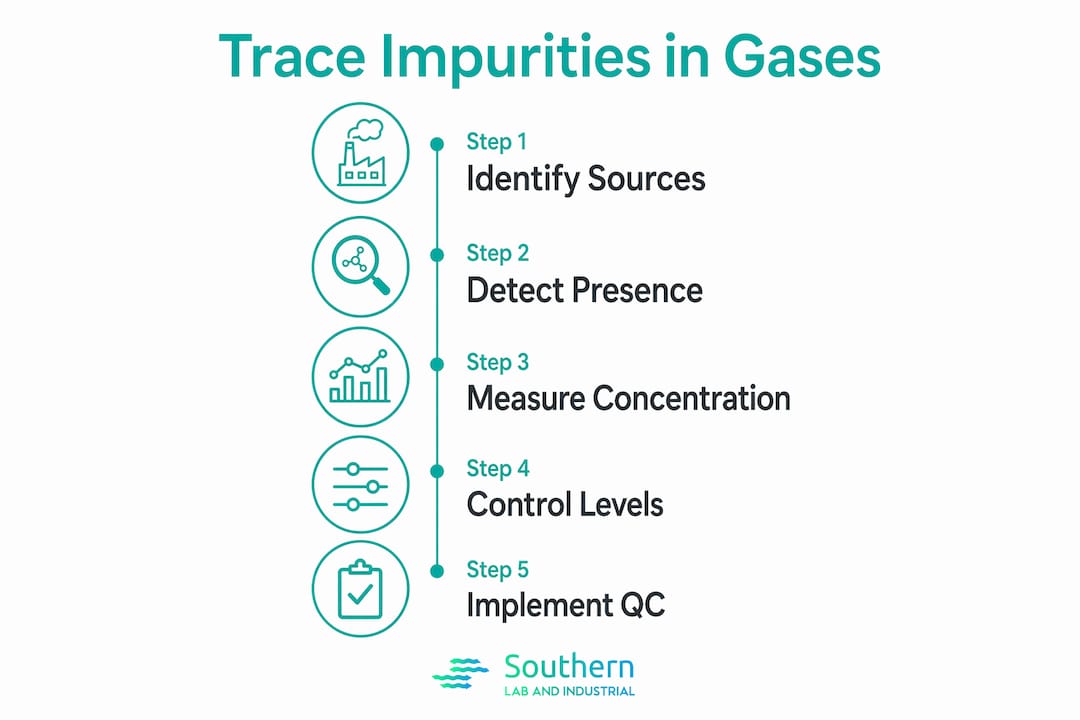
How are trace impurities in gas generators detected and measured?
Impurity analysis in gas generators requires instrumentation matched to the concentration range of interest. No single analyzer covers the full spectrum from ppm to ppt.
Detection technologies in current laboratory use:
- Pulsed Discharge Detectors (PDD): PDD analyzers detect impurities down to less than 10 ppb, comply with ASTM D2504, D2505, and D8098 standards, and provide universal detection for all gases except helium. They are the workhorse for routine high-purity gas quality control.
- Gas Chromatography (GC): Separates complex impurity mixtures before quantification. Essential for identifying siloxane species and light hydrocarbons in carrier and fuel gases.
- ICP-MS with Gas Exchange Device (GED): Detects organometallic compounds and metallic particles in specialty gases at concentrations that GC cannot reach. This technique is critical for gases used in semiconductor and ultra-trace elemental analysis.
- Isotope Dilution Mass Spectrometry (IDMS): IDMS validates gas generator outputs with expanded uncertainty below 9%, meeting ISO/IEC 17025 accreditation requirements. Trace impurity analyzers using this approach now achieve detection limits below 500 ppt for gases like H2 and CO in carrier matrices.
“As laboratory instrument detection limits approach sub-ppb levels, contamination from gas supply and plumbing often masks sample impurities, leading to erroneous data interpretation.” — Analytical scientists working with ICP-MS and specialty gas systems
The compliance framework matters as much as the technology. ASTM D2504 covers non-condensable gases, D2505 addresses ethylene purity, and D8098 targets trace impurities in hydrogen. ISO/IEC 17025 accreditation requires documented measurement uncertainty for all gas purity validation work. If your lab cannot cite a specific standard for each impurity type it monitors, your quality assurance program has a gap.
What impact do trace impurities have on instruments and experimental accuracy?
The impact of gas generator impurities on laboratory instruments is direct, measurable, and expensive. The damage falls into three categories: chemical corrosion, signal interference, and physical blockage.
Chemical corrosion from H2S and moisture. H2S reacts with metal surfaces in detector flow paths to form metal sulfides. Moisture accelerates this process. The result is pitting corrosion in capillary columns, detector jets, and flow controllers. Replacement costs for a corroded GC detector assembly routinely exceed several thousand dollars, not counting the labor and downtime.
Signal noise from metallic and organometallic contaminants. Metallic particles and organometallic compounds in specialty gases create elevated and unstable backgrounds in ICP-MS and ICP-OES systems. This noise floor limits the instrument’s effective detection range and forces analysts to report higher method detection limits than the instrument is actually capable of achieving.
Physical blockage from liquid phase impurities. Oil mist and moisture condensates cause flow restrictions in capillary columns, pressure regulators, and detector orifices. These blockages are insidious because they develop gradually. Analysts often attribute the resulting performance degradation to column aging or detector wear rather than gas contamination.
Shortened component lifespan across the instrument. Continuous exposure to even low-level impurities accelerates wear on septa, O-rings, and detector filaments. A lab running contaminated carrier gas through a GC may replace consumables two to three times more frequently than a lab running certified high-purity gas.
Erroneous data and failed validations. This is the highest-stakes consequence. Gas delivery systems are a major contamination source at sub-ppb detection levels, and contamination from the gas supply can be indistinguishable from sample contamination. A laboratory that fails an external audit because of elevated blanks traced back to the gas generator has a problem that no amount of sample preparation can fix.
Pro Tip: When troubleshooting unexplained baseline elevation or elevated method blanks, run a procedural blank using a certified reference gas instead of your generator output. If the blank drops, your gas generator or delivery system is the contamination source.
How do modern gas generators control and minimize trace impurities?
Modern laboratory gas generators achieve purity grades from 5.0 (99.999%) up to 9.0 (99.9999999%) through multi-stage purification. Residual impurities below 1 ppb are required to reach the upper end of that range. Each purification stage targets a specific impurity class.
Core purification technologies:
- Pressure Swing Adsorption (PSA) dryers: Remove bulk moisture from the gas stream by cycling between adsorption and regeneration phases. Achieve dew points as low as -75°C.
- Regenerative dryers: Provide continuous drying without consumable replacement, suitable for high-flow laboratory installations.
- De-ionizer cartridges: Remove ionic contaminants from water used in electrolytic hydrogen generators, protecting the membrane stack and preventing ionic carryover into the gas stream.
- Activated carbon filters: Impregnated carbon removes H2S through chemical adsorption at 2–5 times the capacity of virgin carbon. Virgin coal-based carbon handles siloxane removal through physical adsorption.
- Coalescing filters: Capture oil mist and liquid aerosols before they reach the instrument.
| Technology | Target Impurity | Achievable Output Level |
|---|---|---|
| PSA dryer | Moisture | Dew point to -75°C |
| Activated carbon (impregnated) | H2S | Below 1 ppm |
| Activated carbon (virgin) | Siloxanes | Below 0.1 mg/m3 |
| Coalescing filter | Oil mist | Below 0.01 mg/m3 |
| De-ionizer cartridge | Ionic contaminants | Conductivity below 0.1 µS/cm |
Generator monitoring is as important as the purification hardware itself. Continuous dew point monitoring, pressure drop trending across filter stages, and periodic third-party gas purity verification are the three practices that separate laboratories with reliable gas quality from those that discover problems only after instrument damage occurs.
What quality control measures should lab scientists implement?
Gas generator quality control is a system, not a single action. The following steps represent the minimum standard for any laboratory running analytical instruments at sub-ppm detection levels.
Establish a baseline gas purity specification. Define the maximum allowable concentration for each impurity type relevant to your instruments. For GC with FID, high-purity gas for FID detectors requires hydrogen and zero air with moisture below 5 ppm and total hydrocarbons below 0.5 ppm. For ICP-MS, the requirements are tighter still.
Validate your gas generator output on installation and after any maintenance. Use PDD analysis for routine checks and IDMS for accreditation-level validation. Document results against your purity specification and retain records for ISO/IEC 17025 compliance.
Specify inert, electropolished tubing for all gas delivery lines. Electropolished tubing eliminates adsorption and memory effects that artificially raise perceived impurity levels. Standard stainless-steel plumbing introduces contamination through surface adsorption, which is a critical error at sub-ppb detection levels.
Schedule preventive maintenance on a fixed calendar, not on symptom onset. Replace activated carbon filters, coalescing elements, and de-ionizer cartridges according to manufacturer specifications. Waiting for performance degradation means the instrument has already been exposed to elevated impurity levels.
Qualify your gas generator supplier formally. Review gas generator supplier qualification steps before committing to a platform. A supplier that cannot provide third-party purity certificates, documented purification stage specifications, and maintenance records is not an appropriate partner for analytical laboratory use.
Pro Tip: Review your lab’s reagent purity protocols alongside your gas purity program. Contamination from gas supply and reagents often interacts, and addressing only one source while ignoring the other produces incomplete results.
Key takeaways
Gas generator trace impurities are the most underestimated source of analytical error in modern laboratories, and controlling them requires matched purification technology, inert delivery infrastructure, and documented quality assurance practices.
| Point | Details |
|---|---|
| Trace impurity definition | Contaminants at ppm to ppt levels in generated gas that degrade instrument performance and data accuracy. |
| Most damaging impurities | H2S, moisture, siloxanes, and oil mist cause corrosion, blockages, and signal interference in GC, ICP-MS, and FTIR systems. |
| Detection technology | PDD analyzers detect below 10 ppb; IDMS validates outputs to below 500 ppt under ISO/IEC 17025 standards. |
| Purification approach | Multi-stage systems using PSA dryers, activated carbon, and coalescing filters achieve purity grades from 5.0 to 9.0. |
| Quality control priority | Electropolished tubing, scheduled filter replacement, and formal supplier qualification are non-negotiable for sub-ppb analytical work. |
Why I think most labs underestimate their gas purity problem
After working with analytical laboratories across a range of industries, the pattern I see most often is this: a lab invests in a high-performance ICP-MS or GC-MS platform, then runs it on gas from a generator that has not been validated since installation. The instrument is capable of detecting at the ppt level. The gas supply is introducing contamination at the ppb level. The analyst spends weeks troubleshooting method performance without ever questioning the gas.
The misconception driving this is the belief that a generator rated for 5.0 purity delivers 5.0 purity continuously, without maintenance or monitoring. It does not. Filter media saturates. Dew point performance drifts. Fittings develop micro-leaks. A generator that passed its factory acceptance test two years ago may be delivering gas that is two full purity grades lower today.
The second misconception is that gaseous impurities are the only concern. Liquid phase contaminants, specifically oil mist and moisture condensates, are the leading cause of flow path damage in my experience. They are invisible to most gas analyzers and accumulate silently until a column plugs or a detector jet blocks.
The cost-benefit case for rigorous gas purity control is straightforward. A complete multi-stage purification upgrade and annual third-party gas purity verification costs a fraction of one detector replacement, one failed audit, or one retracted analytical result. Laboratories that treat gas purity as a fixed infrastructure cost rather than a variable maintenance expense consistently outperform those that do not, on uptime, data quality, and total cost of ownership.
— Kris
How SLI helps labs eliminate trace impurity risks

SLI supplies high-purity lab gas generators from LNI Swissgas and Nel Hydrogen, each engineered with multi-stage purification systems that address moisture, H2S, siloxanes, and particulates at the source. SLI’s generators are configured for GC, ICP-MS, FTIR, and other analytical platforms requiring purity grades from 5.0 to 9.0. Beyond the hardware, SLI provides turnkey installation with electropolished gas delivery infrastructure, scheduled preventive maintenance, and supplier qualification documentation that meets ISO/IEC 17025 requirements. If your lab is experiencing unexplained baseline issues or preparing for an accreditation audit, SLI’s technical team can assess your current gas generation setup and identify the specific impurity risks affecting your instruments. Explore real-world integration examples to see how Gulf Coast laboratories have resolved gas purity challenges with SLI’s support.
FAQ
What is a gas generator trace impurity?
A gas generator trace impurity is a chemical or physical contaminant present at ppm to ppt concentrations in laboratory-generated gases that can degrade instrument performance and analytical accuracy. Common examples include moisture, H2S, siloxanes, oil mist, and metallic particulates.
How low do trace impurity concentrations need to be for ICP-MS use?
ICP-MS applications require carrier and plasma gases with impurity levels below 1 ppb for most analytes, with some ultra-trace methods demanding ppt-level gas purity. Generators supplying ICP-MS systems should deliver gas for ICP-MS at purity grade 6.0 or higher.
Can standard stainless-steel tubing introduce trace impurities?
Standard stainless-steel tubing introduces contamination through surface adsorption and memory effects, which artificially elevate perceived impurity levels at sub-ppb detection. Electropolished, inert tubing is required for ultra-trace gas analysis to eliminate this source of error.
How often should gas generator filters be replaced?
Filter replacement intervals depend on feedstock quality, flow rate, and the specific filter media, but most manufacturers specify replacement every 6–12 months for activated carbon and coalescing elements. Waiting for visible performance degradation means the instrument has already been exposed to elevated impurity levels.
What standard governs trace impurity analysis in high-purity gases?
ASTM D2504, D2505, and D8098 govern trace impurity analysis in non-condensable gases, ethylene, and hydrogen respectively. ISO/IEC 17025 accreditation requires documented measurement uncertainty for all gas purity validation work performed in a laboratory setting.