Gas generation in environmental testing refers to the controlled creation and delivery of precise gas mixtures required to simulate real-world atmospheric conditions and calibrate analytical instruments accurately. The role of gas generation in environmental testing extends far beyond simply supplying a carrier gas. It determines whether your corrosion simulation reflects actual industrial exposure, whether your calibration data is traceable to international standards, and whether your instruments produce results that hold up under regulatory scrutiny. Technologies like flowing mixed gas (FMG) systems, dynamic calibration gas preparation, and on-site PEM electrolysis generation are now central to how environmental labs achieve measurement validity under standards like IEC 60068 and ISO 6145.
How do gas generation methods improve the accuracy of environmental testing?
Accurate environmental testing depends on delivering the right gas at the right concentration, every time. Gas generation methods that fail to control flow rates, mixture ratios, or delivery timing introduce systematic bias that no amount of post-processing can correct.
Flowing mixed gas techniques produce controlled, repeatable mixtures of multiple reactive gases that match realistic atmospheric conditions. FMG systems simultaneously regulate the concentration and flow rate of gases like H2S, NO2, SO2, and Cl2, which is a requirement under IEC 60068-2-60 for corrosive atmosphere testing.
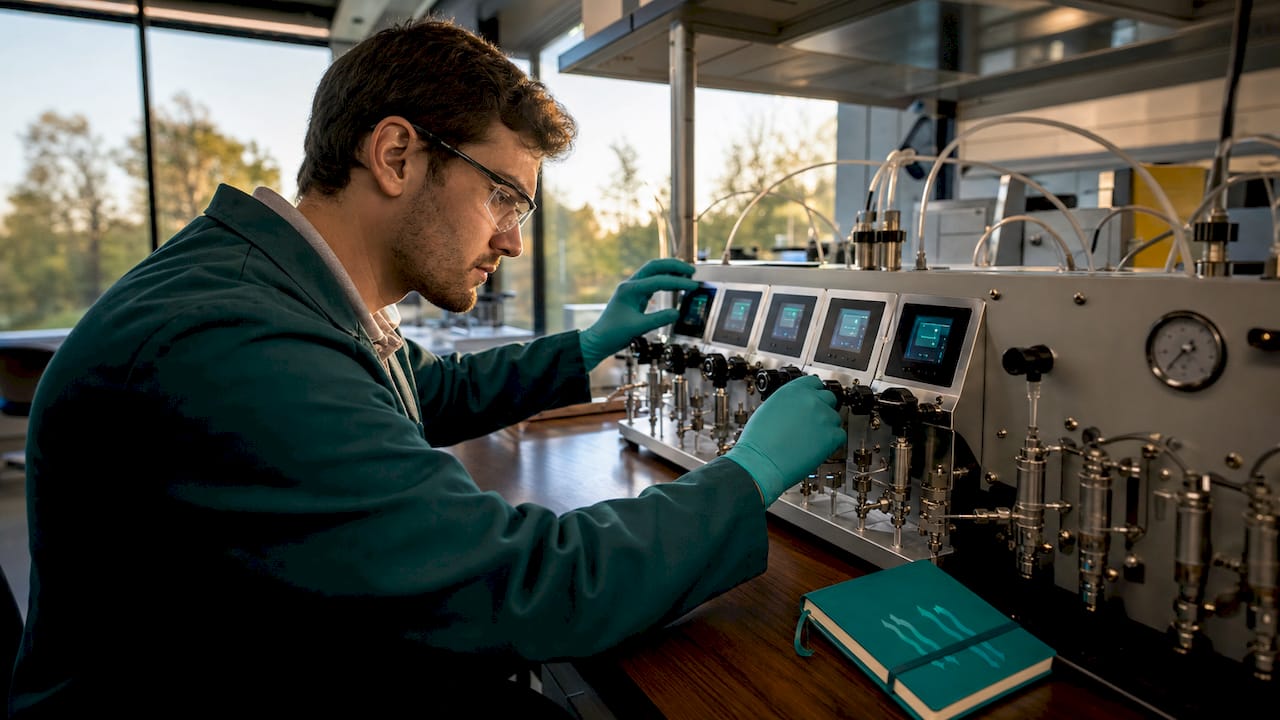
Dynamic calibration gas mixture preparation adds another layer of accuracy. ISO 6145 covers dynamic mixture preparation methods that establish flow calibration, traceability, and uncertainty contributors for gas measurement accuracy. This means every instrument reading can be traced back to a known reference point, which is the foundation of defensible environmental data.
Gravimetric methods complement dynamic approaches. Gravimetrically prepared gas mixtures with tight composition uncertainties help verify chromatographic measurement repeatability and support simplified calibration workflows. Using a single certified mixture plus pressure-based proportionality calculations can cover a wide analytical range without requiring multiple cylinders.
Key factors that affect gas generation accuracy in environmental testing:
- Flow control precision: Mass flow controllers must be calibrated regularly. Even small drift in flow rate changes the delivered concentration of reactive gases.
- Line residence time: Gas delivery lines hold a volume of gas that must be purged before the target concentration reaches the test chamber. Precise test timing must account for this residence time to avoid exposure bias from concentration ramp-up delays.
- Mixture stability: Reactive gases like H2S can adsorb onto tubing walls, especially at low concentrations. Inert-lined or electropolished stainless steel tubing minimizes this effect.
- Humidity interaction: Moisture in delivery lines reacts with certain gases and alters their effective concentration before they reach the test zone.
Pro Tip: Condition your delivery lines with the target gas mixture for at least 30 minutes before starting a timed exposure test. This eliminates adsorption losses and ensures the concentration at the chamber inlet matches your setpoint from the first minute of exposure.
What is the impact of gas generation on corrosive atmosphere simulations?
Corrosive atmosphere simulation is where gas generation quality has the most direct and measurable impact on test validity. Single-gas tests, while simpler to run, consistently underestimate real-world corrosion rates.
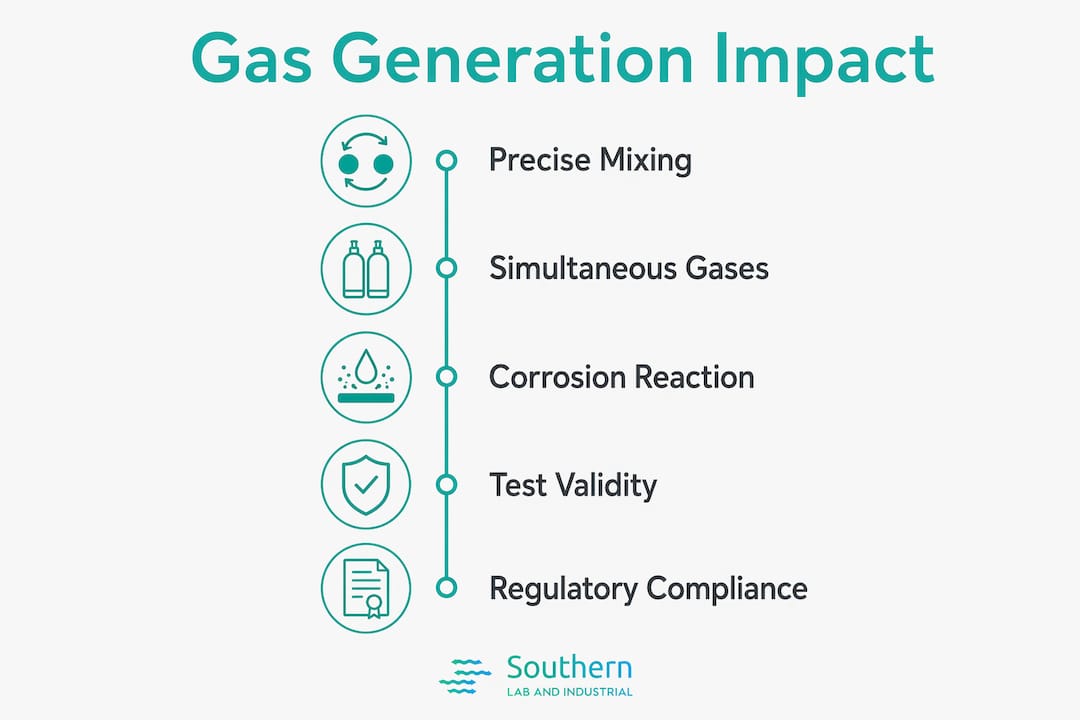
Corrosion rates from combined gases like H2S and NO2 increase exponentially rather than linearly, demonstrating that multi-gas FMG exposure is not optional for realistic simulation. This synergistic effect means that a material passing a single-gas H2S test may still fail in a real industrial environment where NO2 and SO2 are also present.
The IEC 60068-2-60 standard formalizes this requirement. It mandates simultaneous, stable control of multiple reactive gas concentrations throughout the test duration. Meeting this standard requires a gas generation system capable of independent flow control for each gas species, not a pre-mixed cylinder that degrades over time.
Four critical requirements for accurate FMG corrosion simulation:
- Independent gas control: Each reactive gas must have its own mass flow controller and supply line. Shared control introduces cross-contamination and concentration errors.
- Architectural separation of humidification: Humidification systems can dilute or interact chemically with reactive gases, compromising test precision if not controlled independently. The humidification circuit must be physically separated from the reactive gas supply.
- Stable concentration throughout exposure: Concentration must remain within specification for the full test duration, not just at the start. This requires continuous monitoring and closed-loop control.
- Documented traceability: Every gas concentration used in the test must be traceable to a certified reference standard. Without this, the test data cannot support a regulatory or quality assurance claim.
“Synergistic, non-additive corrosion effects mandate simultaneous controlled generation of multiple reactive gases for authentic material stress testing.” — Noxious Gas Test Chamber Selection Guide
Industrial pollutant simulation for electronics, automotive components, and infrastructure materials all depend on this level of control. A gas generation system that cannot maintain stable simultaneous concentrations of H2S, NO2, Cl2, and SO2 will produce test results that do not reflect actual service conditions.
How does on-site gas generation improve testing efficiency and compliance?
On-site gas generation changes the operational model for environmental labs. Instead of managing cylinder deliveries, tracking expiration dates, and accepting concentration uncertainty from aging cylinders, labs generate gas on demand at the point of use.
Modern hydrogen generators produce ultra-high purity gas with integrated safety features and minimal stored volume, making them well suited for environmental labs under regulatory scrutiny. PEM electrolysis systems generate hydrogen from deionized water, eliminating the compressed gas cylinder entirely. The stored volume at any given moment is measured in liters, not cubic feet, which reduces the hazardous material footprint in the lab.
| Factor | Cylinder supply | On-site generation |
|---|---|---|
| Concentration consistency | Degrades as cylinder empties | Constant from first use to last |
| Supply continuity | Dependent on delivery schedule | Continuous, no interruptions |
| Safety footprint | High-pressure cylinders on-site | Minimal stored volume |
| Traceability | Batch-certified at fill date | Real-time purity monitoring |
| Total cost of ownership | High recurring cost | Lower long-term cost after payback period |
| Regulatory documentation | Certificate of analysis per cylinder | Integrated data logging |
On-site gas generation reduces logistical risks and enables continuous supply, improving run-to-run consistency in regulated environmental testing labs. This consistency matters when you are running a validation study or generating data for a regulatory submission. A cylinder that runs out mid-test forces a restart and invalidates the run.
Pro Tip: When evaluating on-site generators for environmental testing applications, request purity verification data at the actual flow rates your instruments require. Generator purity specifications are often stated at maximum flow, and performance can vary at lower flow rates used in calibration applications.
Nitrogen and zero air generators follow the same logic. Zero air generators remove hydrocarbons and moisture from compressed air to produce a clean baseline gas for FID detectors and reference channels. Nitrogen generators supply blanket gas and carrier gas for GC and ICP instruments without the cylinder management burden.
What are the main challenges in integrating gas generation into test workflows?
Integration is where most environmental labs encounter their first real difficulties with gas generation systems. The technology works well in isolation. Connecting it reliably to existing instruments and test chambers requires attention to several technical and procedural factors.
Common integration challenges include:
- Flow calibration at the system level: Individual mass flow controllers may be factory-calibrated, but the assembled system requires end-to-end verification. Flow at the chamber inlet must match the setpoint at the controller.
- Delivery-line conditioning: New tubing and fittings outgas contaminants and adsorb reactive gases. Lines must be conditioned before any test data is collected.
- Electrical requirements: Gas generation systems have specific power quality requirements. Voltage fluctuations can affect mass flow controller performance and data logging integrity. Reviewing electrical requirements for gas generators before installation prevents costly retrofits.
- Piping material selection: Reactive gases like Cl2 and H2S attack certain metals and polymers. Chemical resistance in piping systems must be verified for every gas species in the mixture before installation.
- Data logging and traceability: ASTM D3609 and ISO 6145 provide frameworks for documenting gas delivery calibration, covering permeation tube use, dynamic generation, flow control, and data logging for comprehensive traceability.
Supplier qualification is a separate but equally important step. Qualifying a gas generator supplier means verifying that their equipment meets your purity specifications, that their calibration documentation satisfies your quality management system, and that local technical support is available when the system needs service. Reviewing supplier qualification steps before committing to a purchase prevents mismatches between equipment capability and lab requirements.
Reliable generation of calibration gas mixtures supports long-term integrity and safety in environmental instrument monitoring workflows. Labs that invest in proper integration upfront spend significantly less time troubleshooting measurement anomalies later.
Key Takeaways
Accurate environmental testing requires gas generation systems that deliver traceable, stable, and simultaneous control of multiple reactive gases, supported by proper integration, calibration, and on-site supply continuity.
| Point | Details |
|---|---|
| Multi-gas control is non-negotiable | Single-gas tests miss synergistic corrosion effects that only appear in combined gas exposures. |
| Humidity must be architecturally separated | Independent humidification prevents dilution and chemical interaction with reactive gases. |
| On-site generation improves consistency | Cylinder-free supply eliminates concentration drift and delivery interruptions across test runs. |
| Traceability requires documented calibration | ISO 6145 and ASTM D3609 frameworks must be applied from flow controller to chamber inlet. |
| Integration challenges are predictable | Line conditioning, electrical requirements, and piping material selection must be addressed before first use. |
Why gas generation technology deserves more attention than it gets
Most environmental testing discussions focus on the chamber, the standard, or the test specimen. The gas generation system is treated as background infrastructure. That framing is wrong, and I have seen it produce bad data in otherwise well-run labs.
The most common failure mode I encounter is a lab that has invested in a high-quality test chamber and then connected it to a gas supply that cannot maintain stable concentrations under realistic flow conditions. The chamber passes its calibration check. The instruments look fine. But the corrosion results are inconsistent run to run, and nobody looks at the gas delivery system because it is not the obvious variable.
Dynamic calibration and on-demand generation have changed what is achievable in environmental labs. A lab running on-site hydrogen generation for GC carrier gas alongside a properly integrated FMG system for corrosion testing has a fundamentally different level of control than one managing cylinders. The payback period on that investment is real, but the bigger gain is data quality you can defend.
The next gap I see is in real-time concentration verification at the chamber inlet, not just at the generator output. Most labs verify purity at the generator and assume the delivery system maintains it. That assumption fails with reactive gases. Inline monitoring at the point of exposure is where the field needs to move next.
— Kris
SLI gas generation solutions for environmental testing labs
Environmental labs on the Gulf Coast face specific challenges: high ambient humidity, demanding regulatory environments, and the need for continuous uptime. SLI supplies hydrogen, nitrogen, and zero air laboratory gas generators from LNI Swissgas and Nel Hydrogen, along with turnkey installation and local technical support.

If you are working through gas generator integration challenges or evaluating suppliers for a new environmental testing build-out, SLI provides the technical depth and regional presence to support the full project lifecycle. From initial specification through commissioning and ongoing maintenance, SLI functions as a long-term operational partner, not just a distributor.
FAQ
What is the role of gas generation in environmental testing?
Gas generation in environmental testing provides the controlled, traceable gas mixtures needed to simulate real-world atmospheric conditions and calibrate analytical instruments. Without precise gas generation, test results cannot be validated against standards like IEC 60068 or ISO 6145.
Why is multi-gas testing required for corrosion simulation?
Single-gas tests miss the synergistic corrosion effects that occur when reactive gases like H2S and NO2 are present simultaneously. Corrosion rates from combined gases increase exponentially, not linearly, making multi-gas FMG exposure the only method that reflects real industrial environments.
How does on-site gas generation support regulatory compliance?
On-site generators provide continuous, documented gas supply with real-time purity monitoring, which supports the traceability requirements of environmental testing standards. Cylinder-based supply introduces batch-to-batch variability and documentation gaps that complicate regulatory submissions.
What standards govern gas generation for environmental testing?
ISO 6145 covers dynamic gas mixture preparation and traceability. ASTM D3609 addresses permeation tube calibration methods. IEC 60068-2-60 defines the FMG corrosive atmosphere test requirements that gas generation systems must support.
What is the biggest integration risk when installing a gas generation system?
The most common risk is assuming that factory calibration of individual components equals system-level accuracy. Delivery-line adsorption, residence time delays, and humidity interactions must all be characterized and controlled before the system produces valid test data.