Electrochemical gas generation is defined as the controlled production of gases through electrochemical reactions driven by an applied electric current in a specialized cell. Unlike cylinder-based supply, this process creates gas on demand at the point of use, eliminating transport risk and supply interruptions. For researchers and engineers in analytical laboratories and industrial facilities, understanding electrochemical gas production means understanding faradaic efficiency, current density, and electrode architecture. These parameters determine whether a system delivers the purity and flow rate your instruments require. SLI works with these principles daily, supporting laboratory gas generators for GC, LCMS, ICP, and FTIR instruments across the Gulf Coast.
What is electrochemical gas generation and how does it work?
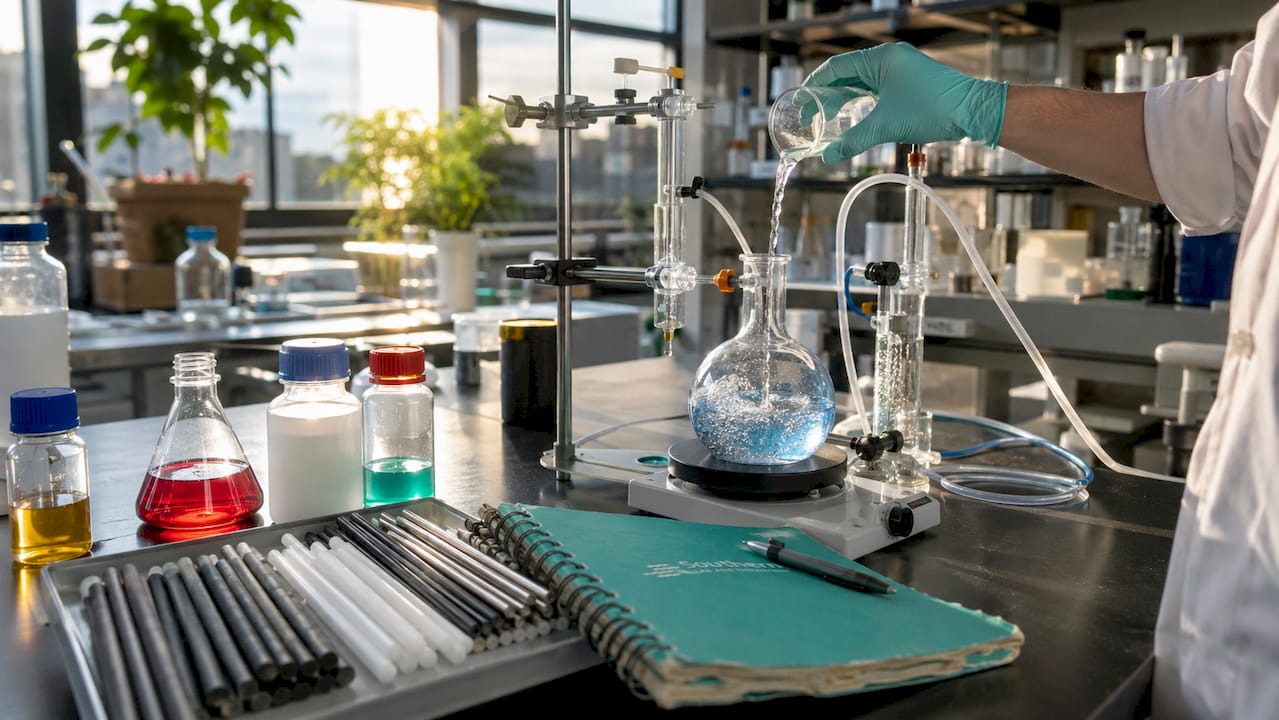
Electrochemical gas generation operates by passing electrical current through an electrochemical cell containing two electrodes, an electrolyte, and often a membrane. The applied voltage drives oxidation at the anode and reduction at the cathode, producing gas as a direct reaction product. Water electrolysis is the most familiar example: water splits into hydrogen at the cathode and oxygen at the anode.
The choice of electrolyte and electrode material directly controls which gas forms and at what rate. Alkaline electrolytes favor hydrogen evolution, while concentrated NaOH or KOH solutions support methane synthesis from CO2 and H2O at elevated temperatures. Electrode materials such as IrO2 and Ru/C are critical for optimizing gas generation performance and minimizing crossover between product streams.
A distinction that matters operationally: electrochemical gas generation differs from gas sensing in a fundamental way. Generation applies external power to produce gas intentionally. Sensing generates a small current when gas interacts with an electrode, measuring concentration rather than creating product. Confusing the two leads to serious specification errors when selecting equipment.
Key electrochemical terms every engineer should know:
- Faradaic efficiency: the percentage of electrons that result in the desired gas product rather than side reactions. Higher faradaic efficiency means less wasted energy.
- Current density: current per unit electrode area (mA cm²), which controls production rate and product purity simultaneously.
- Overpotential: the extra voltage beyond the thermodynamic minimum needed to drive the reaction at a useful rate.
- Electrolyte resistance: the ohmic loss across the solution between electrodes, which increases cell voltage and reduces efficiency.
Pro Tip: When specifying an electrochemical gas generator for a GC or LCMS application, request the faradaic efficiency value at your target flow rate. A system with 99% faradaic efficiency at low flow may drop significantly at peak demand, affecting carrier gas purity.
What are the main technologies in electrochemical gas generation?
The field has advanced well beyond simple beaker-and-electrode setups. Four technology categories now define the electrochemical gas production space for industrial and laboratory use.
Zero-gap electrolyzers with cation exchange membranes. These systems press electrodes directly against a membrane, minimizing electrolyte resistance and enabling pressurized hydrogen production above 5.5 bar at cell voltages as low as 1.1 V at 0.1 A cm². No mechanical compressor is required. That design choice alone removes a major maintenance burden from industrial hydrogen systems.
Ammonia electrolysis systems. Direct electrolysis of liquid anhydrous ammonia produces hydrogen continuously at ambient temperature. Advanced systems achieve production rates exceeding 18.8 mol-H2 gcat⁻¹ h⁻¹ with faradaic efficiencies above 99.3%. That efficiency figure means nearly every electron delivered to the cell becomes hydrogen, not heat or a side product.
Electrochemical CO2 reduction reactors. These systems convert CO2 and H2O into methane or other hydrocarbons using concentrated electrolytes at elevated temperatures. A Pd-Ag membrane reactor operating at 250 °C and 250 mA cm² achieves methane current efficiency of 91%. Performance drops above these thresholds due to gas crossover, which makes operating point selection critical.
HHO gas generators with optimized electrode design. These produce a hydrogen-oxygen mixture for combustion and industrial heating applications. Optimization using Central Composite Design and Artificial Neural Networks achieves maximum gas output at 64.85 g/L NaOH concentration, with a model R-squared value of 98.02%. That statistical accuracy means the optimization model predicts real-world output reliably, reducing trial-and-error commissioning time.
| Technology | Primary Gas | Key Performance Metric |
|---|---|---|
| Zero-gap electrolyzer | Hydrogen | >5.5 bar, 1.1 V at 0.1 A cm² |
| Ammonia electrolysis | Hydrogen | >18.8 mol-H2 gcat⁻¹ h⁻¹, >99.3% faradaic efficiency |
| CO2 reduction reactor | Methane | 91% current efficiency at 250 mA cm² |
| HHO generator | H2/O2 mixture | Max output at 64.85 g/L NaOH, R² = 98.02% |
Macroscale electrolyzer architecture governs performance as much as catalyst selection does. Electrolyzer architecture links current density and cell voltage directly to physical design choices such as flow field geometry, electrode spacing, and membrane compression. Engineers who focus only on catalyst chemistry and ignore cell architecture routinely underperform their design targets.
What factors influence efficiency and purity in electrochemical gas generation?
Efficiency and purity are not independent variables. Pushing one often compromises the other, and the operating point where both are acceptable is narrower than most system specifications suggest.
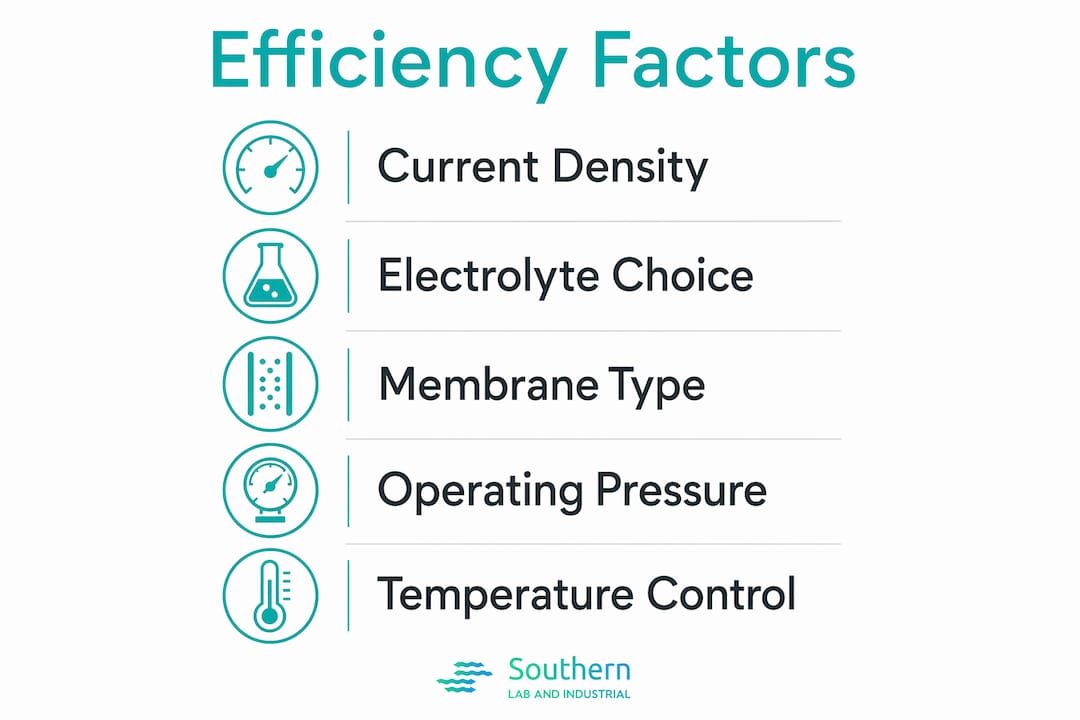
Current density is the primary control lever. Higher current density increases production rate but also increases the driving force for gas crossover through the membrane. In methane synthesis reactors, performance is stable up to 250 mA cm², then degrades as cross-leak allows hydrogen and methane to mix on the wrong side of the membrane. Purity drops, and the energy cost per unit of product rises sharply.
Membrane selection determines how well the system separates product streams under pressure. Cation exchange membranes in zero-gap configurations physically block gas crossover while allowing ion transport. The membrane must withstand both the chemical environment of the electrolyte and the mechanical stress of pressurized operation. Material selection for electrolyzer piping and membranes follows the same chemical resistance logic as industrial pipe systems: the wrong material fails under operating conditions, not under lab conditions.
Gas crossover at triple-phase boundaries (gas, liquid, and solid meeting at the electrode surface) is managed using fluid dynamics principles. Applying Bernoulli’s principle at triple-phase boundaries creates localized pressure differentials up to 116.3 × 10⁻³ Pa through controlled fluid flow velocity, physically suppressing gas migration across the electrode interface. This approach improves both efficiency and product purity without adding membrane complexity.
Additional factors that engineers must monitor continuously:
- Electrolyte concentration: too dilute increases resistance; too concentrated promotes unwanted side reactions and accelerates electrode degradation.
- Operating temperature: higher temperatures reduce electrolyte resistance but increase gas crossover rates and membrane wear.
- Thermodynamic and impedance monitoring: real-time electrochemical impedance spectroscopy detects membrane fouling and electrode degradation before they cause purity failures.
- Electrode catalyst loading: balancing catalyst and electrolyte parameters requires continuous monitoring at high current densities to maintain product purity and prevent cross-leak.
Pro Tip: Run electrochemical impedance spectroscopy on your cell monthly, not just during commissioning. Impedance shifts of 10–15% often precede measurable purity drops by several weeks, giving you time to intervene before instrument performance is affected.
What are the key applications of electrochemical gas generation?
Electrochemical gas production serves a wider range of industries than most engineers initially expect. The common thread is the need for on-site, high-purity gas without the logistics of cylinder management.
- Hydrogen for fuel cells and industrial processes. Industrial hydrogen generators based on PEM and alkaline electrolysis supply hydrogen for fuel cell testing, metal processing, and semiconductor manufacturing. On-site generation eliminates cylinder delivery schedules and the safety risks of storing large hydrogen volumes.
- Oxygen and zero air for analytical laboratories. Electrochemical cells produce oxygen and zero air for GC flame ionization detectors, FTIR purge gas, and combustion analysis. On-site generation maintains consistent purity that cylinder gas cannot always guarantee between deliveries.
- Methane and hydrocarbon synthesis. CO2 reduction reactors convert waste carbon dioxide into methane or formate, creating value from an industrial byproduct. This pathway is gaining traction in facilities that already capture CO2 and want to monetize it rather than vent it.
- Environmental testing and monitoring. Electrochemical cells generate calibration gases for air quality monitors and emissions testing equipment. Generating calibration gas on demand removes the shelf-life problem that affects pre-mixed cylinder standards.
- CO2 capture and conversion integration. Combining CO2 capture with electrochemical conversion in a single process bypasses the energy-intensive desorption step required in conventional carbon capture. This integrated approach reduces the total energy cost of carbon valorization and is a major trend in industrial decarbonization.
The gas generation vs. cylinder supply comparison consistently favors on-site electrochemical generation for facilities with continuous gas demand above a threshold flow rate. The crossover point depends on local cylinder pricing, delivery frequency, and instrument uptime requirements.
Key Takeaways
Electrochemical gas generation produces high-purity gases on demand by driving controlled reactions in electrochemical cells, with faradaic efficiency, current density, and membrane design determining output quality and energy cost.
| Point | Details |
|---|---|
| Faradaic efficiency defines system quality | Systems exceeding 99.3% faradaic efficiency waste almost no electrical energy on side reactions. |
| Zero-gap electrolyzers remove compression | Cation exchange membrane designs deliver hydrogen above 5.5 bar without mechanical compressors. |
| Current density has a performance ceiling | Methane reactors hit 91% efficiency at 250 mA cm², then degrade sharply above that threshold. |
| Architecture matters as much as catalyst | Macroscale cell design governs current density and voltage as directly as electrode chemistry does. |
| CO2 integration cuts process energy | Combining capture and electrochemical conversion in one step eliminates energy-intensive desorption. |
The part of electrochemical gas generation most engineers underestimate
I have reviewed a lot of electrochemical gas system specifications over the years, and the pattern is consistent: engineers spend 80% of their attention on catalyst selection and almost none on cell architecture. The research is clear that macroscale design choices, specifically flow field geometry, electrode compression, and membrane interface management, govern real-world performance as much as any catalyst coating.
The second underestimated factor is the operating point. A system rated for 99% faradaic efficiency delivers that number at one specific current density and temperature. Push it harder to meet a production spike, and you cross into the crossover regime where purity drops and energy cost per unit of product climbs. I have seen labs run their generators at 120% of rated current density for months, then wonder why their GC baseline drifted. The generator was producing gas. It just was not producing gas at the purity the instrument needed.
The optimization tools now available, specifically ANN and CCD modeling, reduce the experimental burden of finding the right operating point significantly. A model with an R-squared value of 98.02% predicts gas yield across the variable space without running hundreds of physical experiments. That is a genuine time and cost advantage for any facility commissioning a new system or troubleshooting an existing one.
My advice: treat the operating point as a living parameter, not a commissioning setting. Monitor impedance, track faradaic efficiency monthly, and adjust electrolyte concentration seasonally as ambient temperature changes. The facilities that do this consistently get years more reliable service from the same hardware.
— Kris
How SLI supports your gas generation system
SLI supplies and supports on-site gas generators for analytical laboratories and industrial facilities across the Gulf Coast, working with LNI Swissgas and Nel Hydrogen systems that apply the electrochemical principles covered here.

Whether you are specifying a new hydrogen generator for a GC lab, troubleshooting purity issues in an existing system, or evaluating the total cost of ownership against cylinder supply, SLI provides local technical support and turnkey installation. The lab gas generator solutions page covers hydrogen, nitrogen, and zero air options for GC, LCMS, ICP, and FTIR instruments. For facilities already running generators, the gas generator performance benchmarks resource gives you the efficiency and purity targets your system should be hitting. Contact SLI to discuss your specific application.
FAQ
What is electrochemical gas generation?
Electrochemical gas generation is the controlled production of gases such as hydrogen, oxygen, or methane by applying electric current to drive chemical reactions in a specialized electrochemical cell. The process produces gas on demand at the point of use, replacing cylinder-based supply.
How does faradaic efficiency affect gas output?
Faradaic efficiency measures the percentage of electrons that produce the target gas rather than heat or side products. Systems with faradaic efficiency above 99% deliver nearly all input energy as usable gas, minimizing operating cost.
What is the difference between electrochemical gas generation and gas sensing?
Gas generation applies external electrical power to produce gas intentionally. Gas sensing generates a small current when gas interacts with an electrode, measuring concentration rather than creating product. The two technologies use similar components but serve opposite functions.
Why do zero-gap electrolyzers not need mechanical compressors?
Zero-gap electrolyzers press electrodes directly against a cation exchange membrane, which physically separates and pressurizes the hydrogen stream during production. This design delivers hydrogen above 5.5 bar without a separate compression stage.
What causes purity loss in electrochemical gas generators?
Gas crossover through the membrane is the primary cause of purity loss, and it increases sharply above the rated current density. Electrolyte concentration, operating temperature, and membrane degradation all accelerate crossover, which is why continuous impedance monitoring is the standard practice for high-purity applications.