Gas generation is defined as the on-site production of high-purity gases through chemical or physical processes, while liquid gas technology converts those same gases into cryogenic liquid form for bulk storage and transport. For researchers and engineers weighing gas generation vs liquid gas research outcomes, the choice between these two supply strategies directly affects purity, cost, safety, and operational continuity. Industry benchmarks from the U.S. Department of Energy and peer-reviewed process engineering literature confirm that neither approach is universally superior. The right selection depends on your application environment, infrastructure constraints, and purity requirements. SLI works with labs and industrial facilities across the Gulf Coast to match the correct supply method to each specific use case.
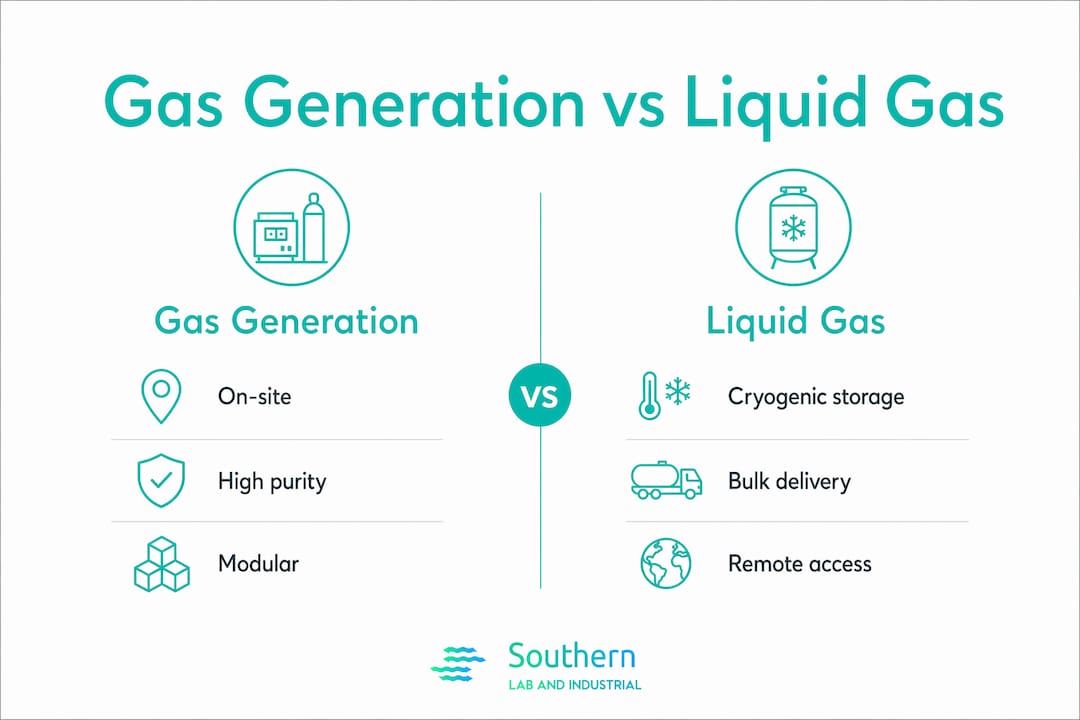
What are the primary gas generation methods vs. liquid gas technologies?
Gas generation and liquid gas technologies differ at the process level, and those differences cascade into every operational decision you make downstream.
Core gas generation methods
Steam-methane reforming (SMR) produces 95% of hydrogen in the U.S., operating at temperatures between 700°C and 1,000°C and pressures of 3–25 bar. That dominance reflects SMR’s cost efficiency at scale, but it also means most industrial hydrogen supply chains are built around a single process with significant thermal infrastructure requirements. Pressure swing adsorption (PSA) separates nitrogen or hydrogen from a mixed gas stream by cycling pressure across an adsorbent bed, making it well-suited for laboratory gas generators where continuous, unattended operation is the priority. Electrolysis splits water into hydrogen and oxygen using electrical current, and its appeal grows as renewable electricity becomes cheaper.
Liquid gas technologies
Liquid gas production starts with compression and cooling of a gas below its boiling point, a process called liquefaction. Liquefied natural gas (LNG) is stored at approximately minus 162°C, and liquid hydrogen (LH2) requires minus 253°C. Those temperatures demand specialized cryogenic vessels, insulated transfer lines, and active pressure management. Before the gas reaches an instrument or burner, a vaporization system converts it back to gaseous form. Cryogenic vaporization introduces phase change risks including icing on heat exchangers, thermal stress on fittings, and pressure fluctuations that require active monitoring.
Operational comparison
| Parameter | On-site gas generation | Liquid gas supply |
|---|---|---|
| Operating temperature | Ambient to 1,000°C (SMR) | Down to minus 253°C (LH2) |
| Pressure range | 3–25 bar (SMR); lower for PSA | High-pressure cryogenic vessels |
| Equipment complexity | Moderate; self-contained units | High; cryogenic tanks, vaporizers, controls |
| Purity achievable | Up to 99.999% | Variable; often needs re-purification |
| Supply continuity | Continuous on demand | Dependent on delivery schedule |
Pro Tip: If your GC or LCMS instrument requires carrier gas at 99.999% purity, confirm whether your liquid gas supplier includes a certificate of analysis for each delivery. On-site PSA generators produce gas at a fixed, validated purity level every cycle.
How do efficiency and environmental impacts compare?
Efficiency in gas supply is not just about energy input per unit of gas produced. It includes logistics losses, purification overhead, and the carbon cost of the full supply chain.
Thermal efficiency and emissions
Optimized modular gas-to-liquid reactors reach thermal efficiencies of 60.9% and reduce CO2 emissions by 56.9% compared to conventional gas flaring. That carbon efficiency of 62.8% positions modular GTL technology as a serious option for facilities that need liquid fuels but want to reduce their emissions profile. On the fuel conversion side, switching from liquid fuel to gas fuel in mobile power plants reduces greenhouse gas emissions by approximately 36.7%–37.3% and cuts fuel costs by over 82%. The fuel cost reduction alone justifies the infrastructure investment in most industrial scenarios.
Purity losses and logistics overhead
On-site generators achieve purity up to 99.999%, while liquid gas often requires multi-stage purification at the point of use. That re-purification step adds equipment cost, maintenance burden, and a potential contamination point. Liquid gas supply chains also carry logistics losses: boil-off during transport and storage is unavoidable with cryogenic fluids, and those losses represent both wasted product and a hidden cost that rarely appears on a per-unit price quote.
Environmental profile of gas-to-liquid conversion
Gas-to-liquid technology converts natural gas into synthetic liquid fuels with lower sulfur content and reduced particulate emissions compared to crude oil fuels. This positions GTL as a decarbonization tool for transport and industrial sectors that cannot yet run on pure gas infrastructure. The tradeoff is capital intensity: GTL plants require significant upfront investment, which is why modular reactor designs are attracting R&D attention.
What are the practical application scenarios for each technology?
The decision between on-site generation and liquid gas delivery is ultimately an infrastructure and continuity question.
Where on-site generation wins
On-site gas generation is the clear choice for analytical laboratories running GC, LCMS, ICP, or FTIR instruments continuously. These instruments require carrier and detector gases at validated purity levels, and any supply interruption causes downtime that costs far more than the gas itself. PSA nitrogen generators and PEM electrolysis hydrogen generators produce gas on demand, eliminating the cylinder change schedule and the associated safety risks of high-pressure cylinder handling. SLI’s industrial hydrogen generation systems, built around Nel Hydrogen and LNI Swissgas platforms, are designed specifically for this continuous, high-purity use case.
Where liquid gas delivery wins
Liquid gas delivery suits facilities in regions without natural gas pipeline access, or applications requiring very large volumes of gas that on-site generation cannot economically match. LNG is the standard fuel choice for remote power generation, marine propulsion, and peak-shaving applications where pipeline gas is unavailable. Liquid gas suits areas without pipelines, while on-site generation suits continuous, high-purity needs. For chemical processing plants, understanding pipe material selection for cryogenic service is a prerequisite before committing to a liquid gas supply model.
Pros and cons at a glance
On-site gas generation:
- Continuous supply with no delivery dependency
- Purity up to 99.999% without additional purification
- Lower long-term total cost of ownership
- Requires upfront capital for generation equipment
- Dependent on utility power and feedstock availability
Liquid gas supply:
- Flexible deployment in remote or pipeline-free locations
- Scalable volume without on-site generation capacity limits
- Established delivery infrastructure in most regions
- Cryogenic storage adds complexity and safety requirements
- Boil-off losses and re-purification costs add to total cost
Pro Tip: When evaluating total cost of ownership for liquid gas versus on-site generation, include the fully loaded cost of cylinder or tanker deliveries, safety compliance, and any re-purification equipment. The payback period for on-site generators is typically shorter than the initial capital comparison suggests.
What recent innovations are improving gas generation and liquid gas systems?
Both technology categories are advancing rapidly, and the improvements are converging on the same goals: higher efficiency, lower emissions, and greater reliability.
Additive manufacturing in gas generation
Additive manufacturing techniques including laser powder bed fusion (LPBF) and direct metal laser sintering (DMLS) are changing how gas generator components are designed and built. These methods allow internal geometries that are impossible to machine conventionally, reducing joint failure points and improving flow dynamics under high-pressure conditions. Selective laser melting (SLM) enables modular generator designs that are lighter, more compact, and more reliable than cast or welded equivalents. The practical result for lab and industrial users is a generation unit with a longer service interval and a smaller footprint.
Modular GTL and heat integration
Modular gas-to-liquid reactor designs are reducing the minimum viable scale for GTL conversion, making the technology accessible to mid-size industrial operations and stranded gas monetization projects. Heat integration improvements recover thermal energy from exothermic conversion reactions, feeding it back into the process to raise overall thermal efficiency. Catalyst technology advances in Fischer-Tropsch synthesis are extending catalyst life and improving selectivity toward desired liquid fuel fractions.
Advances in cryogenic storage
Enhanced vacuum-insulated cryogenic vessels now achieve lower boil-off rates, reducing product loss during storage and transport. Active pressure management systems use real-time sensors to detect phase change anomalies before they cause thermal stress failures. For facilities using on-site hydrogen generation for fueling applications, these storage advances matter when liquid hydrogen buffer tanks are part of the system design. Manufacturing plants evaluating infrastructure upgrades should also assess plastic pipe system benefits for low-pressure gas distribution within the facility.
Key takeaways
On-site gas generation delivers the highest purity and lowest long-term cost for continuous laboratory and industrial use, while liquid gas supply remains the practical choice for remote or high-volume applications where pipeline access is absent.
| Point | Details |
|---|---|
| SMR dominates hydrogen production | Steam-methane reforming produces 95% of U.S. hydrogen at 700°C–1,000°C and 3–25 bar. |
| On-site purity advantage | On-site generators reach 99.999% purity; liquid gas typically requires additional purification steps. |
| Fuel switching cuts emissions | Converting from liquid fuel to gas fuel reduces greenhouse gas emissions by 36.7%–37.3%. |
| Liquid gas suits remote sites | Cryogenic delivery works where pipelines are absent, but adds vaporization complexity and boil-off losses. |
| Additive manufacturing improves generators | LPBF and DMLS techniques reduce joint failures and improve flow geometry in modern gas generation units. |
My read on where this technology split is heading
The gas generation vs. liquid gas debate is often framed as a binary choice, but in practice the most capable facilities run both. What I have seen consistently is that engineers underestimate the hidden costs on the liquid gas side. Boil-off losses, re-purification equipment, delivery scheduling, and cryogenic safety compliance add up to a total cost of ownership that rarely matches the per-unit price on the delivery invoice.
The more interesting shift is happening at the modular GTL and additive manufacturing level. When a mid-size industrial operation can deploy a modular reactor that reaches 60.9% thermal efficiency and cuts CO2 by 56.9% compared to flaring, the economics of on-site conversion become genuinely competitive with delivered liquid gas. That was not true five years ago.
For analytical labs specifically, the case for on-site generation is already closed. The purity argument alone settles it. What I watch now is how fast PEM electrolysis costs fall, because that will determine whether green hydrogen on-site generation becomes the default for labs that currently run SMR-derived hydrogen. The trajectory is clear. The timeline is the only open question.
— Kris
SLI solutions for gas generation and supply reliability
SLI serves analytical laboratories and industrial facilities across the Gulf Coast with on-site gas generation systems for hydrogen, nitrogen, and zero air. Every installation is designed to replace cylinder or tanker delivery with a continuous, validated gas supply matched to the purity requirements of your specific instruments.
SLI partners with LNI Swissgas and Nel Hydrogen to provide generation platforms that cover everything from bench-scale GC support to large-volume industrial hydrogen production. If you are working through real-world integration challenges or evaluating whether on-site generation fits your facility’s infrastructure, SLI’s technical team provides turnkey installation and ongoing local support. Explore laboratory gas generator solutions to see the full range of systems available for your application.
FAQ
What is the difference between gas generation and liquid gas supply?
Gas generation produces gas on-site through processes like PSA, SMR, or electrolysis. Liquid gas supply delivers cryogenically liquefied gas by tanker or cylinder for on-site vaporization and use.
Which method delivers higher gas purity?
On-site gas generators achieve purity up to 99.999% without additional treatment. Liquid gas often requires multi-stage purification at the point of use to reach equivalent purity levels.
When does liquid gas make more sense than on-site generation?
Liquid gas is the practical choice for remote locations without pipeline access or for applications requiring very large gas volumes that on-site generation cannot economically match.
How does gas generation efficiency compare to liquid gas systems?
Modular gas-to-liquid reactors reach thermal efficiencies of 60.9%, while on-site PSA and electrolysis systems avoid the boil-off and logistics losses inherent in cryogenic liquid gas supply chains.
What are the main risks of cryogenic liquid gas storage?
Cryogenic systems face phase change risks including icing on heat exchangers, thermal stress on fittings, and pressure fluctuations that require active monitoring and specialized vaporization management.