A structured preventive maintenance program is the single most effective way to protect gas purity, extend equipment life, and avoid unplanned downtime in facilities running on-site gas generators. Facility managers who schedule industrial gas generator maintenance as a formal, tiered program, rather than reacting to failures, consistently achieve better uptime and lower total cost of ownership. The framework draws from manufacturer requirements, NFPA 110 compliance standards, and usage-based triggers to define daily, monthly, and annual service intervals. Getting the schedule right from the start prevents the two most common and costly failures: purity drift and compressor damage.
What are the recommended maintenance intervals for gas generators?
A tiered preventive maintenance schedule for industrial gas generators includes daily visual inspections, monthly operational tests, and annual professional service. Each tier addresses a different failure mode and requires a different level of technical skill. Skipping any tier does not just defer work. It compounds risk.
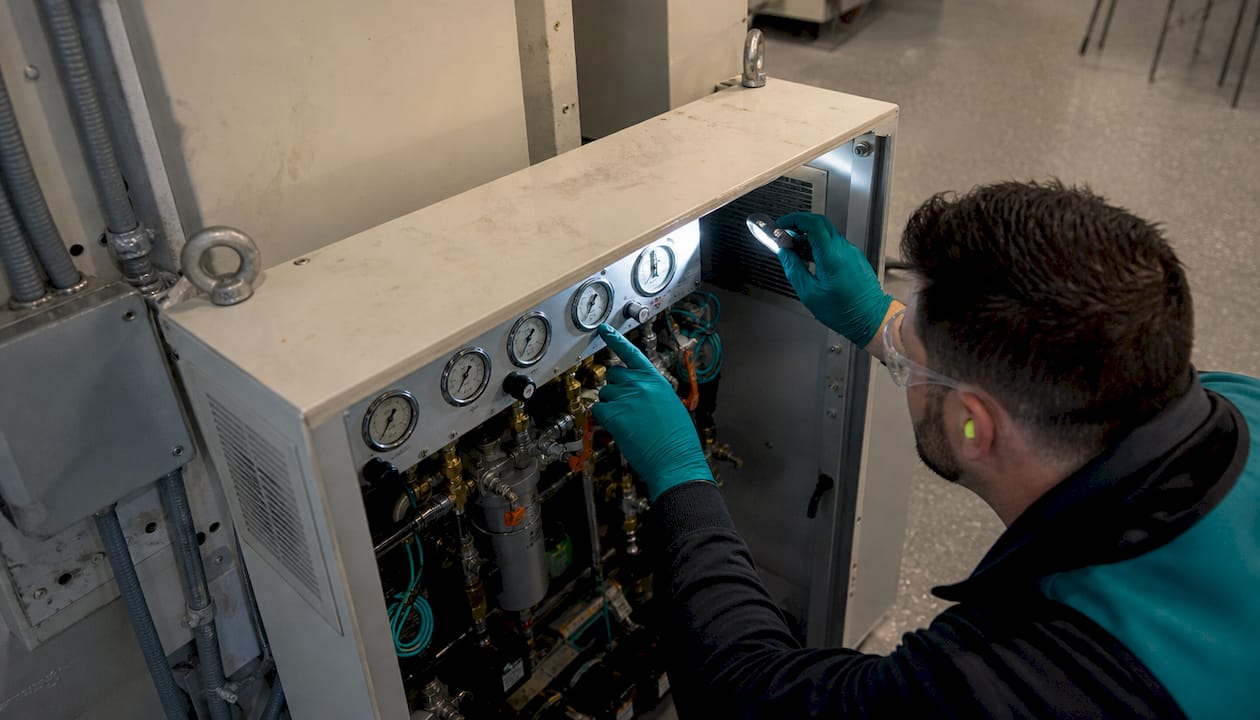
Daily inspection tasks
Daily checks take less than five minutes and catch the failures that develop overnight. Every shift should verify the following:
- Pressure readings are within the manufacturer’s specified range
- No visible leaks at fittings, valves, or connection points
- No active alarms on the control panel
- Condensate drains are clear and functioning
- Inlet air temperature and humidity are within acceptable limits
These checks require no tools and no specialized training. Their value is early detection, not diagnosis.
Monthly operational tests
Monthly service moves beyond observation into active testing. Load testing lasting at least 30 minutes confirms the generator performs under real operating conditions, not just at idle. Monthly tasks include:
- Full leak check using sensory inspection and soapy water tests on all fittings
- Verification of output purity against instrument baseline readings
- Battery charge and condition check for generators with electronic controls
- Review of alarm history logs for recurring fault codes
- Inspection of pre-treatment filters for saturation or bypass
Pro Tip: Log every monthly test result in a dated entry. A single month of missing records can create a compliance gap under NFPA 110 audit conditions.
Annual professional service
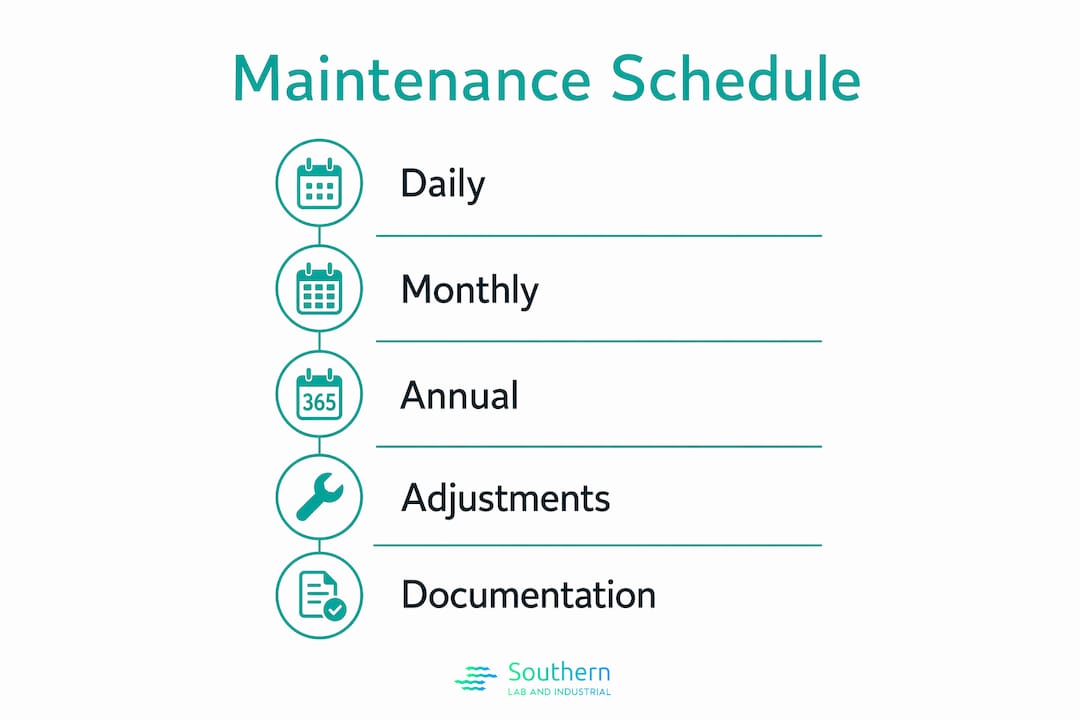
Annual professional service typically lasts 1–2 hours regardless of unit size and covers the components that daily and monthly checks cannot reach. A qualified technician should complete:
| Service Task | Interval | Notes |
|---|---|---|
| Inlet filter replacement | Annual | Coarse filters annually; fine filters every 2–5 years |
| Compressor cleaning | Annual | Prevents heat buildup and efficiency loss |
| Oxygen sensor calibration | Annual | Critical for purity accuracy in nitrogen generators |
| Gas line leak testing | Annual | Full system pressure test |
| Oil change | Every 100–200 operating hours | Per manufacturer specification |
| Air filter replacement | Every 50–100 operating hours | Adjust for environment |
| Spark plug inspection | Every 50–100 operating hours | For gas-powered units |
Oil change intervals for gas and LPG generators typically fall between 100 and 200 operating hours. That interval shortens in high-use or high-temperature environments.
How to align your schedule with usage and environmental factors?
Time-based intervals are a starting point, not a final answer. A generator running 20 hours per week in a climate-controlled lab needs a different schedule than one running continuously in a Gulf Coast industrial facility with high humidity and airborne particulates. The generator service interval guide from SLI covers how to integrate both time-based and usage-based triggers into a single coherent program.
Adjusting for harsh environments
Environmental factors like humidity and dust require shortening filter replacement intervals and increasing pre-treatment maintenance frequency. In practice, this means:
- Facilities with visible airborne dust should inspect inlet filters weekly, not monthly
- High-humidity environments may require daily condensate drain checks to prevent moisture ingress
- Outdoor or semi-outdoor installations need more frequent inspection of electrical connections for corrosion, a risk detailed in guides on preventing pipe system corrosion
- Facilities near chemical processes should verify that inlet air remains oil-free at every inspection
Pro Tip: Track operating hours on a wall-mounted hour meter or digital log. Relying on calendar dates alone causes you to miss usage-based triggers, especially during production surges.
Monitoring purity trends to adjust intervals
Purity data is the most reliable leading indicator of maintenance need. A gradual decline in output purity, even one that stays within spec, signals that molecular sieve media or pre-treatment components are degrading. The adsorption media in a nitrogen generator can last up to 20 years when inlet air quality is maintained. When pre-treatment fails, that lifespan collapses. Reviewing purity trends monthly lets you adjust service intervals before a failure occurs, rather than after.
What tools and documentation practices support effective scheduling?
Documentation is not an administrative formality. It is the mechanism that turns a maintenance schedule into a compliance record and a diagnostic tool. Treating generator maintenance as a formal, logged program improves uptime, simplifies audits, and reveals patterns that predict failures weeks in advance.
A complete maintenance record for each service event should capture:
- Date, technician name, and unit serial number
- All tasks performed and components replaced, with part numbers
- Purity readings before and after service
- Alarm codes present at the start of service and their resolution
- Operating hours at time of service
- Next scheduled service date and any deferred items
Digital maintenance management systems offer search and trend analysis that paper logbooks cannot match. For facilities subject to NFPA 110 or data integrity regulations, a digital system also provides tamper-evident records. The SLI gas generator remote monitoring guide explains how continuous data logging integrates with scheduled maintenance to close the gap between inspections.
Practical tools for field maintenance
Every maintenance technician working on industrial gas generators should have access to:
- A calibrated load bank tester for monthly operational verification
- A soapy water solution or electronic leak detector for gas line checks
- A calibrated purity analyzer matched to the generator’s gas type
- A digital hour meter log or CMMS (Computerized Maintenance Management System) entry
- Manufacturer service manuals for each unit on site
The gas generator performance benchmarks published by SLI give facility teams a reference point for evaluating whether post-service readings are within acceptable ranges.
How to troubleshoot common maintenance scheduling pitfalls?
The most expensive maintenance mistake is not a missed filter change. It is the decision to skip annual service on a low-use or standby generator because it “hasn’t run much.” Standby generators still require annual professional inspections and monthly exercising to maintain battery charge and prevent component seizure. Inactivity causes its own failure modes, including valve sticking, seal drying, and sieve media degradation from moisture that was never purged.
Early warning signs you should not ignore
Catching degradation early is the entire point of a scheduled program. The following signs indicate that a service interval needs to move forward, not wait for the calendar:
- A pressure drop of more than 5% from baseline at the same flow rate
- Output purity declining across two or more consecutive monthly readings
- Unusual noises during compressor cycling, including rattling or high-pitched tones
- Increased frequency of alarm activations, even if the alarms self-clear
- Condensate drains discharging more liquid than usual, which signals a pre-treatment issue
Sensory checks and soapy water leak tests detect small leaks before they trigger alarms. Small leaks degrade performance gradually, making them harder to attribute to a single cause without a documented baseline.
Pro Tip: Coordinate gas generator service with scheduled instrument downtime. Aligning these windows eliminates the need to take instruments offline twice and reduces total facility downtime per year.
Common scheduling mistakes that facilities repeat year after year include skipping documentation after routine checks, ignoring environmental changes that warrant shorter intervals, and failing to update the schedule after a generator is relocated or its duty cycle changes. The SLI resource on common generator failure signs covers the specific indicators that should trigger an unscheduled inspection between regular service events.
Key takeaways
A structured, tiered maintenance program combining daily inspections, monthly tests, and annual professional service is the most reliable method to protect gas purity and prevent unplanned generator failures.
| Point | Details |
|---|---|
| Use a tiered schedule | Daily, monthly, and annual intervals each address distinct failure modes and must all be maintained. |
| Adjust for environment | High humidity and dust require shorter filter intervals and daily condensate drain checks. |
| Document every service event | Logged records support NFPA 110 compliance and enable trend-based failure prediction. |
| Protect pre-treatment systems | Keeping inlet air clean, dry, and oil-free is the primary driver of generator longevity. |
| Service standby units too | Low-use generators still need annual inspection and monthly exercising to prevent component seizure. |
What I’ve learned from watching facilities skip the schedule
Facilities that treat generator maintenance as a formal program consistently outperform those that rely on reactive repairs. That is not an opinion. It is a pattern I have observed across industrial and laboratory settings where the cost of a single unplanned outage, including instrument recalibration, lost samples, and emergency service fees, far exceeds a full year of scheduled maintenance.
The insight that most facilities miss is this: the generator itself is rarely the first thing to fail. Pre-treatment components, specifically the inlet filters, condensate drains, and dryers, degrade first. When those fail, they push contaminated air into the generator core, destroying molecular sieve media that would otherwise last decades. Facilities that invest in pre-treatment maintenance spend a fraction of what reactive facilities spend on core component replacements.
I also advocate strongly for pre-arranged service contracts. Professional service contracts reduce emergency downtime costs and keep facilities audit-ready without requiring maintenance staff to track every interval manually. When service is scheduled in advance and aligned with instrument maintenance windows, the total annual downtime drops noticeably. The math on that is straightforward, and you have already done it if you have ever priced an emergency callout versus a planned visit.
— Kris
SLI’s service support for gas generator maintenance programs
Facility teams managing on-site gas generators along the Gulf Coast have access to SLI’s technical support and service resources, built specifically for hydrogen, nitrogen, and zero air systems from LNI Swissgas and Nel Hydrogen.
SLI provides turnkey installation, scheduled service agreements, and direct technical support that aligns with the maintenance intervals and documentation practices described here. The gas generator integration case studies on the SLI site show how facilities have resolved scheduling conflicts and pre-treatment failures in real-world settings. For facilities ready to formalize their maintenance program, the SLI service and support page is the right starting point for discussing a service agreement tailored to your equipment and operating environment.
FAQ
What is the minimum maintenance frequency for an industrial gas generator?
Daily visual inspections, monthly operational tests, and annual professional service represent the minimum accepted standard. Skipping any tier increases the risk of purity drift and unplanned failure.
How often should oil be changed in an industrial gas generator?
Oil changes are recommended every 100–200 operating hours for gas and LPG generators, though the exact interval depends on the manufacturer’s specification and operating environment.
Do standby generators need the same maintenance schedule?
Yes. Standby generators require annual professional inspections and monthly exercising regardless of how infrequently they run, because inactivity causes valve sticking, seal drying, and battery discharge.
What is the most important part of a gas generator maintenance program?
Pre-treatment system maintenance is the highest-leverage activity. Keeping inlet air clean, dry, and oil-free protects the generator core and can extend molecular sieve media life to 20 years or more.
How do I know when to service my gas generator ahead of schedule?
Pressure drops from baseline, declining purity trends across consecutive readings, unusual compressor noises, and increased alarm frequency all indicate that service should move forward. Use the gas generation troubleshooting steps from SLI to diagnose the root cause before the next scheduled interval.