Relying on delivered gas cylinders is a familiar pain point for Gulf Coast procurement officers: unexpected delivery delays, fluctuating vendor prices, logistical overhead for cylinder tracking, and the constant risk of running out of process gas at the worst possible moment. The hidden costs embedded in cylinder-based supply routinely outpace what facility managers budgeted. On-site gas generation changes that equation by converting a recurring, unpredictable expense into a controlled capital investment with predictable operating costs. This article walks you through how to classify your facility’s actual needs, build a defensible budget, select properly sized equipment, and avoid the planning mistakes that undercut even well-intentioned projects.
Table of Contents
- Distinguishing gas generation facility types and budgets
- Estimating costs and budget drivers for natural-gas power and gas systems
- Selecting and sizing gas generation systems for specific applications
- Budgeting for facility-scale gas generation in production processes
- The uncomfortable truth nobody tells you about gas generation budgets
- Explore tailored gas generation solutions for your facility
- Frequently asked questions
Key Takeaways
| Point | Details |
|---|---|
| Distinguish generator types | On-site power and industrial gas generators require separate budget strategies. |
| Budget for real-world costs | Installation and ongoing fuel or materials expenses are often underestimated during planning. |
| Match solution to application | Always select gas generation systems based on your specific usage needs and purity requirements. |
| Model utilization realistically | Use actual operating profiles for budgeting rather than nameplate capacity. |
| Facility-scale budgeting matters | Production applications demand a deeper budget breakdown including capital and daily operating costs. |
Distinguishing gas generation facility types and budgets
Before you write the first line of a budget, you need to resolve a terminology problem that derails procurement planning more often than any technical specification: the difference between on-site power generation and on-site industrial gas generation. They are not interchangeable, and their cost structures are completely different.
On-site power generation means producing electricity or mechanical energy on your premises, typically using natural-gas-fired turbines or reciprocating engines. These systems are sized in kilowatts or megawatts, and the primary cost driver is fuel. Texas data centers are now building their own gas-fired power plants to support AI workloads, underscoring that procurement should separate on-site power generation from on-site industrial gas generation because budget models and cost drivers differ significantly.
On-site industrial gas generation means producing a specific gas, such as nitrogen, oxygen, hydrogen, or zero air, directly at the point of use. These systems are sized by flow rate (liters per minute or standard cubic feet per hour) and purity specification. The primary cost drivers are electricity consumption, membrane or PSA consumable life, and maintenance contracts.
| Feature | On-site power generation | On-site industrial gas generation |
|---|---|---|
| Primary output | Electricity (kW/MW) | Gas: N₂, O₂, H₂, zero air |
| Sizing unit | Kilowatts or megawatts | L/min or SCFH at target purity |
| Main fuel/input | Natural gas | Electricity (compressed air for N₂/O₂) |
| CapEx range | $50K to $10M+ | $5K to $500K+ depending on scale |
| Primary OpEx driver | Natural-gas price | Power consumption, maintenance |
| Key applications | Emergency backup, grid independence | GC, ICP, FTIR, production welding, blanketing |
| Regulatory burden | Emissions permits, utility interconnect | Pressure vessel codes, local fire codes |
Gulf Coast facilities often need both categories, but they must be budgeted separately. An analytical lab running GC or ICP instruments needs lab solutions centered on high-purity gas generators, not a turbine. A production plant blanketing storage tanks with nitrogen has a different scale and infrastructure requirement. A facility converting natural gas to hydrogen for fueling or process use requires industrial hydrogen generators designed for continuous, high-flow output. And bioprocessing operations running bioreactors have their own purity and flow profiles, which is why purpose-built gas supply for incubators and bioreactors exists as a distinct product category.
Key takeaway: Mixing up these two categories leads to scope creep, wrong vendor selection, and budgets that collapse on contact with real quotes. Define the output you need before you define the system.
Estimating costs and budget drivers for natural-gas power and gas systems
Once you’ve selected the right facility type, your next move is to build a realistic budget. Here’s how the numbers stack up:
A commonly cited starting point for natural-gas generator hardware is a cost range of $3,000 to $26,000, but that figure covers only the generator unit itself. Installation, wiring, fuel line connections, transfer switches, and permitting can easily triple the all-in cost. A facility manager who budgets $15,000 for a standby generator and ignores the balance-of-plant costs will find themselves $30,000 short before the first test run.
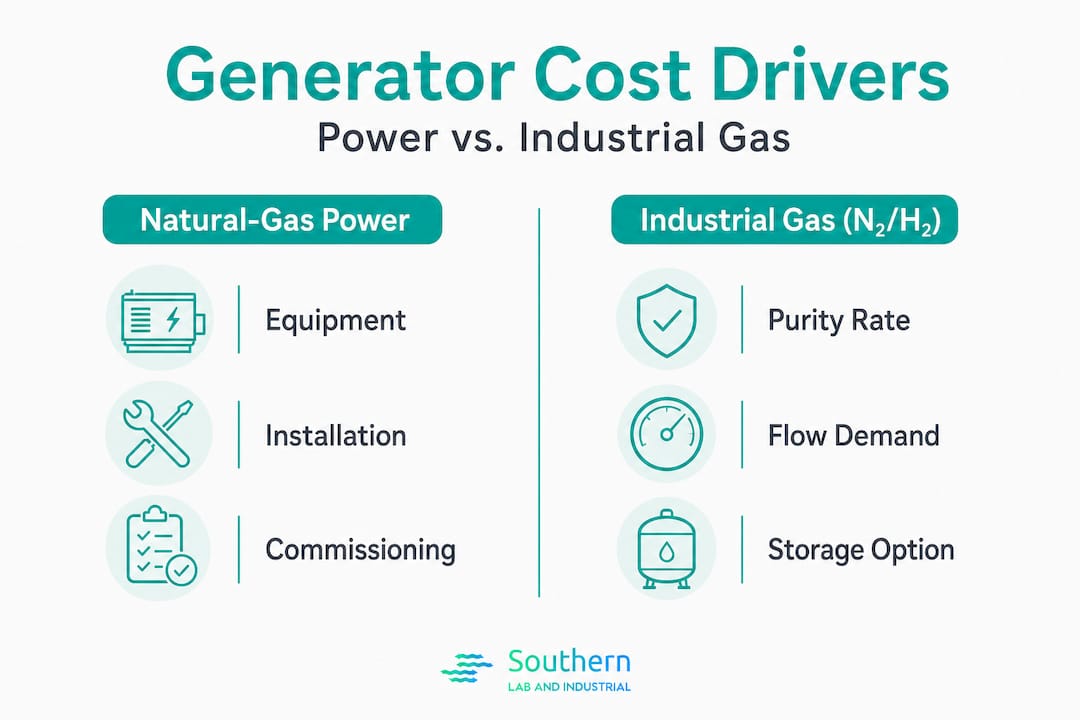
For industrial gas generators, the cost picture is shaped by purity requirements, flow demand, and whether you need a continuous-duty or demand-based system. A nitrogen generator for a modest analytical lab might cost $8,000 to $25,000 installed. A high-flow nitrogen system for tank blanketing or modified atmosphere packaging can run $50,000 to $200,000. Hydrogen systems for laboratory GC applications sit on the lower end; industrial-scale hydrogen systems for fueling or process use are a completely different budget category.
Operating costs for industrial power generation account for 50% of the total cost of generation over the asset’s life, and natural-gas pricing alone can account for 80% of OpEx for fuel-based systems. That ratio clarifies why locking in favorable gas supply contracts and modeling fuel price scenarios is not optional for power generation projects.
Steps for accurate cost estimation:
- Define the output specification precisely: purity grade, flow rate, pressure, and duty cycle.
- Separate equipment cost from installation cost. Request a fully installed quote, not just hardware pricing.
- Identify the utility inputs required: electrical service capacity, compressed air supply, water cooling if applicable.
- Estimate annual consumable costs: filters, desiccant, membranes, or electrolyzer stack replacement intervals.
- Model OpEx over a 5 and 10-year horizon using conservative and optimistic fuel or power price assumptions.
- Calculate payback period against your current cylinder supply spend, including all delivery, rental, and demurrage fees.
Pro Tip: Budget a minimum of 15% above your installed equipment quote for commissioning, staff training, and first-year consumables. Facilities that skip this buffer consistently experience budget overruns in the first 12 months.
| Cost component | Natural-gas power generator | Industrial gas generator (N₂/H₂) |
|---|---|---|
| Equipment hardware | $3K to $26K (standby) | $8K to $500K+ |
| Installation and civil work | 50% to 200% of equipment cost | 20% to 75% of equipment cost |
| Annual fuel/power | High, fuel price sensitive | Moderate, electricity cost drives |
| Maintenance contract | 2% to 5% of CapEx/year | 3% to 8% of CapEx/year |
| Permitting and compliance | Medium to high | Low to medium |
Explore dedicated nitrogen generators if your primary need is inert gas supply, or review industrial H2 fueling options if hydrogen production at scale is your target application.
Selecting and sizing gas generation systems for specific applications
Budget in hand, the next critical step is picking a system sized and designed for your real operational needs. Getting this wrong is expensive in both directions: an undersized system causes production interruptions, while an oversized unit delivers poor return on capital and elevated power consumption per unit of gas produced.
Key questions to determine proper sizing and selection:
- What is your peak simultaneous demand in liters per minute or SCFH? Not your average, your peak.
- What purity grade does the most demanding instrument or process require?
- Is demand continuous, shift-based, or intermittent? This determines whether you need on-board storage buffer or not.
- What are the pressure requirements at the point of use, and how far is the generator from that point?
- Does your application mix instruments with different purity needs, and can they share a common header?
- What are your local safety code requirements for hydrogen storage and ventilation?
For analytical laboratory settings, hydrogen generators for GC are a well-established replacement for high-pressure cylinders. These units generate carrier gas or fuel gas on demand, eliminating stored hydrogen volumes and reducing risk. They connect directly to GC and GC-MS instruments and maintain consistent purity throughout the day regardless of cylinder pressure variations, which is a real analytical advantage.
It is critical, however, to understand what these units are not. Ultra-high-purity hydrogen generators for GC/GC-MS are compact analytical instruments with built-in monitoring and safety systems, but they are not utility-scale systems. Flow rates are measured in tens to low hundreds of milliliters per minute. You cannot use a GC lab hydrogen generator to supply a hydrogen fueling station, a production reactor, or a fuel cell test stand. The engineering, safety certification, and pressure ratings are categorically different. For those needs, consult fuel cell hydrogen generator solutions designed for higher-flow, continuous-duty industrial environments.
Safety notice: Hydrogen systems at any scale require site-specific hazard assessment, proper ventilation design, gas detection, and compliance with NFPA 2 (Hydrogen Technologies Code). Never assume that a system rated for one application can be repurposed for another without a formal engineering review.
Pro Tip: Don’t substitute a lab-scale hydrogen or nitrogen generator for industrial-scale demand, even temporarily. Under-pressure operation degrades instrument performance, and running a unit at 150% of rated flow accelerates component wear dramatically, often voiding the warranty and shortening stack life by 30% to 50%.
Reviewing a lab consumables workflow guide and a lab consumables checklist can help procurement teams ensure that gas generation selection is integrated into the broader consumables procurement strategy, preventing gaps between instrument needs and supply.
Budgeting for facility-scale gas generation in production processes
When generation goes beyond support gas and powers production, like a methanol plant using natural gas as feedstock, the budgeting framework expands significantly. Here’s how to map it out:
Production-scale gas generation is not an equipment purchase. It is a capital project. The methanol-from-natural-gas economic model illustrates this well: capital investment and daily production costs must both be modeled with detailed breakdowns of capital and operating categories before a procurement decision can be made responsibly.
Capital investment categories for facility-scale projects:
- Fixed capital: direct plant equipment, instrumentation, piping, electrical, and civil work
- Outside Battery Limits (OSBL) capital: utilities infrastructure, feedstock interconnects, storage, safety systems
- Contingency: typically 10% to 20% of fixed capital for scope growth and cost estimation uncertainty
- Commissioning and startup costs: often underestimated, covering trial runs, process optimization, and initial catalyst or reagent loads
Daily production cost components:
- Raw materials: feedstock gas cost per unit of output
- Utilities: electricity, cooling water, steam, compressed air
- Operating charges: labor, supervision, quality control
- Plant overhead: maintenance, insurance, administrative allocation
- Depreciation: amortizing fixed capital over asset life, typically 10 to 20 years
Steps for facility-scale gas generation budgeting:
- Commission a pre-FEED (Front End Engineering Design) study to define scope and produce Class 4 or Class 3 cost estimates.
- Itemize fixed and OSBL capital separately, and apply location factors for Gulf Coast construction costs, which tend to run 10% to 15% above national averages due to labor market and logistics conditions.
- Develop a sensitivity model that shows total project NPV (net present value) under at least three natural-gas price scenarios: current, plus 20%, and minus 20%.
- Include a detailed working capital estimate for first-fill chemicals, spare parts, and initial inventory.
- Establish a contingency reserve based on project maturity, ranging from 10% at FEED completion to 30% at conceptual stage.
- Validate production cost assumptions against current market benchmarks before presenting to finance.
The difference between a utility gas project (nitrogen for blanketing) and a production gas project (methanol synthesis) is not just scale. It is organizational complexity, regulatory exposure, and the number of stakeholders involved. Procurement officers who treat production gas projects as large equipment purchases consistently underestimate timeline and risk.
The uncomfortable truth nobody tells you about gas generation budgets
With technical and economic steps covered, let’s shift to a perspective most procurement guides miss.
Most gas generation projects that go over budget do not fail because of bad equipment choices. They fail because of overoptimistic assumptions baked into the original model, specifically around utilization and fuel prices.
Here is the reality: a system that runs at 60% utilization does not cost 60% of what a fully utilized system costs. Fixed costs, depreciation, and maintenance are largely independent of output. That means your cost per unit of gas produced rises sharply when demand falls below nameplate assumptions. Economic sensitivity analysis consistently shows that the overall economics of on-site gas and power generation are highly sensitive to both utilization rates and fuel price assumptions, and that budgetary comparisons must be conducted across realistic operating profiles, not theoretical maximums.
Procurement teams often size systems to peak projected demand, then present economics based on running at that peak 85% of the time. When actual utilization lands at 55%, the payback period can double. When natural-gas prices move 25% in a single quarter, as Gulf Coast facilities have experienced more than once in the past decade, OpEx models built on stable price assumptions become fiction.
The second hidden risk is the appeal of cookie-cutter packages. Vendors who offer pre-configured bundles based on nominal flow rates often underspecify the balance-of-plant: inadequate buffer storage, insufficient dryer capacity, or undersized electrical service. These gaps surface during commissioning at the worst possible time.
Our recommendation for hydrogen generator and nitrogen system planning: always model costs using your actual recorded utilization data, not nameplate capacity. If you do not have 12 months of consumption data, use 70% utilization as your base case and sensitivity test down to 50%.
Pro Tip: Request that vendors provide cost-per-unit-output figures at 50%, 70%, and 100% utilization. A vendor who cannot produce this table is not equipped to support a defensible budget submission.
Explore tailored gas generation solutions for your facility
If you’re ready to apply these principles and boost operational efficiency, here’s where to start.
Whether your facility runs sensitive analytical instruments or high-demand industrial processes, the right on-site generation system eliminates cylinder dependency and delivers measurable cost control. The challenge is matching equipment to your actual operating profile, not a generic specification.
Our team specializes in exactly that kind of match. Explore lab gas generator solutions for GC, ICP, FTIR, and LCMS applications, or review industrial hydrogen generator options for larger-scale or specialty production needs. Facilities running bioprocessing operations can find purpose-built incubator and bioreactor gas systems designed for precise atmosphere control. Reach out to our Gulf Coast specialists to discuss your flow rates, purity requirements, and budget parameters. We provide turnkey installation, local technical support, and ongoing maintenance to ensure your system performs at specification from day one.
Frequently asked questions
What is the typical cost range for a facility natural-gas generator installation?
Installed natural-gas generator systems usually run between $3,000 and $26,000 for the generator unit itself, but installation and related costs can dramatically increase the total, sometimes tripling the initial equipment price.
How does on-site industrial gas generation improve operational efficiency?
Generating gas on-site reduces cost, increases reliability, and eliminates the logistical hassles of cylinder delivery and storage. On-site industrial gas generation also removes the budget volatility that comes from vendor pricing changes and emergency delivery fees.
Can ultra-high-purity hydrogen generators for GC applications supply production-scale hydrogen?
No. GC-grade hydrogen generators are compact analytical units with output measured in milliliters per minute and cannot be used for utility-scale or industrial hydrogen supply under any configuration.
What is the biggest budgeting mistake when planning a gas generation facility?
Underestimating operating costs is the most common failure. Operating costs can represent 50% of lifetime generation costs, and natural-gas price swings alone can account for 80% of OpEx, making unrealistic fuel price assumptions a critical budget risk.
Recommended
- Laboratory Gas Generators | Hydrogen, Nitrogen & Zero Air | Southern Laboratory and Industrial
- Nitrogen Generator vs Gas Cylinders: Total Cost of Ownership | SLI Houston
- On-Site Industrial Hydrogen Generation | Nel PEM Electrolyzers | SLI Houston
- Hydrogen Generators for Fuel Cell Testing & R&D | SLI Houston