Last updated August 19, 2026 · Reviewed by Kris Andaur, Founder & President, Southern Laboratory and Industrial
Many labs and industrial sites along the Gulf Coast are quietly overpaying for gas supply, not because their vendor rates are unusually high, but because cylinder-based contracts carry a layer of costs that rarely appear on the original quote. Residual gas left in returned cylinders, recurring delivery surcharges, cylinder rental fees, and the real but underreported cost of a supply outage add up faster than most procurement budgets account for. This article breaks down how generator and cylinder contracts actually compare across cost structure, safety profile, and operational reliability, so your facility can make a fully informed decision rather than a default one.
Table of Contents
- How generator contracts differ from cylinder supply agreements
- Cost comparison: Total cost of ownership for generators vs cylinders
- Safety, risk, and supply continuity: Operational factors
- Maintenance and reliability: What labs and facilities must plan for
- Technical selection: PSA vs membrane generators and purity needs
- Why conventional gas supply contracts miss the mark for modern labs
- Find your optimal gas supply solution with SLI
- Frequently asked questions
Key Takeaways
| Point | Details |
|---|---|
| Contract cost differences | Gas generator contracts shift focus to ownership and predictable costs, while cylinder contracts incur hidden fees. |
| Safety and reliability | Generators minimize high-pressure risks and supply outages compared to cylinders. |
| Maintenance planning | Regular maintenance is essential for generators—budget for service intervals to prevent downtime. |
| Technical selection | Purity needs and capacity requirements should drive generator technology choice for labs. |
| SLI solutions | SLI offers a range of gas generator solutions and expert support to optimize laboratory supply systems. |
How generator contracts differ from cylinder supply agreements
The procurement logic behind gas cylinders is familiar and comfortable. You sign a supply agreement, cylinders arrive on a schedule, and you pay per unit delivered plus rental on the cylinders themselves. That model works at small scale and low volume, but it introduces a set of dependencies that grow more expensive as your facility’s gas consumption increases.
PSA generators shift the agreement from commodity delivery and rental terms to a capital expenditure (CAPEX) model paired with predictable utility and maintenance costs. You purchase or finance the equipment, connect it to a compressed air supply, and generate gas on demand at your own facility. The contract structure changes from a repeating variable expense to a manageable fixed asset.
Here is how the two supply models compare at a structural level:
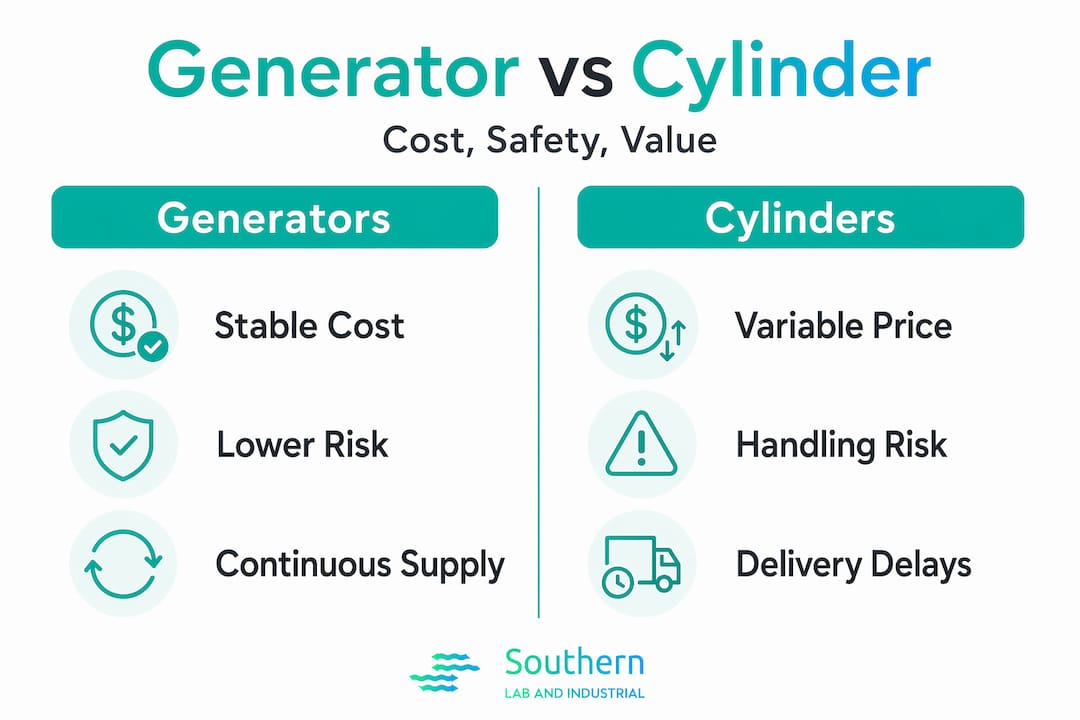
| Factor | On-site gas generator | Cylinder supply contract |
|---|---|---|
| Primary cost model | CAPEX + utilities + maintenance | Recurring rental + refill + delivery |
| Supply control | Fully independent | Dependent on vendor schedule |
| Price stability | High, predictable | Exposed to market fluctuations |
| Delivery logistics | None required | Regular vendor coordination |
| High-pressure storage | Minimal | Required on-site |
| Residual gas loss | None | Present in every returned cylinder |
| Outage risk | Low (generator dependent) | Delivery delay or vendor disruption |
Key structural differences worth noting:
- Generator contracts involve local equipment ownership, predictable running costs tied to electricity rates, and periodic planned maintenance.
- Cylinder contracts carry ongoing rental charges, delivery surcharges, and price volatility tied to the bulk gas market.
- Supply independence from a generator means your GC, LCMS, or ICP instruments keep running even when a delivery is delayed or a route is disrupted.
- High-pressure cylinder storage requires designated safe zones, safety training, and regulatory compliance that generators avoid entirely.
For facilities managing a full lab gas solutions portfolio, the structural shift from cylinders to generators also reduces the administrative overhead of tracking cylinder inventories, managing return logistics, and reconciling delivery invoices.
“PSA generator contracts are not the same as cylinder contracts. They shift the agreement from commodity delivery and rental terms to CAPEX plus predictable utilities and maintenance, while improving supply availability.”
For facilities running industrial hydrogen generation, the same principle applies at an even larger scale, where hydrogen cylinder logistics carry added regulatory weight.
Cost comparison: Total cost of ownership for generators vs cylinders
With contract structures clarified, the more important question is what each option actually costs over a three to five year horizon. Upfront generator pricing looks large on a capital budget request. But the total cost of ownership (TCO), which accounts for all costs over the equipment’s useful life, almost always favors the generator for moderate to high consumption facilities.
PSA generators offer cost stability by avoiding bottled and bulk gas price fluctuations, reducing logistics costs, minimizing storage risks, and eliminating residual gas losses from returned cylinders. Each of those items represents a real line item that cylinder users pay regularly without always identifying it as avoidable.

Key cost drivers for each option:
| Cost category | Generator | Cylinders |
|---|---|---|
| Initial capital | High (equipment purchase) | Low (deposit on cylinders) |
| Monthly running cost | Electricity + scheduled maintenance | Rental + refill + delivery fees |
| Residual gas losses | Zero | 5 to 15% of purchased gas |
| Price volatility exposure | None | Linked to bulk gas market (BLS Producer Price Index, industrial gases, 2026) |
| Downtime cost | Planned maintenance only | Delivery delay, outage exposure |
| Long-term cost trend | Stable or declining | Rising with demand and inflation |
Follow these steps to calculate your facility’s real cost:
- Pull 12 months of cylinder invoices. Include all line items: gas fill, cylinder rental, hazmat fees, and delivery surcharges.
- Estimate residual loss. Ask your vendor what the typical residual percentage is at return, or weigh returned cylinders. Five percent is conservative for nitrogen; some facilities run higher.
- Add downtime cost. Calculate the hourly cost of an instrument sitting idle during a delivery delay or missed schedule. For a single GC or LCMS, this number often exceeds $500 per hour when labor and missed throughput are counted.
- Get a generator quote with installation included. Compare the annualized capital cost plus electricity and maintenance against your cylinder spend.
- Calculate the payback period. Divide the net generator investment by the annual savings. For mid to high consumption labs, payback periods of 18 to 36 months are common.
Pro Tip: Request an itemized invoice from your current cylinder vendor before any generator evaluation meeting. The itemized breakdown almost always reveals fees that are easy to reduce or eliminate with on-site generation.
A nitrogen generator cost analysis specific to your consumption rate and purity requirements will sharpen this comparison considerably and give your procurement team concrete numbers to defend internally.
Safety, risk, and supply continuity: Operational factors
Moving from cost to safety, the differences between generators and cylinders are not subtle. High-pressure cylinder storage introduces a class of risk that on-site generators eliminate at the source.
Generators reduce high-pressure cylinder storage risks, avoid boil-off losses from liquid tanks, eliminate unused residual gas loss from returned cylinders, and ensure a continuous gas supply without dependence on delivery schedules. Each of those benefits maps directly to a real safety or reliability outcome.
Operational safety and continuity benefits of generators:
- No high-pressure storage vessels in the lab or facility. Compressed air at standard line pressure feeds the generator, which produces gas at working pressure only.
- No cylinder handling injuries. Cylinder movement, cap removal, and connection are among the most common sources of gas-related lab accidents. Generators eliminate this activity entirely.
- No supply outages from missed deliveries. Scheduled deliveries can be disrupted by weather, route changes, or vendor logistics problems. Gulf Coast facilities are particularly familiar with weather-related supply chain disruptions.
- No boil-off loss from liquid nitrogen tanks. Facilities using liquid supply systems lose a percentage of product continuously through venting, a cost that is easy to overlook on monthly statements.
- Residual gas loss is eliminated. Every returned cylinder contains gas that was paid for but not used. Over a year, this adds up to a meaningful percentage of total gas spend.
Pro Tip: Map every supply point in your facility, including instruments, storage areas, and connection stations. Identify which points are most vulnerable to a supply interruption, and use that map to size a generator correctly for continuous coverage.
For facilities managing CO2 or gas supply to biological systems, the same safety logic applies. Stable, safe lab gas supply for incubators and bioreactors depends on uninterrupted flow at validated purity, something cylinder-based supply cannot guarantee with the same consistency.
Regulatory note: Many Gulf Coast facilities operate under EPA, OSHA, and local fire marshal rules that govern on-site storage of compressed gases (NFPA 55, 2023 edition). Reducing cylinder inventory often simplifies compliance and can lower insurance premiums.
Maintenance and reliability: What labs and facilities must plan for
Generators are not zero-maintenance systems. Understanding the maintenance schedule before purchase is essential for accurate budgeting and for avoiding the performance failures that follow neglected service.
Proper generator maintenance is essential: missing service intervals can lead to gas contamination or unplanned downtime, and air compressor rebuilds are required every 8,000 to 12,000 hours of operation. That translates to roughly three to five years of continuous service for most labs, but the interval depends on usage intensity and ambient conditions.
Key maintenance tasks to plan for:
- Air compressor service: Oil changes, filter replacement, and rebuild at the 8,000 to 12,000 hour interval. Compressor neglect is the most common cause of generator failure.
- Inlet air filter replacement: Dirty inlet filters reduce flow and force the compressor to work harder. Replace on schedule, more frequently in dusty industrial environments.
- Desiccant or sieve replacement: PSA generators use molecular sieve material to separate nitrogen. Sieve degradation reduces purity and must be caught early through regular purity monitoring.
- Output purity verification: Use an inline oxygen analyzer to confirm purity is within specification. Do not rely solely on the generator’s internal sensors.
- Outlet filter checks: Downstream filters protect instruments from particulates. Verify condition at each service interval.
Pro Tip: Set calendar reminders for every maintenance task at the time of installation, not when the first service is due. Build the schedule into your facility’s preventive maintenance system so it is never a surprise budget item.
“Missing service on a lab gas generator can lead to contamination or downtime. Air compressor rebuilds are required every 8,000 to 12,000 hours, and preventive maintenance is the single most effective way to protect your investment.”
For facilities running LCMS or UHPLC instruments, gas purity failures caused by deferred generator maintenance practices can corrupt analytical results without triggering an obvious instrument alarm. The cost of rerunning samples, or worse, reporting inaccurate data, far exceeds the cost of the missed service.
Facilities with fuel cell testing or other demanding applications should also build a service schedule for generators into their annual operating plan, with vendor support agreements in place before the equipment is commissioned.
Technical selection: PSA vs membrane generators and purity needs
Before finalizing any contract or purchase decision, the generator technology itself must match your purity and capacity requirements. Choosing the wrong technology is a costly mistake that impacts both performance and total cost.
PSA technology is designed for very high purity and continuous high-capacity nitrogen output, while membrane systems may be suitable for lower purity needs. Purity requirements should drive generator technology selection, and that choice directly affects both CAPEX and OPEX.
Comparing the two primary technologies:
PSA (Pressure Swing Adsorption) generators:
- Purity range: 95% to 99.999% nitrogen
- Best for: GC, LCMS, ICP, FTIR, and other analytical instruments with strict purity requirements
- Higher upfront cost, but matches demanding applications without compromise
- Suitable for continuous high-volume production
- PSA vs membrane technologies comparison confirms PSA as the standard for lab-grade purity
Membrane generators:
- Purity range: typically 90% to 99% nitrogen
- Best for: blanket gas, purging, fire suppression, tire inflation, and other industrial uses where ultra-high purity is not required
- Lower CAPEX, simpler maintenance, but purity ceiling limits application
- Not recommended for most analytical instrument applications
Capacity planning: Size the generator for peak demand plus a safety margin of 15 to 20%. Undersized generators run at full load constantly, accelerating compressor wear.
Application matching: For ICP and ICP-MS applications, purity requirements are non-negotiable. PSA is the correct technology, and the generator specification must be confirmed against the instrument manufacturer’s requirements before purchase.
Purity targets drive the technology decision. Get those specifications from your instrument vendor first, then use them to anchor the generator specification.
Why conventional gas supply contracts miss the mark for modern labs
Most procurement teams arrive at cylinder contracts through familiarity, not analysis. The cylinder model is established, the vendor relationships are in place, and the invoices are manageable enough that the full cost picture never gets scrutinized. That is exactly where facilities lose money year after year.
The real problem is not that cylinders are inherently bad. It is that the cylinder model was designed for occasional, low-volume use, and many labs have scaled far beyond that baseline without revisiting the economics. When nitrogen consumption crosses a threshold where cylinders are arriving weekly or more frequently, the logistics overhead alone justifies a serious generator evaluation.
What we see consistently is that labs underestimate the cost of supply disruption. A missed delivery that shuts down a GC for a day is not just a gas cost problem. It is a throughput problem, a labor problem, and potentially a customer commitment problem. These costs are real and they do not appear on a cylinder invoice.
The generator model also changes the facility’s risk posture in ways that matter to safety officers and insurers. Fewer high-pressure vessels on-site, reduced handling activity, and a continuous supply chain that does not depend on a third-party delivery schedule all reduce exposure. Some facilities on the Gulf Coast have discovered this in the hardest way possible, during hurricane season, when cylinder deliveries are delayed or suspended and instruments go dark.
Procurement teams that factor in only the line-item gas cost are comparing a partial picture. The sample evaporation gas generator use case is a good example: facilities running high-throughput evaporation workflows cannot afford the variability that cylinder supply introduces into their daily operations.
The transition to a generator is a capital decision, not just a supply decision. Framing it that way internally is often the key step that unlocks proper budget review and approval.
Find your optimal gas supply solution with SLI
The cost, safety, and operational evidence points in one direction for most Gulf Coast labs and industrial facilities running moderate to high gas volumes. The question is not whether a generator makes sense, it is which configuration fits your specific instruments, purity requirements, and budget structure.
SLI offers a full range of on-site gas generators for nitrogen, hydrogen, and zero air, backed by turnkey installation, local technical support, and ongoing maintenance agreements designed for Gulf Coast facilities. Explore the complete lab solutions portfolio to see application-specific options, or review the nitrogen generator product options to match generator specifications to your instruments. For biological applications, the gas supply for incubators section covers validated solutions for CO2 and nitrogen in life science environments. Contact SLI directly to get a facility-specific cost comparison and start the transition from cylinder dependency to on-site generation.
Frequently asked questions
What are the main differences between generator and cylinder contracts?
Generator contracts are based on owning equipment with predictable utility and maintenance costs, while cylinder contracts rely on ongoing rental, refill, and delivery fees. As the Atlas Copco explainer on PSA nitrogen generators notes, PSA generators shift the agreement from commodity delivery and rental terms to CAPEX plus predictable utilities and maintenance.
How much does maintenance cost for a lab gas generator?
Annual maintenance kits, filter replacements, and periodic compressor rebuilds are the primary costs, with major compressor service required every 8,000 to 12,000 hours. According to Lab Manager’s purchasing guide, preventive maintenance is critical to avoiding contamination and unplanned downtime.
What are the safety benefits of installing a generator instead of cylinders?
Generators eliminate high-pressure cylinder storage and handling risks, remove the threat of supply outages from missed deliveries, and avoid residual gas losses from returned cylinders. The Atlas Copco PSA nitrogen resource confirms that generators also prevent boil-off losses from liquid nitrogen tanks.
How do I choose between PSA and membrane generator technology?
PSA generators are the correct choice for high-purity, continuous supply applications like GC, LCMS, and ICP instruments, while membrane generators serve lower-purity industrial uses. Purity requirements from your instrument manufacturer should drive the selection, as noted in Atlas Copco’s PSA generator explainer.