Laboratory managers who assume their on-site gas generator automatically delivers ultra-high-purity gas are often surprised when an analytical instrument flags a contamination event or detector baseline drift appears without warning. The output purity of a gas generator is not a fixed property of the machine itself. It depends critically on a component that frequently gets overlooked during procurement: the purification column. Understanding what this component is, how it operates, and how to specify it correctly is one of the most important decisions you will make for long-term analytical reliability and total cost of ownership.
Table of Contents
- What is a gas generator purification column?
- How purification columns work: Media, mechanisms, and designs
- Critical considerations for specifying and operating purification columns
- Nuances and alternatives: Membranes vs. adsorption towers
- A practical perspective: What most procurement teams miss about purification columns
- Explore high-purity gas generator solutions with SLI
- Frequently asked questions
Key Takeaways
| Point | Details |
|---|---|
| Essential for purity | The purification column is critical to removing moisture, oxygen, and contaminants from gas generator output. |
| Multiple technologies exist | Columns can use adsorbent media for adsorption or membranes for selective gas separation. |
| Careful specification is vital | Matching purifier design and operation to your system’s flow and contaminant profile ensures reliable, high-purity gas. |
| Upstream filtration matters | Pre-treating feed gas protects purification columns from rapid media exhaustion and purity loss. |
What is a gas generator purification column?
Gas generators are often sold on headline purity figures, but those figures are only achievable under specific conditions. The purification column is the hardware that bridges the gap between raw generator output and the actual purity level your instruments require.
A purification bed or tower is a purpose-built component positioned inside or directly downstream of an on-site gas generator. It contains a selective adsorbent medium that removes specific impurities from either the feed gas entering the generator or the product gas leaving it. Depending on the system design, a single column or a series of columns may be used to strip moisture, oxygen, carbon dioxide, and trace hydrocarbons down to the parts-per-million or parts-per-billion levels required by sensitive instruments.
The range of applications is broad. Purification columns are essential in:
- Gas chromatography (GC) and LC-MS systems, where carrier gas purity directly affects detector sensitivity and column life
- ICP and ICP-MS spectrometry, where argon or nitrogen purge gas must meet strict purity thresholds
- FTIR analyzers, which are highly sensitive to CO2 and water vapor
- Zero air generators, where residual hydrocarbons must be eliminated entirely
- Industrial production processes, where product contamination from carrier gas impurities is unacceptable
For an introduction to how these components fit within broader lab gas generator basics, it helps to treat the purification column as the quality control stage in an otherwise mechanical process. The generator produces gas; the purification column refines it.
“A gas generator purification column is a purification bed/tower inside, or used alongside, an on-site gas generator that removes specific impurities from the generator’s feed gas or from the generated product gas, so the output meets higher-purity requirements for analytical instruments and industrial processes.”
Without a properly specified and maintained purification column, even the most sophisticated PSA nitrogen generator will fall short of the purity levels required for trace-level analytical work.
How purification columns work: Media, mechanisms, and designs
The performance of a purification column is rooted in two core processes: adsorption and regeneration. Understanding both will help you evaluate vendor claims and make better procurement decisions.
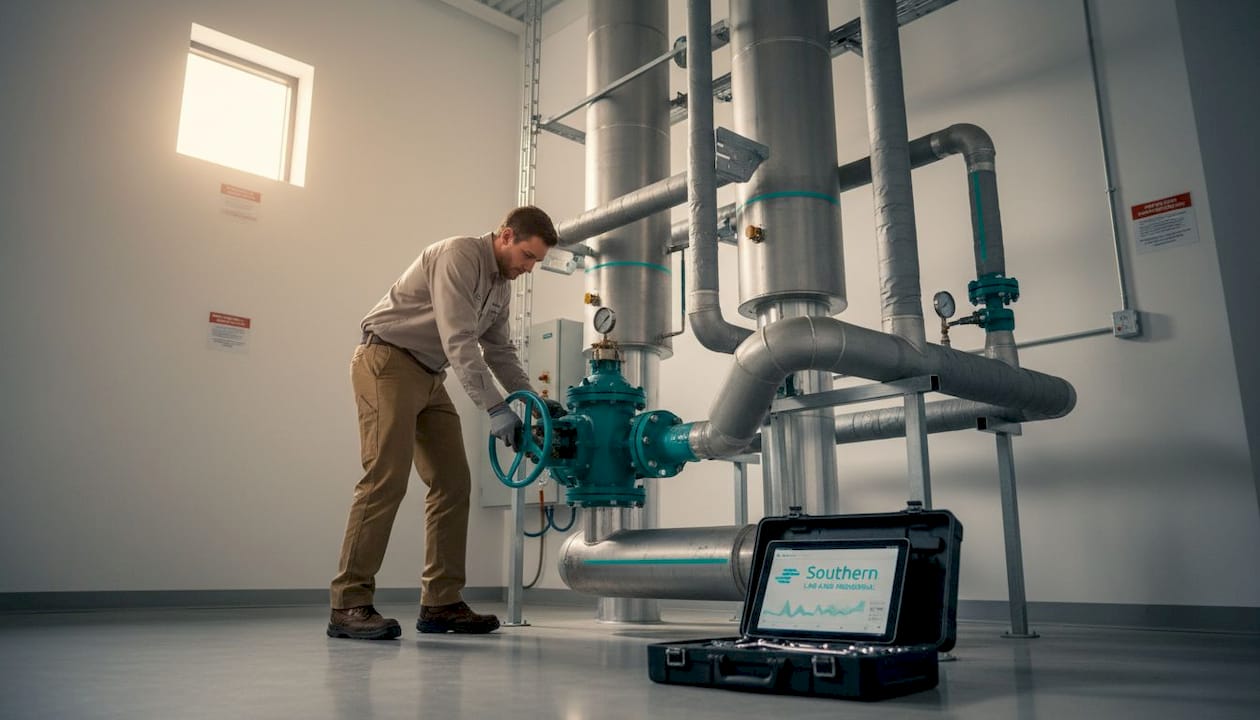
Adsorption is the process by which gas-phase impurities bond to the surface of a solid adsorbent medium as the gas flows through the column. Different media have different affinities for different contaminants. Molecular sieve materials, for example, are highly effective at capturing water vapor and CO2 based on molecular size exclusion. Activated carbon beds excel at removing organic vapors and trace hydrocarbons. Specific metal oxide catalysts can oxidize residual hydrocarbons into CO2 and water, which are then captured downstream.
In PSA-based nitrogen generators, the column cycle works as follows:
- Adsorption phase: Feed gas is pressurized through the active column. The adsorbent medium captures target impurities as the gas passes through, and high-purity product gas exits the column outlet.
- Saturation approach: As the medium approaches capacity, breakthrough of impurities can occur if the cycle is not switched in time. Monitoring systems or timed switching prevents this.
- Depressurization: Pressure in the column is reduced, releasing the captured impurities into the exhaust stream and beginning the regeneration cycle.
- Regeneration: The column purges the desorbed impurities and returns to its original adsorption capacity.
- Re-pressurization: The column is brought back to operating pressure, ready for the next adsorption cycle.
For continuous flow applications, a dual-tower design is the standard solution. While one tower adsorbs, the other regenerates, ensuring uninterrupted high-purity gas delivery. This is particularly critical in zero air and high-purity nitrogen applications where even brief purity excursions can invalidate results.
The table below summarizes the most common adsorbent media, the impurities they target, and their typical applications:
| Adsorbent medium | Primary impurities removed | Typical application |
|---|---|---|
| Molecular sieve (3A, 4A, 5A) | Water vapor, CO2 | Nitrogen generation, GC carrier gas drying |
| Carbon molecular sieve (CMS) | Oxygen, nitrogen separation | PSA nitrogen generators |
| Activated carbon | Hydrocarbons, VOCs | Zero air generation, hydrocarbon polishing |
| Alumina (activated) | Moisture, HF traces | Multi-stage systems, pre-treatment beds |
| Metal oxide catalyst | Residual hydrocarbons (catalytic oxidation) | Zero air, ultra-high-purity applications |
For TOC analyzer gas purification, the combination of activated carbon and molecular sieve beds is common because these instruments are sensitive to both organic contaminants and moisture.
Pro Tip: Always match your adsorbent media selection to the specific contaminant profile of your incoming feed gas, not just the target outlet purity. A system optimized for moisture removal will not address residual hydrocarbons without an additional stage.
Critical considerations for specifying and operating purification columns
Grasping how purification columns work is just the starting point. Managers must also understand the operational realities that can make or break system performance over a multi-year deployment.
One of the most frequently overlooked factors is flow rate matching. Purifier performance depends directly on contact time, which is the duration each volume of gas spends in contact with the adsorbent medium. If flow rate exceeds the column’s design capacity, contact time drops and the medium cannot fully capture target impurities. The purifier may not reach advertised impurity-reduction levels, even under normal operating conditions, if the system is over-driven.
Impurity surges are another operational risk that procurement teams rarely factor into their specifications. A cylinder change, a compressor restart, or a sudden shift in ambient conditions can introduce a transient spike in moisture, oxygen, or particulates. These surges can temporarily overwhelm a single-stage purifier and allow contaminants to pass through to downstream instruments. Multi-stage purifier arrangements specifically address this risk by providing sequential removal layers.
Key operational and procurement considerations include:
- Minimum inlet quality requirements: Always request the maximum allowable inlet dew point, oxygen content, and particulate load from the vendor. If your feed air or source gas exceeds these thresholds, the purification column will saturate prematurely.
- Upstream filtration: Coalescing filters, particulate filters, and pre-dryers upstream of the purification column extend media life significantly. Without them, oil aerosols, water droplets, and particulates from a compressor can load the column in a fraction of its rated service life.
- Anticipated flow range: Specify minimum and maximum flow conditions, not just the nominal design point. Columns that perform well at rated flow may underperform at peak demand.
- Multi-stage arrangements: For ICP gas requirements and other high-sensitivity instruments, a two or three stage purification train protects downstream detectors from both steady-state and surge contamination.
- Service access: Modular column designs allow media replacement without system shutdown, reducing maintenance downtime. Confirm this before purchase.
Statistic callout: A purifier operating at two times its rated flow can see effective contact time drop by 50%, meaning impurity concentrations at the outlet may be significantly higher than the manufacturer’s specification under those conditions.
Pro Tip: Install multiple purifier stages in series when protecting high-value instruments. The first stage handles bulk removal, extending media life in the final stage, which is responsible for achieving your critical purity specification.
Nuances and alternatives: Membranes vs. adsorption towers
Not every gas generator uses a classical adsorption column for purification. Alternative technologies are in widespread use, and procurement teams that do not understand the distinction can end up with systems that do not meet their purity requirements for specific applications.
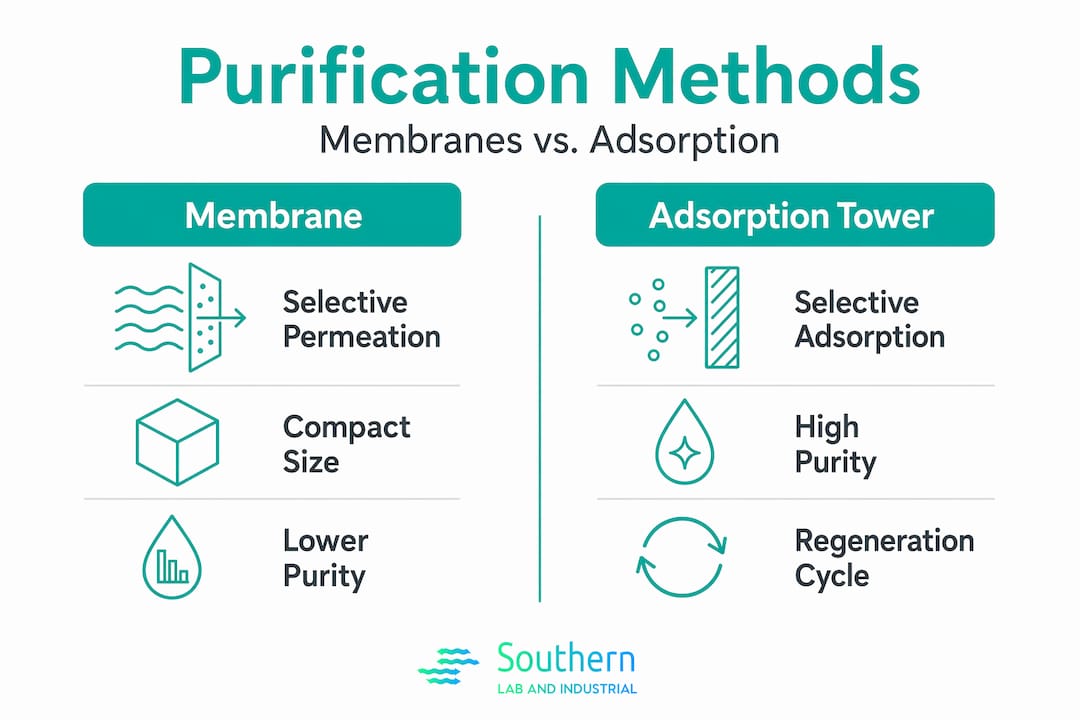
The key distinction is between adsorption-based purification and membrane-based purification. In adsorption systems, impurities are captured by a selective solid medium under pressure and periodically released during regeneration. In membrane systems, gas is separated by selective permeation through a hollow-fiber or flat-sheet membrane that allows certain molecules to pass faster than others. The term “column” is sometimes used loosely in membrane systems to describe the housing or stack arrangement, even though no adsorbent media is involved.
Buyers should confirm the specific technology in any system under evaluation. The distinction matters because:
- Achievable purity levels differ. PSA adsorption systems can routinely achieve nitrogen purities of 99.9995% or higher. Membrane systems typically top out at around 99.5% to 99.9% nitrogen purity, which is adequate for some applications but insufficient for GC carrier gas or LC-MS work.
- Maintenance profiles differ. Adsorption columns require periodic media replacement or regeneration. Membrane modules degrade gradually over time and may require full module replacement rather than media servicing.
- Pressure requirements differ. PSA systems require a pressurized feed air supply and generate waste gas during regeneration. Membrane systems have no regeneration cycle but are sensitive to feed pressure fluctuations.
| Feature | Adsorption tower (PSA) | Membrane module |
|---|---|---|
| Separation mechanism | Selective adsorption onto media | Selective molecular permeation |
| Maximum nitrogen purity | 99.9995% and above | Typically up to 99.9% |
| Maintenance requirement | Media replacement or regeneration | Module replacement on degradation |
| Continuous flow | Requires dual-tower configuration | Inherently continuous |
| Best suited for | GC, LC-MS, ICP, FTIR, zero air | General industrial, blanketing |
| Response to feed surges | Buffered by media capacity | More sensitive to feed variations |
For multi-stage purification in demanding industrial or analytical settings, adsorption-based systems are generally the preferred choice. Membrane systems offer simplicity and lower capital cost where the purity ceiling is acceptable.
Always clarify the purification technology with the vendor before finalizing a procurement decision. Asking specifically whether the system is PSA-based, membrane-based, or a hybrid will prevent costly mismatches between system capability and application requirements.
A practical perspective: What most procurement teams miss about purification columns
Having reviewed the technical and procurement factors in detail, there is a broader operational truth that deserves direct attention. Most specification errors involving purification columns are not caused by ignorance of the technology. They are caused by a disconnect between the vendor’s published specifications and the real-world conditions in which the system will operate.
Vendors routinely present headline purity figures measured under optimal laboratory conditions: controlled feed air quality, rated flow, stable temperature, and clean compressor output. What those figures do not capture is how the column behaves when your compressor is aging, when ambient humidity spikes during a Gulf Coast summer, or when a sudden instrument demand surge pushes flow beyond the design point. These are not edge cases. They are normal operating conditions in most industrial and analytical facilities.
The procurement oversight that causes the most damage in long-term deployments is neglecting upstream pre-treatment. Consider the evidence: insufficient pre-treatment such as oil aerosols, particulates, or elevated incoming dew point causes purification column media to load far faster than rated, reducing achievable purity well before the manufacturer’s stated service interval. Yet request for proposals in procurement cycles almost never ask vendors to specify inlet quality requirements or upstream filtration recommendations. They ask about outlet purity and price.
The practical recommendation here is straightforward. When evaluating a gas generator system, request three documents from every vendor: the inlet quality specification sheet, the recommended upstream pre-treatment configuration, and a maintenance schedule tied to actual field conditions rather than ideal laboratory conditions. If a vendor cannot provide all three, that is a meaningful signal about their long-term support capability.
Additionally, pre-treatment essentials should be budgeted into the total cost of ownership calculation from day one, not treated as optional accessories. A high-quality coalescing filter and pre-dryer upstream of your purification column can double the effective service life of the media, which translates directly to lower maintenance cost and more consistent purity over the system’s operational lifetime.
The bottom line from years of field experience in analytical and industrial gas generation: the purification column is only as good as the conditions it operates in. Procurement teams that evaluate the full system, including what goes into the column and not just what comes out, make better decisions and experience fewer costly surprises.
Explore high-purity gas generator solutions with SLI
Applying the principles in this guide requires not just the right knowledge but the right system and the right support behind it. For laboratory managers and procurement officers ready to move from analysis to action, SLI offers purpose-built solutions designed for the exact applications discussed here.
SLI’s portfolio of lab gas generators covers hydrogen, nitrogen, and zero air systems with advanced multi-stage purification technologies matched to analytical instrument requirements. Whether you are specifying a system for GC, LC-MS, ICP, or TOC analyzer gas solutions, SLI provides turnkey installation, pre-treatment configuration, and ongoing technical guidance. Local technical support along the Gulf Coast means your team has direct access to specialists who understand both the equipment and the operational environment. Reach out to discuss your facility’s gas purity requirements and get a system recommendation built around your actual inlet conditions and instrument demands.
Frequently asked questions
What impurities do purification columns typically remove?
Purification columns in gas generators commonly remove moisture, oxygen, CO2, and trace hydrocarbons to meet the purity thresholds required by analytical instruments such as GC, LC-MS, and FTIR systems.
How often does a purification column need maintenance or replacement?
Maintenance intervals vary based on actual operating flow rates and incoming feed gas quality. Because over-running a purifier reduces effectiveness, service schedules should be based on hours of use under your specific load conditions rather than calendar-based intervals alone.
Are all gas generator purification columns the same?
No. Technology and performance vary significantly. Some gas generators purify via membranes rather than adsorption towers, which limits achievable purity and changes the maintenance profile. Always confirm whether a system is PSA-based or membrane-based before purchasing.
Why is upstream filtration important in gas generator systems?
Upstream filtration prevents oil aerosols, particulates, and excess moisture from entering the purification column. When the generator is fed with insufficient pre-treatment, column media loads faster than rated, shortening service life and reducing achievable outlet purity.