When the hydrogen feeding your GC or ICP system runs out mid-analysis, the real problem is rarely the cylinder. It is the supply model. Electrolysis splits water into hydrogen and oxygen using electricity inside an electrolyzer, and for labs that need a continuous, high-purity gas source, understanding this technology at a working level is no longer optional. Electrolyzer hydrogen production explained correctly means going beyond the basic chemistry to understand which system type matches your instruments, your safety zone, and your budget reality.
Table of Contents
- Understanding electrolyzer technologies and how they produce hydrogen
- Efficiency, cost factors, and balance of plant considerations for electrolyzers
- Safety and purity monitoring for reliable hydrogen production in labs
- Choosing the right electrolyzer for your laboratory and industrial needs
- Maximizing efficiency and ensuring safe operation: practical tips for laboratory managers
- A laboratory manager’s perspective: why system-level thinking beats focusing only on electrolyzer stacks
- Explore efficient hydrogen production solutions with Southern Laboratory and Industrial
- Frequently asked questions
Key Takeaways
| Point | Details |
|---|---|
| Electrolyzer basics | Electrolysis uses electricity to split water into hydrogen and oxygen, producing clean hydrogen gas. |
| Technology comparison | PEM electrolyzers offer higher purity and pressure, while alkaline systems dominate in installed capacity and lower upfront costs. |
| Balance of plant impact | Non-stack components drive up to 60% of costs and affect energy efficiency significantly. |
| Safety monitoring | Flow and purity monitoring prevent dangerous gas crossover and maintain hydrogen quality in labs. |
| Practical selection tips | Choose electrolyzers considering purity, pressure, response time, footprint, and maintenance for your lab needs. |
Understanding electrolyzer technologies and how they produce hydrogen
The electrolysis process explained simply: apply a direct electrical current across two electrodes submerged in an electrolyte, and water molecules split. Hydrogen collects at the cathode. Oxygen collects at the anode. What differs between technologies is everything in between.
Proton exchange membrane (PEM) electrolyzers use a solid polymer membrane to conduct protons. PEM electrolyzers operate at 70 to 90°C and produce high-purity hydrogen at pressures between 30 and 34 bar, without a liquid electrolyte in the gas stream. That matters for labs because pressurized output reduces or eliminates the need for downstream compression.
Alkaline electrolyzers are the more established technology. Alkaline systems operate below 100°C using hydroxide ions carried through a liquid electrolyte, typically potassium hydroxide. They dominate installed capacity globally because they are well-understood, durable, and carry lower upfront stack costs. The trade-off is a slower dynamic response to power changes and lower output pressure.
Solid oxide electrolyzers operate at 700 to 800°C, using waste heat to improve electrical efficiency. They are promising for industrial-scale renewable hydrogen production but are not a practical choice for most lab environments because of thermal complexity and startup times.
Here is how the three main types compare across parameters relevant to lab and industrial operations:
| Parameter | PEM | Alkaline | Solid oxide |
|---|---|---|---|
| Operating temperature | 70 to 90°C | Below 100°C | 700 to 800°C |
| Output pressure | 30 to 34 bar | 1 to 30 bar | Atmospheric |
| Hydrogen purity | 99.999% | 99.5 to 99.9% | 99.9%+ |
| Dynamic response | Fast (seconds) | Slow (minutes) | Very slow |
| Maturity | Commercial | Mature | Early commercial |
| Best fit | Lab analytics, variable power | Large industrial base load | Waste heat recovery |
Key differences worth knowing before you request a quote:
- PEM systems are compact and suited for lab-scale hydrogen generators that sit on a bench or in a utility room
- Alkaline systems carry lower stack replacement costs over time but require more footprint
- Industrial PEM electrolyzers bridge the gap for facilities that need both analytical-grade purity and higher volume output
- Solid oxide adds complexity without a proportional benefit for most analytical lab use cases
Now that you know the basic electrolyzer types and how hydrogen is produced, let’s explore their efficiency and cost factors affecting lab operations.
Efficiency, cost factors, and balance of plant considerations for electrolyzers
Energy consumption is the number most vendors quote. The number that actually drives your operating costs is wider. Total electricity consumption for hydrogen production runs approximately 55 kWh per kilogram of hydrogen when you account for balance of plant energy use of 6 to 10 kWh/kg H₂ on top of the stack itself. That gap is where many lab managers get surprised after installation.
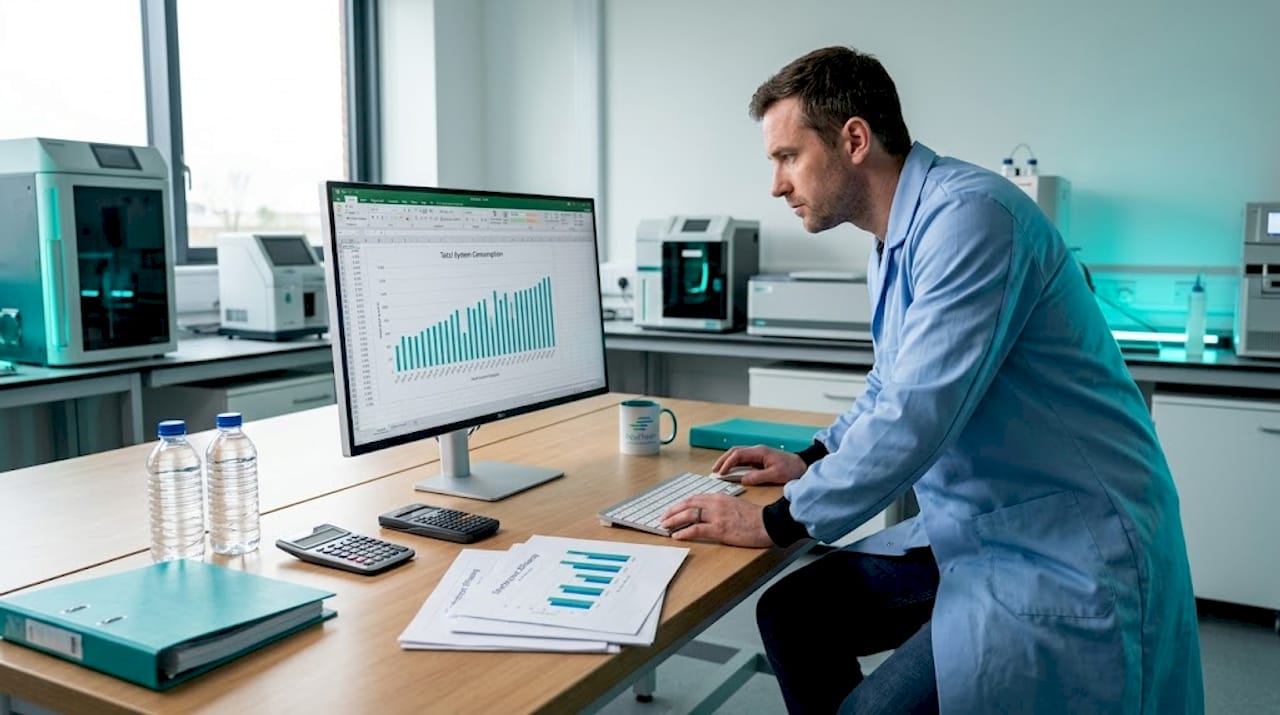
Balance of plant (BOP) refers to everything outside the electrolyzer stack: water purification, thermal management, power electronics, gas drying, compression, and storage. These subsystems are not passive. They consume energy, require maintenance, and degrade over time independently of the stack.
Here is the cost breakdown that changes how you should evaluate proposals:
| Cost component | Share of total CAPEX |
|---|---|
| EPC and civil works | 40 to 50% |
| Balance of plant | 40 to 60% of total PEM CAPEX |
| Electrolyzer stack | Approximately one-third |
EPC and civil works alone represent 40 to 50% of project cost. The stack, which most vendors lead with in their pitch, is only one-third. This is why comparing stack prices between vendors tells you very little about what you will actually spend.
Five cost and efficiency factors lab managers should evaluate before purchasing:
- Water quality input: Feed water must meet deionized standards. Poor water quality degrades membranes faster and raises operating costs over time.
- Power electronics quality: Inefficient rectifiers and power supplies create conversion losses that multiply across thousands of operating hours.
- Thermal management: Uncontrolled temperature swings degrade catalyst layers and reduce output consistency.
- Compression requirements: If the electrolyzer output pressure is too low for your instruments, you will pay for external compression. High-pressure PEM output can eliminate this cost.
- Drying and purification: Residual moisture in the hydrogen stream damages analytical detectors. BOP-integrated dryers are worth the capital cost upfront.
Pro Tip: When reviewing a proposal, ask the vendor to provide a full system energy audit including BOP losses, not just stack efficiency. The Levelized Cost of Hydrogen (LCOH) for PEM systems runs approximately 3.8 EUR/kg when BOP is accounted for correctly. If a proposal excludes BOP operating costs from the LCOH figure, the total cost of ownership will come in higher than projected.
Laboratory gas generators that integrate BOP subsystems into a single managed unit give you predictable operating costs and fewer moving parts to track. Pairing hydrogen generation with laboratory nitrogen generators on the same infrastructure also consolidates your gas management overhead. For a direct look at how on-site generation compares financially to cylinders, the generator cost comparisons page is worth reviewing before finalizing a capital request.
Having reviewed efficiency and cost factors, next we’ll examine operational safety considerations essential for labs producing hydrogen with electrolyzers.
Safety and purity monitoring for reliable hydrogen production in labs
Hydrogen is a small molecule that moves through materials other gases cannot. In a lab environment, that physical property creates specific risks that require deliberate monitoring protocols, not general gas safety guidelines.
Continuous monitoring of hydrogen and oxygen purity, flow rates, and temperatures is vital to detect gas crossover and membrane degradation. Gas crossover happens when hydrogen migrates through the membrane into the oxygen side or vice versa. At low levels it reduces purity. At higher concentrations it creates a flammable mixture inside the system.
The key monitoring requirements for PEM electrolyzer safety in labs:
- Purity sensors on both hydrogen and oxygen outlets, checked continuously, not on a scheduled basis
- Flow meters placed upstream of sampling points to catch imbalances that indicate membrane compromise before they become safety events
- Temperature monitoring at stack, BOP, and ambient levels to flag thermal excursions early
- Ventilation interlocks that activate automatically based on sensor readings, not manual checks
Critical compliance note: Hydrogen sensors placed at high room points activate ventilation below 1% concentration per IEC standards. Since hydrogen rises and pools at ceiling level, low placement of sensors will miss early accumulation entirely.
A membrane pinhole is not always an immediate catastrophe. It is a slow degradation event that compounds. Labs that skip purity trending data miss early warning signs until the problem requires a full membrane replacement, which carries both cost and downtime consequences. Proper hydrogen purity monitoring at the instrument level also protects your detectors from gas quality drift that would otherwise show up as unexplained analytical inconsistencies.
Pro Tip: Place a dedicated hydrogen sensor within 12 inches of the ceiling above your electrolyzer installation. This single addition, combined with an automatic ventilation interlock, satisfies IEC safety requirements and gives you a documented compliance record for facility inspections.
Industrial hydrogen safety protocols apply equally to labs. The concentration thresholds are the same whether you are running a GC fleet or a large-format industrial process.
With safety protocols established, let’s compare electrolyzer types to understand which best fit specific lab needs and operational constraints.
Choosing the right electrolyzer for your laboratory and industrial needs
The question is rarely “which electrolyzer is best.” It is “which electrolyzer fits what this lab actually needs.” Those are different questions, and the answer shifts significantly based on your instruments, your space, and your power supply situation.
Alkaline electrolyzers dominate with 64% of installed capacity globally, but that statistic reflects legacy industrial deployments, not analytical lab priorities. For most lab managers running GC, LCMS, FTIR, or ICP instruments, PEM systems achieve 99.999% hydrogen purity and operate at pressures up to 34 bar, which aligns directly with instrument gas specifications and reduces the compression infrastructure you would otherwise need.
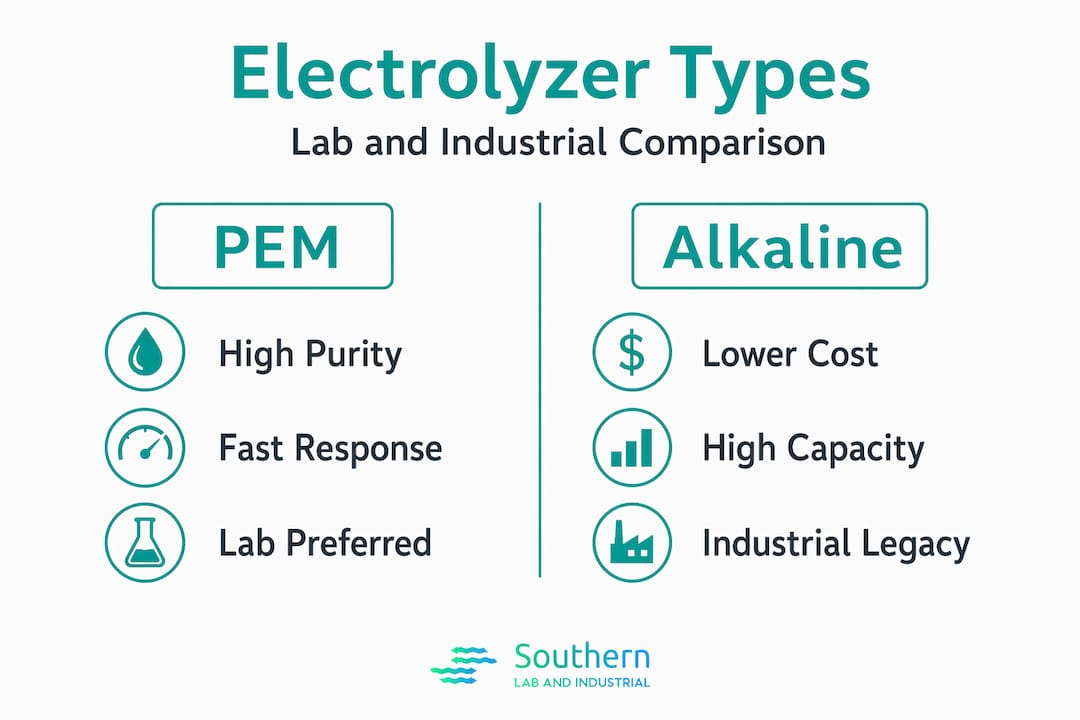
| Criteria | PEM electrolyzer | Alkaline electrolyzer |
|---|---|---|
| Hydrogen purity | 99.999% | 99.5 to 99.9% |
| Output pressure | Up to 34 bar | 1 to 30 bar |
| Footprint | Compact | Larger |
| Dynamic response | Seconds | Minutes |
| Startup time | Minutes | 15 to 60 minutes |
| Maintenance cycle | Membrane and stack replacement | Electrolyte management |
| Cost position | Higher upfront, lower BOP losses | Lower upfront, higher long-term complexity |
| Best application | Analytical labs, variable renewables | Industrial base load, large-scale production |
Factors that should drive your selection:
- Purity requirement: If your instruments require 99.999% hydrogen, alkaline output requires additional purification steps that add cost and maintenance
- Pressure requirement: High-pressure PEM output can feed instruments directly, eliminating secondary compression
- Power supply: PEM responds to variable power in seconds, making it compatible with facilities using renewable or backup power sources
- Physical space: Compact PEM units fit in lab utility spaces without dedicated machine rooms
- Maintenance resources: Alkaline systems require electrolyte concentration management; PEM requires membrane inspection and water quality discipline
Industrial PEM and alkaline generators both have valid roles at scale. For the analytical lab environment specifically, compact PEM generators consistently deliver the purity, pressure, and footprint profile that matches instrument requirements with the least downstream complexity.
Maximizing efficiency and ensuring safe operation: practical tips for laboratory managers
With the right system selected, operational discipline determines whether you realize the efficiency you paid for or lose it gradually to avoidable degradation.
Electrolyzer efficiency factors are not fixed. They drift based on how well the system is maintained, monitored, and operated. Balance of plant optimization and routine monitoring reduce costs and prevent efficiency loss from power electronics and compression inefficiencies over time.
Operational checklist for lab managers:
- Check feed water conductivity weekly. Elevated conductivity indicates contamination that accelerates membrane fouling
- Log stack voltage trends monthly. A rising voltage at constant current is an early indicator of membrane or catalyst degradation before it becomes a fault condition
- Verify gas sensor calibration quarterly. Sensors drift, and an uncalibrated sensor gives false confidence in a system that may already be compromised
- Inspect dryer performance after any unexpected shutdown. Thermal cycling can reduce desiccant effectiveness
- Review ventilation interlock test records monthly. Automated systems still need manual verification that they are activating correctly
Integrated purity and flow monitoring with early crossover detection prevents membrane damage and safety risks in PEM electrolyzers. The cost of a membrane replacement, plus the downtime of a full system teardown, far exceeds the cost of the monitoring equipment that could have prevented it.
Pro Tip: Build a simple dashboard that tracks stack voltage, feed water conductivity, and hydrogen purity daily. You do not need sophisticated software. A spreadsheet with weekly entries and a threshold alert is enough to catch 80% of failure modes before they become downtime events.
Staff training matters as much as hardware. Everyone who works near the electrolyzer system needs to know the hydrogen sensor alarm thresholds, what to do if an alarm triggers, and where the manual shutoff is. Lab gas solutions that include installation and training take this burden off internal teams. Ongoing electrolyzer service and monitoring support gives lab managers a documented maintenance record and a point of contact when anomalies appear.
A laboratory manager’s perspective: why system-level thinking beats focusing only on electrolyzer stacks
Most conversations about electrolyzer procurement start and end with the stack. Efficiency rating, membrane type, output capacity. That focus is understandable because the stack is the technology. It is also the wrong place to spend most of your evaluation time.
The biggest gains in cost reduction and efficiency come from optimizing the entire electrolyzer system, not just the stack. In practice, this means a lab that installs a high-spec PEM stack but neglects water purification, power supply quality, and monitoring infrastructure will underperform a lab with a mid-tier stack and excellent BOP discipline.
The hidden cost in most lab hydrogen systems is not the gas itself. It is the unplanned downtime when a membrane degrades faster than expected, or when an analytical run is invalidated by purity drift no one was tracking. Adequate monitoring and maintenance of auxiliary systems are often overlooked but are the difference between a hydrogen system that runs for ten years and one that requires emergency service calls every eighteen months.
The operators who get the most from their systems treat hydrogen generation as infrastructure, not equipment. Infrastructure gets documented, maintained on a schedule, and reviewed when facility needs change. Equipment gets used until it fails. The difference in total cost of ownership over a five-year period is significant, and the difference in analytical reliability is measurable.
If you are evaluating a new hydrogen generator, ask the vendor three questions: What does BOP maintenance look like at 12 months? What monitoring data does the system log, and how do you access it? What is the membrane replacement interval under your specific feed water conditions? The answers will tell you more about real-world performance than any efficiency spec sheet.
Comprehensive lab gas systems that integrate generation, monitoring, and support into a single managed package take the system-level thinking and operationalize it for you.
Explore efficient hydrogen production solutions with Southern Laboratory and Industrial
If you are ready to move from cylinders to on-site hydrogen generation, or you need to upgrade an existing system that is not meeting purity or reliability targets, the right starting point is a provider that understands both the technology and the lab environment it operates in.
Southern Laboratory and Industrial supplies laboratory gas generators and on-site hydrogen production systems designed specifically for analytical instruments along the Gulf Coast. The HG Series hydrogen generators deliver high-purity hydrogen at pressures suited for direct instrument feed, eliminating cylinder logistics and the variability that comes with them. From compact lab-bench units to industrial-scale systems, every installation includes turnkey setup, local technical support, and access to ongoing electrolyzer service and support that keeps your hydrogen supply predictable and your instruments running.
Frequently asked questions
What is an electrolyzer and how does it produce hydrogen?
An electrolyzer uses electricity to split water into hydrogen and oxygen through electrochemical reactions at an anode, cathode, and electrolyte interface, producing pure hydrogen gas on demand. Electrolysis is the core mechanism behind all modern electrolyzer-based hydrogen production.
Which electrolyzer type produces the highest purity hydrogen for laboratory use?
PEM electrolyzers consistently produce hydrogen above 99.999% purity, making them the preferred choice for sensitive analytical instruments that cannot tolerate gas quality variation.
How can I ensure safe hydrogen production with a PEM electrolyzer in the lab?
Implement continuous purity and flow monitoring, place hydrogen sensors at ceiling level per IEC standards, maintain feed water quality, and verify ventilation interlocks on a monthly schedule to prevent gas crossover events.
What role does balance of plant play in electrolyzer efficiency and cost?
Balance of plant components can account for 40 to 60% of total CAPEX in PEM electrolyzer systems and add 6 to 10 kWh per kilogram of hydrogen in energy use, making BOP optimization the single largest lever for reducing your total hydrogen production cost.
Why is PEM electrolyzer technology preferred for integrating with renewable energy sources?
PEM electrolyzers respond to power input changes in seconds and operate at 70 to 90°C with no liquid electrolyte in the gas path, making them well-suited to the variable output profiles of solar and wind power sources.