Gas generator flow rate is one of the most frequently misunderstood specifications in engineering and facility management, and the confusion is costly. Many professionals conflate flow rate with capacity rating, then size their gas supply systems around the wrong number entirely. Whether you manage an analytical lab running GC or ICP-MS instruments, or you oversee an industrial facility with power generation assets, understanding what gas generator flow rate actually means, how to measure it, and how to optimize it will directly affect your operating costs, gas purity, and system reliability.
Table of Contents
- Key Takeaways
- What gas generator flow rate actually means
- Flow rate, capacity rating, and generator efficiency
- Instruments and methods for measuring flow rate
- Factors that affect flow rate in real operating conditions
- Calculating and optimizing gas generator flow rate
- My perspective on flow rate as an operational priority
- Optimize your gas supply with Getsli
- FAQ
Key Takeaways
| Point | Details |
|---|---|
| Flow rate vs. capacity rating | Flow rate is the volume of gas delivered per unit time; capacity rating defines maximum potential output under rated conditions. |
| Units vary by application | Gas flow rate is expressed in SCFH, L/min, or Nm³/h depending on the generator type and industry standard. |
| Load profile drives efficiency | Running fuel-powered generators at 50 to 75% of rated capacity delivers the most efficient fuel consumption per unit of output. |
| Measurement requires compensation | Raw volumetric readings must be corrected for temperature and pressure to produce accurate standard volume data. |
| Oversizing hurts performance | Oversized generators run at partial load, increasing fuel waste and, in non-fuel generators, risking gas purity degradation. |
What gas generator flow rate actually means
The term “flow rate” covers two distinct concepts depending on what type of generator you are working with. For fuel-powered generators, flow rate typically refers to the rate at which fuel gas is consumed to produce electrical power. For non-fuel gas generators (hydrogen, nitrogen, zero air), flow rate describes the volume of product gas delivered to the downstream system per unit of time.
Both are measured in volumetric units. The three most common are:
- Standard Cubic Feet per Hour (SCFH): Predominant in North American industrial and laboratory settings.
- Liters per Minute (L/min): Common in laboratory and analytical instrument contexts, particularly for hydrogen and nitrogen generators.
- Normal Cubic Meters per Hour (Nm³/h): Standard in European industrial applications and large-scale power generation.
The distinction between volumetric flow and energy flow matters more than most engineers expect. Volumetric flow tells you how much gas moves through the system per unit time at defined reference conditions. Energy flow (expressed in BTU/hr or kW equivalent) tells you how much chemical energy that gas contains. For billing, combustion design, and instrument calibration, using the wrong metric produces real errors.
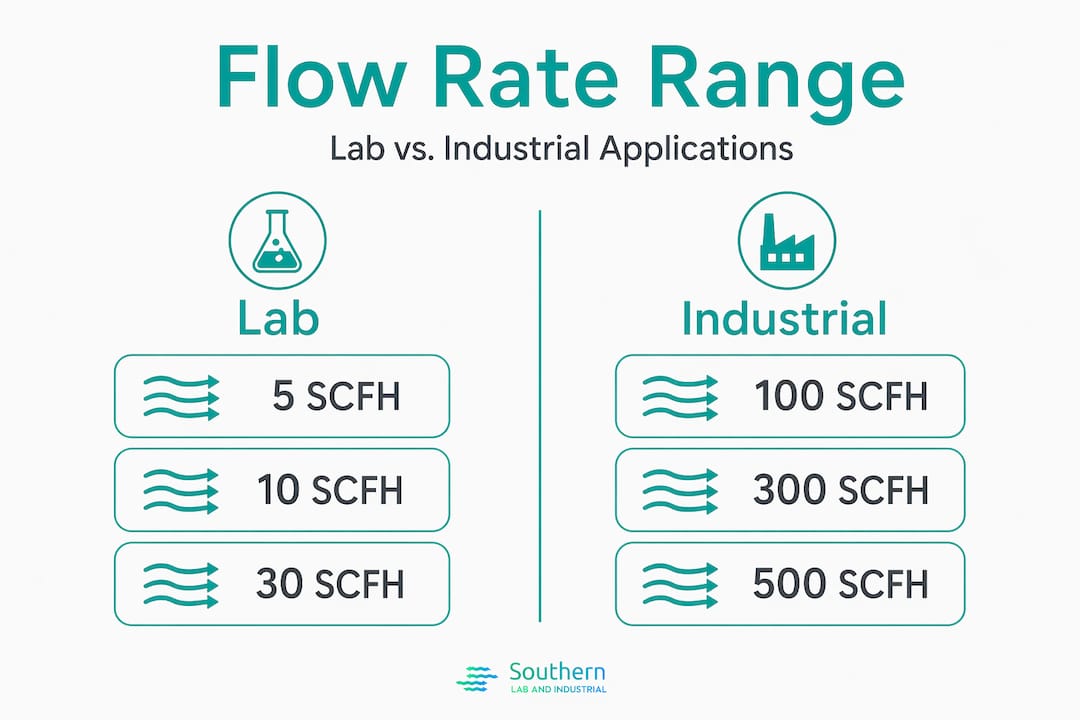
For lab applications, typical flow rates range from 5 to 10 SCFH for low-volume operations to more than 30 SCFH for high-volume systems. A mid-sized analytical lab running multiple GC instruments simultaneously will often fall in the 10 to 20 SCFH range. For industrial power generation with large gas engines, flow rates can reach hundreds to thousands of Nm³/h, requiring a completely different class of metering equipment.
Flow rate, capacity rating, and generator efficiency
Understanding what is gas generator capacity rating requires separating it from flow rate. Capacity rating defines the maximum output a generator can deliver under specified conditions: rated voltage, ambient temperature, altitude, and load type. Flow rate is the actual gas volume moving through the system at any given operating point. The two are related, but they are not interchangeable.
For fuel-powered generators, fuel consumption scales directly with electrical load. A 5 kW generator consumes approximately 0.75 gallons per hour at load. That consumption rate is a direct expression of fuel gas flow rate, and it changes as load changes. This is where generator fuel consumption becomes a practical proxy for flow rate monitoring in field settings where dedicated flow meters are not installed.
The relationship between load profile and gas generator efficiency is not linear, and that asymmetry has operational consequences. The most efficient operating band for most fuel-powered generators falls between 50% and 75% of rated capacity. Running below 50% load means you are still consuming a disproportionate amount of fuel to keep the engine turning. Running at or above 90% load for extended periods accelerates wear and reduces generator life.
Here are the key factors connecting capacity rating, flow rate, and efficiency:
- Rated vs. actual load: Capacity rating sets the ceiling; your load profile determines where you actually operate on the efficiency curve.
- Eco-mode performance: Variable-speed generators using eco-mode can reduce fuel use by 20 to 40% compared to fixed-speed models running at 3600 RPM regardless of load.
- Purity vs. flow tradeoff: In non-fuel gas generators, exceeding rated flow capacity reduces gas purity. Pushing a nitrogen generator beyond its rated flow to meet a sudden demand spike may deliver gas that fails your instrument’s purity specification.
- Proper sizing for efficiency: Oversized generators run at partial load and incur fuel penalties that compound over time. Matching your generator to your actual load profile, not your theoretical peak, is the more disciplined approach.
Pro Tip: Before specifying a gas generator, collect at least 30 days of load data from your facility’s existing gas supply. Sizing to average demand plus a 20% buffer typically delivers better total cost of ownership than sizing to the highest recorded peak.
Instruments and methods for measuring flow rate
Accurate flow rate measurement is where engineering intention meets operational reality. The most widely used instrument class for natural gas and product gas measurement in generator systems is the gas turbine flow meter.

Gas turbine flow meters measure volumetric flow by translating rotor revolutions into a flow signal. As gas passes through the meter, it spins a rotor at a speed proportional to the volumetric flow rate. Accuracy for these meters typically falls in the ±1.0% to ±1.5% range, which is sufficient for most industrial billing and performance management applications.
Meter sizing matters significantly. A DN50 turbine meter handles flows in the 10 to 100 Nm³/h range. A DN100 meter scales to 40 to 800 Nm³/h. A DN150 meter covers 150 to 1,500 Nm³/h. Selecting the wrong meter size for your operating range will push measurements into the low-accuracy zone at the edges of the instrument’s turndown ratio.
| Meter Size | Typical Flow Range | Accuracy |
|---|---|---|
| DN50 | 10 to 100 Nm³/h | ±1.0% to ±1.5% |
| DN100 | 40 to 800 Nm³/h | ±1.0% to ±1.5% |
| DN150 | 150 to 1,500 Nm³/h | ±1.0% to ±1.5% |
The MWM TCG 4170 V20 gas engine, rated at 2,500 kWel with 46% electrical efficiency, illustrates why meter turndown ratios matter. At variable load, fuel gas demand can swing dramatically. This engine requires flow meters with turndown ratios up to 20:1 to maintain accuracy across its operating range.
Raw volumetric readings are not sufficient on their own. Gas compressibility effects require that all volumetric readings be corrected to standard conditions using temperature and pressure compensation. Flow computers or volume correctors handle this in real time. Without this correction, your flow data will be inaccurate during demand fluctuations, which is precisely when accurate measurement matters most. This is especially critical for billing and performance tracking in facilities with multiple gas-consuming assets.
Pro Tip: When integrating flow meters into a facility management system, specify instruments with 4 to 20 mA analog output or MODBUS communication. This allows direct data acquisition into your SCADA or BMS without manual logging, which is where measurement errors typically enter the picture.
Factors that affect flow rate in real operating conditions
Gas generator flow rate is not a static number you set during commissioning and forget. Several variables shift it continuously, and understanding those variables is what separates a well-designed system from one that constantly requires manual intervention.
Environmental derating is the most commonly overlooked factor. Altitude and ambient temperature reduce air density, which directly affects combustion quality and maximum power output in fuel-powered generators. The same generator rated at 100 kW at sea level and 77°F may deliver only 85 kW at 5,000 feet elevation or during a 105°F summer day in the Gulf Coast region. That power reduction corresponds directly to a reduction in the fuel gas flow rate the system can productively use. Always request manufacturer derating curves before finalizing your system design.
Load fluctuations also affect flow rate in ways that simple nameplate specifications do not capture. A facility with a highly variable load profile, such as a research lab that cycles instruments throughout the day, will see gas demand patterns that differ significantly from a 24-hour continuous industrial process. This is where understanding actual load profiles over time becomes operationally valuable. Matching gas supply capacity to real demand patterns, rather than theoretical maximums, reduces waste and prevents purity failures.
| Scenario | Flow Rate Impact | Risk |
|---|---|---|
| High altitude operation | Reduced effective flow and output | Power shortfall, combustion inefficiency |
| High ambient temperature | Reduced air density, lower combustion efficiency | Derating without warning if not designed for it |
| Undersized generator | Forced to run at high load continuously | Reduced lifespan, elevated fuel consumption |
| Oversized generator | Partial load operation becomes the norm | Poor fuel efficiency, purity issues in gas generators |
Turndown ratio also defines how flexibly your generator can respond to changing demand. A system with a narrow turndown ratio performs poorly when load drops significantly, either wasting fuel or shutting down entirely. For laboratory gas generators supplying instruments like nitrogen systems for LC-MS and ICP, turndown flexibility is a specification worth examining carefully during procurement.
Calculating and optimizing gas generator flow rate
Getting gas generator flow rate right operationally starts with a calculation framework, not just a measurement. The foundational relationship is straightforward: flow rate equals load divided by fuel energy density, adjusted for generator efficiency. In practice, this means using your actual load data and your generator’s Brake Specific Fuel Consumption (BSFC) figure to estimate expected fuel flow, then validating that against metered readings.
Follow these steps to validate and optimize your system:
- Establish baseline consumption. Record metered fuel or gas consumption over a representative operating period of at least two weeks. This gives you a real consumption baseline, not a theoretical one.
- Compare to manufacturer specs. Calculate expected flow at your average load using the generator’s published efficiency curve. A significant deviation between measured and expected values signals a metering issue, a load profile mismatch, or an equipment problem.
- Apply load management strategies. If your data shows frequent operation below 50% load, consider load consolidation or generator sequencing across multiple units to keep each one in the efficient operating band.
- Specify replacement or new units based on real data. When selecting new lab or industrial generators, use your validated consumption data to specify the correct flow capacity rather than defaulting to oversized equipment.
- Integrate monitoring into your facility management system. Real-time flow data integrated into your BMS or SCADA allows you to catch deviations before they become outages or quality failures.
Pro Tip: For non-fuel gas generators like hydrogen or nitrogen units, set a flow rate alarm at 90% of rated capacity rather than 100%. This gives you a warning window to adjust demand or bring additional capacity online before purity degradation begins.
My perspective on flow rate as an operational priority
I have worked with enough facilities to recognize a consistent pattern: flow rate monitoring gets treated as a commissioning task rather than an ongoing operational discipline. Engineers spend considerable time specifying meters and sizing generators correctly, then leave the monitoring to whoever is on shift, with no structured review process. That is where the real cost accumulates.
In my experience, the facilities that manage gas generator flow rate well are not necessarily the ones with the most sophisticated instrumentation. They are the ones that review their consumption trends weekly, act on deviations quickly, and understand that generator efficiency is not fixed. Load profiles change as processes evolve, and the generator system needs to be re-evaluated periodically against current demand, not the demand that existed when the system was installed.
The most avoidable mistake I see is sizing based on peak demand without accounting for how rarely that peak actually occurs. You end up with an oversized generator running at 40% load most of the time, burning excess fuel and, in the case of non-fuel gas generators, delivering gas that barely approaches the purity ratings it was specified for. Temperature and pressure compensation in metering is another gap I see regularly. Facilities assume their raw meter readings are accurate, but without real-time correction, those numbers drift during demand swings and seasonal temperature changes, introducing billing errors and performance blind spots.
My advice is to treat flow rate monitoring as a financial instrument, not just a technical one. Every cubic foot of gas your generator consumes or produces has a cost attached to it. Tracking that number accurately, trending it over time, and responding to anomalies is how you convert a well-specified generator into a well-managed one.
— Kris
Optimize your gas supply with SLI
SLI supplies laboratory and industrial gas generators, including hydrogen, nitrogen, and zero air systems, to facilities across the Gulf Coast that need precise, continuous gas supply. When flow rate accuracy and gas purity matter to your instrument performance or production output, the generator you select and how it is sized and monitored determines your real operating costs.
Getsli’s team provides turnkey installation, local technical support, and ongoing maintenance backed by partnerships with LNI Swissgas and Nel Hydrogen. If you are evaluating a gas generator for GC, LC-MS, ICP, or industrial power applications, explore Getsli’s lab gas generator solutions to see specifications, flow rate ranges, and purity ratings matched to your application. For ICP and ICP-MS specific requirements, the ICP-MS generator lineup covers precision flow needs for your most demanding instruments.
FAQ
What is gas generator flow rate?
Gas generator flow rate is the volume of gas produced or consumed per unit of time, typically expressed in SCFH, L/min, or Nm³/h. It applies to fuel gas consumption in power generators and product gas output in laboratory gas generators.
How does flow rate differ from capacity rating?
Capacity rating defines the maximum output a generator can deliver under rated conditions, while flow rate reflects the actual gas volume moving through the system at a given operating point. The two are related but not equal.
What units are used to measure gas generator flow rate?
The most common units are Standard Cubic Feet per Hour (SCFH) for North American lab and industrial applications, Liters per Minute (L/min) for analytical instrument setups, and Normal Cubic Meters per Hour (Nm³/h) for large-scale European industrial systems.
Why does temperature and pressure compensation matter for flow measurement?
Raw volumetric flow readings shift with changes in gas temperature and pressure. Without real-time compensation using a flow computer or volume corrector, flow measurement errors occur during demand fluctuations, producing inaccurate billing data and unreliable performance records.
What is the most fuel-efficient operating range for a gas generator?
Running a generator at 50 to 75% of rated capacity delivers the best fuel efficiency. Operating below 50% load increases fuel consumption per unit of output, while sustained operation above 90% load accelerates wear and reduces equipment life.