Gas generation scalability is the ability of an on-site specialty gas generator system to adjust output capacity reliably and cost-effectively as your laboratory’s consumption needs change, all while maintaining gas purity and flow performance. For analytical labs running GC, LC-MS, ICP-MS, or FTIR instruments, this capability transforms gas supply from a volatile, logistics-heavy cylinder dependency into a predictable, fixed-cost utility. Southern Laboratory and Industrial (SLI), working with certified partners LNI Swissgas and Nel Hydrogen, builds scalability into every system it deploys, from single-instrument nitrogen generators to multi-unit hydrogen arrays for industrial buyers.
The operational case for scalability comes down to three things:
- Supply resilience: On-site generation eliminates the risk of cylinder shortages, delivery delays, and helium supply chain volatility.
- Cost predictability: High-volume users, particularly those running LC-MS instruments, typically see ROI under two years when switching from delivered cylinders to on-site generation.
- Operational flexibility: A scalable system grows with your instrument count without requiring a full infrastructure replacement.
Table of Contents
- Core principles of scalable on-site gas generation
- Operational and financial advantages of scalable gas generation
- Best practices for installing and scaling gas generators
- Why SLI is the right partner for scalable gas generation
- SLI’s scalable gas generation solutions for your lab
- Key takeaways
Core principles of scalable on-site gas generation
Understanding gas generation scalability concepts starts with the engineering decisions made at the time of purchase and installation. These principles apply across nitrogen, hydrogen, and zero air generators.
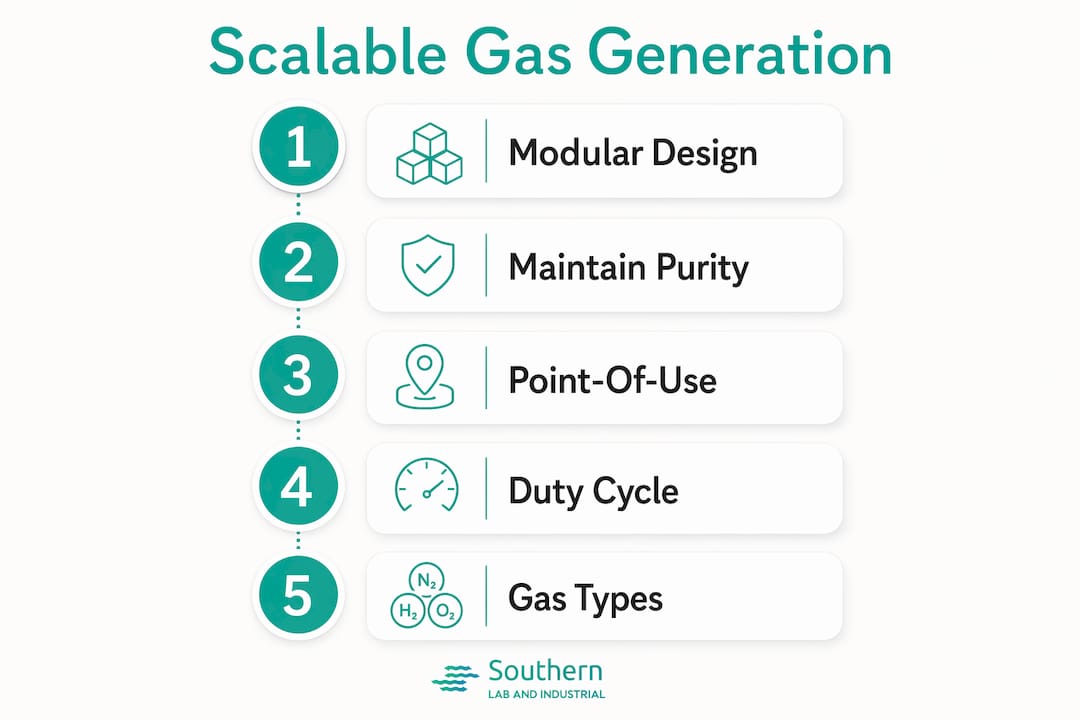
1. Modular system architecture
Modular designs are the foundation of scalable gas generation. Units with dual compressor stacks or stackable modules allow you to add capacity incrementally rather than replacing the entire system. If one module requires service, the remaining module continues operating at partial capacity, preventing total instrument downtime. Modular, compact systems placed at the point of use also adapt more easily to equipment expansion than centralized installations.
2. Flow rate flexibility and purity maintenance
A scalable system must hold target purity across its full operating range, not just at a single flow setpoint. PSA-based nitrogen generators, for example, use pressure swing cycles that can be tuned to match demand. PEM hydrogen generators produce gas on demand from deionized water, so output tracks consumption directly. The key requirement is that purity specifications stay stable whether you are running one GC or four.
3. Point-of-use placement versus centralized supply
A centralized generator feeds the entire lab loop but creates a single point of failure. Point-of-use systems isolate risk by instrument, so a generator fault affects only one workstation rather than the whole facility. For labs planning to add instruments over time, point-of-use placement also means each new instrument gets its own dedicated supply without requiring new plumbing runs across the lab.
4. Duty cycle management and flow headroom
Never run a generator at 100% duty cycle. Running at maximum capacity continuously accelerates wear on compressors and membranes. Selecting a unit with 20–30% flow headroom above your peak demand allows the system to cycle off, cool down, and extend component life. This headroom also gives you room to add a second instrument without immediately outgrowing the generator.
Pro Tip: Size your generator to your projected 18-month instrument load, not today’s load. The cost difference between a unit with 20% headroom and one with 40% headroom is small compared to the cost of replacing a worn-out compressor ahead of schedule.
5. Gas type implications on scalability
Nitrogen, hydrogen, and zero air each scale differently. Nitrogen PSA generators are volume-oriented and suit LC-MS desolvation flows well. Hydrogen PEM generators are purity-oriented, producing up to 99.99999% purity for GC carrier gas and FID fuel. Zero air generators require multi-stage filtration to eliminate hydrocarbons. Integrated triple-output systems that produce all three gases from a single chassis with independent closed-loop control represent one practical approach to multi-gas scalability in a compact footprint.
6. Integration with lab automation and monitoring
Intelligent generators with load-following capability communicate directly with instruments via I/O connections. When a mass spectrometer enters standby mode overnight, the generator ramps down compressor speed automatically. This load-following design reduces electricity consumption by up to 30% and extends the service life of compressor seals, directly improving total cost of ownership.
Operational and financial advantages of scalable gas generation
7. Cost savings and ROI
The financial case for on-site generation is clearest for high-volume users. LC-MS instruments consume large gas volumes for ion desolvation, and cylinder delivery fees accumulate quickly. On-site generation converts that variable monthly expense into a fixed capital asset with a defined payback period. For labs at this consumption level, the payback period is often under two years.
8. Instrument performance improvements
Stable, on-site gas supply directly improves chromatography results. Butterworth Laboratories documented that switching to on-site generators improved baseline signal-to-noise ratios significantly on their GC systems. The mechanism is straightforward: cylinder gas purity varies between deliveries, while a well-maintained on-site generator holds purity continuously.
9. Supply chain risk mitigation
Cylinder-based supply exposes labs to delivery delays, vendor pricing changes, and global shortages. The helium supply constraint is a permanent condition, not a temporary disruption, and labs running GC on helium carrier gas face ongoing cost and availability risk. Switching to hydrogen carrier gas via an on-site PEM generator eliminates that exposure entirely. On-site generation also removes the carbon footprint of cylinder logistics and the physical hazard of storing high-pressure cylinders in the lab.
10. Energy efficiency at scale
Load-following generators adjust compressor speed to match actual instrument demand rather than running flat-out regardless of consumption. The electricity savings from this adaptive control compound over time, particularly in labs where instruments run on scheduled batches rather than continuously. Pairing a correctly sized generator with intelligent controls keeps the system operating in its efficient load band throughout the day.
Best practices for installing and scaling gas generators
11. Prioritize point-of-use placement
Under-bench installation at the instrument level reduces plumbing run length, minimizes pressure drop, and isolates any fault to a single workstation. It also simplifies future expansion: adding a new GC means adding one generator, not re-engineering a central supply manifold.
12. Future-proof with modular designs
Select units with documented upgrade paths. A generator that accepts an additional compressor module or can be paralleled with a second unit gives you a clear capacity expansion route without a full system replacement. Modular, compact designs placed under lab benches are the standard recommendation for labs expecting instrument growth.
13. Build a proactive maintenance schedule
Gas generators require structured maintenance to protect total cost of ownership. Filter and membrane replacement on schedule prevents oil carryover that can contaminate mass spectrometer optics, a repair far more expensive than any maintenance kit. Budget for annual filter kits and track compressor hours to anticipate rebuild intervals.
14. Address safety and regulatory compliance
Hydrogen generators require leak detection protocols and automatic shutdown features. PEM-based units produce hydrogen on demand with minimal stored volume, which reduces the hazard compared to cylinders, but installation must still comply with local fire codes and lab safety requirements. Zero air generators must meet hydrocarbon specifications for the instruments they serve. Verify that any generator you purchase carries the certifications required by your facility’s safety officer before installation.
Pro Tip: Before finalizing a generator purchase, confirm the vendor provides a turnkey installation service that includes leak testing, instrument connection verification, and a documented commissioning report. This protects you from installation errors that only surface during the first week of operation.
Why SLI is the right partner for scalable gas generation
Southern Laboratory and Industrial (SLI) specializes in on-site lab gas generators for analytical laboratories and industrial facilities along the Gulf Coast, covering hydrogen, nitrogen, and zero air applications across GC, LC-MS, ICP-MS, FTIR, and TOC instruments.
SLI’s approach to scalability rests on three pillars:
- Certified equipment partnerships: SLI works with LNI Swissgas for laboratory-grade nitrogen and hydrogen generators, Nel Hydrogen for industrial-scale PEM electrolyzers, and NXT Power for instrument power conditioning. Each partner brings documented performance specifications and established service histories.
- Turnkey installation and local support: SLI handles site assessment, installation, commissioning, and ongoing maintenance from its Houston base, giving Gulf Coast labs a local technical contact rather than a remote call center.
- Technical resources for lab managers: SLI publishes detailed guides and troubleshooting documentation so your team can identify issues early, understand gas generator integration challenges, and make informed decisions about capacity expansion.
The combination of certified hardware, local expertise, and long-term service commitment positions SLI as a partner for the full lifecycle of a scalable gas generation system, not just the initial purchase.
SLI’s scalable gas generation solutions for your lab
Gas generation scalability is not a feature you can retrofit easily. The decisions made at purchase and installation determine whether your system can grow with your lab or force a costly replacement in three years.
SLI gives analytical lab managers and industrial buyers a direct path to scalable, certified gas generation without the guesswork of sourcing equipment independently. You get hardware from LNI Swissgas and Nel Hydrogen with documented purity specs, turnkey installation from a Houston-based team that knows Gulf Coast lab environments, and ongoing support that keeps your total cost of ownership predictable. Whether you are replacing cylinders for a single LC-MS or building out a multi-instrument hydrogen supply for a growing analytical department, SLI sizes and configures the system to your actual demand, with headroom built in for what comes next.
Contact SLI or visit the lab gas generator catalog to get a system recommendation matched to your instrument load and facility layout.
Key takeaways
On-site gas generation scalability requires modular hardware, correct flow headroom, point-of-use placement, and proactive maintenance to deliver reliable capacity growth without replacing infrastructure.
| Point | Details |
|---|---|
| Flow headroom protects longevity | Select a generator with 20–30% capacity above peak demand to prevent continuous full-load operation. |
| Point-of-use placement reduces risk | Installing one generator per instrument isolates faults and simplifies future capacity expansion. |
| Load-following controls save energy | Intelligent generators reduce electricity consumption by up to 30% by matching compressor speed to instrument demand. |
| On-site generation improves performance | Butterworth Laboratories documented a 20–30% improvement in GC signal-to-noise ratios after switching to on-site generators. |
| SLI provides turnkey scalable systems | SLI partners with LNI Swissgas, Nel Hydrogen, and NXT Power to deliver certified, locally supported gas generation for Gulf Coast labs. |
Recommended
- Gas Generation System Troubleshooting Steps for Labs – getsli.com
- Gas Generation in Environmental Testing: A Technical Guide – getsli.com
- Gas Generator Integration Challenges: Real-World Examples – getsli.com
- Laboratory Gas Generators | Hydrogen, Nitrogen & Zero Air | Southern Laboratory and Industrial