Last updated August 19, 2026 · Reviewed by Kris Andaur, Founder & President, Southern Laboratory and Industrial
When a GC baseline drifts or an ICP plasma destabilizes, the first suspect is rarely the gas supply. Yet high purity gas generation standards exist precisely because trace contaminants at the parts-per-billion level can corrupt analytical results before you even realize the source. A purity percentage printed on a spec sheet tells only part of the story. What matters for your instruments is the explicit limit on oxygen, moisture, hydrocarbons, and other named impurities. This article breaks down how those standards work, how compliance is verified, and what your facility needs to do to maintain it.
Table of Contents
- Key Takeaways
- High purity gas generation standards: grades, impurities, and what the numbers mean
- Measuring what matters: ASTM methods and ultra-trace analysis
- Common pitfalls in gas generation commissioning and operation
- Selecting and maintaining compliant gas generation systems
- My perspective on where purity standards actually break down
- On-site gas generation solutions built for compliance
- FAQ
Key Takeaways
| Point | Details |
|---|---|
| Purity % alone is insufficient | Grades like 5.0 or 6.0 define named impurity limits in ppmv, not just percentage purity. |
| ASTM standards govern verification | Methods like ASTM D2504 and D8098 specify how trace impurities are measured at ppb levels. |
| Installation affects purity stability | Compressed air pre-treatment and leak-tight sample paths are as critical as generator specifications. |
| Maintenance schedules preserve compliance | Pre-filter replacements and sensor calibration cycles are required to sustain purity grade integrity. |
| On-site generation offers control | PSA and electrolytic generators allow continuous, verifiable purity output aligned with ISO standards. |
High purity gas generation standards: grades, impurities, and what the numbers mean
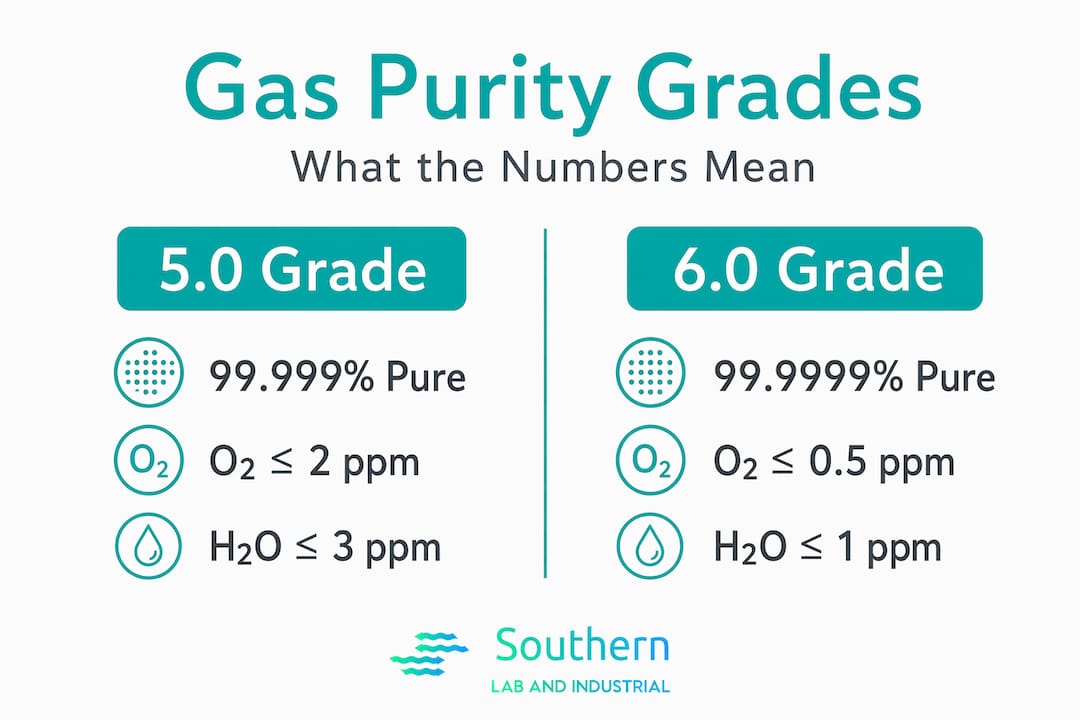
The purity grade system used by specialty gas suppliers is built around a “nines” notation. A grade 5.0 gas is 99.999% pure. A grade 6.0 gas is 99.9999% pure. The number before the decimal point represents the quantity of nines. That framework is useful as a quick reference, but it says nothing about which impurities remain in that fractional percentage.
Specialty gas suppliers define purity grades by quantified ppm limits on specific contaminants, not just overall purity percentages. For nitrogen, grade 5.0 carries limits of O2 ≤ 2 ppmv, H2O ≤ 3 ppmv, and total hydrocarbons ≤ 0.1 ppmv as methane equivalent. Grade 6.0 tightens those limits to O2 ≤ 0.3 ppmv and H2O ≤ 0.5 ppmv. That difference matters enormously when you are running LC-MS or ICP-MS, where even sub-ppm oxygen can cause oxidation artifacts or suppress ionization.
The table below illustrates how named impurity limits differ across nitrogen purity grades:
| Grade | Purity (%) | O2 limit (ppmv) | H2O limit (ppmv) | Total HC (ppmv) |
|---|---|---|---|---|
| N2 4.8 | 99.998 | ≤ 5 | ≤ 5 | ≤ 0.5 |
| N2 5.0 | 99.999 | ≤ 2 | ≤ 3 | ≤ 0.1 |
| N2 6.0 | 99.9999 | ≤ 0.3 | ≤ 0.5 | ≤ 0.05 |
Hydrocarbons deserve particular attention. In GC applications, hydrocarbon contamination in carrier gas creates ghost peaks and baseline noise that can invalidate quantification. In ICP-MS, moisture carryover shifts plasma temperature. Grading by “nines” alone can mask impurity profiles that break specific analytical methods, which is why every gas generation specification for critical applications should list individual contaminant ceilings rather than rely on a single percentage figure.
Pro Tip: When evaluating any gas generation system for laboratory use, request the full certificate of analysis listing individual named impurity limits in ppmv. A grade designation without that breakdown is not sufficient for method validation documentation.
International standards reinforce this approach. ISO 14687:2025 provides graded quality characteristics for hydrogen across residential, commercial, industrial, and vehicular applications, specifying impurity limits for each grade rather than relying on percentage purity alone. The principle is the same across gases: classification is only meaningful when tied to specific contaminant ceilings.
Measuring what matters: ASTM methods and ultra-trace analysis
Knowing the specification is one thing. Verifying that your gas generation system is actually meeting it in real time is a separate, more technically demanding challenge.
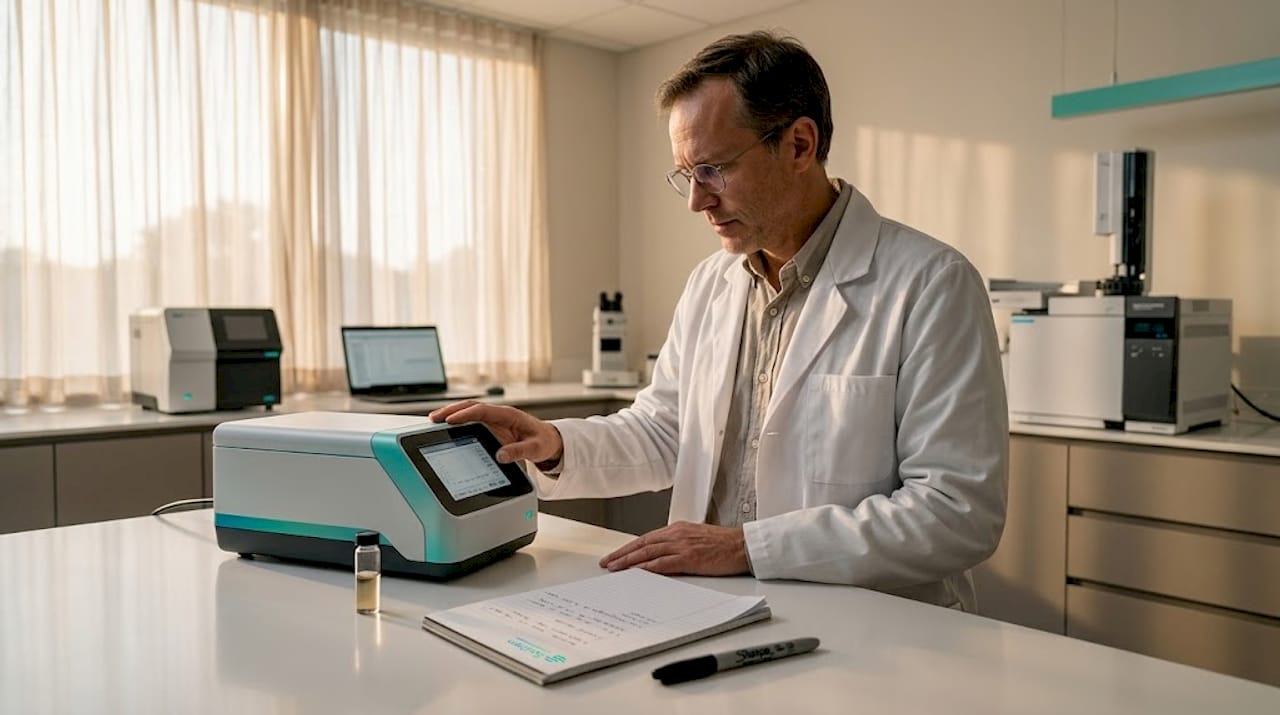
The primary analytical methods for verifying high purity gas quality come from ASTM. ASTM D2504, D2505, and D8098 govern trace impurity analysis for high purity gases, covering permanent gases, moisture, and hydrocarbons respectively. Instruments built to these standards use Pulsed Discharge Detection (PDD), a technique sensitive enough to detect impurities below 10 parts per billion. That level of sensitivity is not optional for grade 5.0 or 6.0 applications — it is the baseline required to confirm compliance.
Key considerations for on-site purity verification include:
- Analyzer placement: Measuring at the point of use rather than at the generator outlet catches downstream contamination from tubing, fittings, and regulators.
- Sample path materials: Stainless steel electropolished tubing and PTFE-lined connections minimize adsorption of moisture and reactive impurities that could produce false-low readings at the analyzer.
- Baseline drift correction: PDD-based analyzers require periodic zero-gas calibration to avoid drift in long-duration monitoring programs.
- Reference standards stability: Multicomponent gas standards for hydrogen purity analysis remain stable over 160 or more days for most inert species, but reactive components like formaldehyde degrade faster, which affects how often calibration standards must be replaced.
Pro Tip: For labs operating under ISO/IEC 17025 accreditation, integrate periodic purity verification into your quality management system as a documented procedure, not just an ad hoc check. Auditors expect evidence of ongoing monitoring, not just a one-time commissioning report.
The challenge most facilities underestimate is contamination introduced between the generator and the instrument. A generator can produce grade 5.0 nitrogen at the outlet while delivering significantly degraded gas at the instrument port if the sample path has not been qualified. That qualification requires the same ASTM-compliant instrumentation used to verify the generator itself.
Common pitfalls in gas generation commissioning and operation
Putting a PSA nitrogen generator online and assuming it will consistently deliver specification-grade gas is one of the most common missteps in laboratory gas system commissioning. The generator spec sheet describes performance under controlled inlet conditions. Real facilities rarely match those conditions exactly.
Here are the critical failure points that Getsli’s technical team encounters most frequently during commissioning audits:
- Inadequate compressed air pre-treatment. PSA systems require oil-free compressed air (ISO 8573-1:2010) with defined dew point and oxygen inlet thresholds. Facilities that skip or defer oil coalescing filters and desiccant dryers expose the molecular sieve beds to contamination. Once contaminated, the beds cannot be regenerated in the field without specialized equipment.
- Inadequate leak testing of the distribution network. A fitting that passes a rough bubble test at installation may fail a helium leak check at 10-8 mbar·L/s. At grade 5.0 oxygen limits of 2 ppmv, even a slow ambient air leak into the system will push oxygen levels above specification within hours.
- Assuming PSA stability equals cylinder stability. PSA generators produce nitrogen in a pressure-swing cycle, which means outlet purity can fluctuate slightly between bed regeneration cycles. Facilities accustomed to cylinder gas sometimes do not budget for a downstream surge volume or purity buffer to smooth those variations.
- Neglecting oxygen sensor calibration. An oxygen sensor that drifts by 0.5 ppmv in a system running at 2 ppmv O2 limit represents 25% measurement error. Annual sensor replacement or recalibration is not optional for compliance assurance.
“Meeting the spec sheet during factory acceptance testing is straightforward. Maintaining that performance continuously, in a real facility with real inlet air variability and real plumbing, requires deliberate design and verification — not just installation.”
The best commissioning protocols treat the first 30 days of operation as a qualification period, with daily purity logging at the point of use, not just at the generator outlet. Any deviation triggers root-cause investigation before the system is certified for routine analytical use.
Selecting and maintaining compliant gas generation systems
For laboratory and industrial facilities making the transition from cylinder supply to on-site generation, the selection decision involves more variables than flowrate and purity grade. Matching the generator to your specific industrial gas purity requirements means accounting for instrument demand, acceptable purity floor, and the verification infrastructure required to prove compliance over time.
Key selection and maintenance factors for on-site gas generators include:
- Purity specification match: A PSA nitrogen generator producing 99.9% nitrogen with O2 ≤ 1000 ppm and dew point −40 °C is adequate for blanket gas applications but not for LC-MS or ICP carrier gas, which require grade 5.0 or better. Clarify the instrument’s gas quality requirement before selecting generator technology.
- ISO 8573-1 compliance class: This standard classifies compressed gas purity across three parameters: particulates, water, and oil. Specifying the required ISO 8573-1 class for your application ties the generator selection to a verifiable, internationally recognized benchmark.
- Maintenance schedule alignment: Pre-filter replacements every six months, weekly valve drains, and annual O2 sensor checks are standard requirements per ISO/IEC 17025. Budget both the parts cost and technician time into your total cost of ownership calculation.
- GLP and regulatory documentation: Labs operating under Good Laboratory Practice need documented evidence that the gas supply meets specification throughout each analytical run. On-site generators that log purity data to a data management system simplify this considerably compared to manual cylinder traceability.
For hydrogen specifically, gas generator options for GC and GC-MS are designed to deliver ultra-high purity hydrogen at controlled flowrates, with purity verification built into the instrument’s control system. That design eliminates the manual cylinder handling risk and supports continuous documentation for audits.
The table below summarizes typical purity targets by application:
| Application | Gas | Typical purity grade | Key impurity concern |
|---|---|---|---|
| GC carrier gas | H2 or N2 | 5.0 or higher | Total HC, O2 |
| LC-MS nebulizer | N2 | 4.8 minimum, 5.0 preferred | H2O, O2 |
| ICP-MS plasma | Ar or N2 | 5.0 | O2, H2O |
| Blanket / purge gas | N2 | 4.5 to 5.0 | O2 |
| FTIR purge gas | N2 or dry air | CO2 and H2O free | CO2, H2O |
For facilities running nitrogen-dependent instruments like LC-MS and ICP, reviewing the NG Series specifications against your current purity requirements is a practical first step before engaging a vendor. Quality assurance does not stop at procurement. Ongoing monitoring and lab quality control practices for gas-dependent instruments should be integrated into your standard operating procedures from day one.
My perspective on where purity standards actually break down
I have reviewed enough commissioning reports and failure investigations to say this plainly: the purity grade on the box rarely causes problems. What causes problems is everything that happens between the generator and the instrument port.
In my experience, the facilities that struggle most with gas purity compliance are not the ones running inadequate generators. They are the ones running technically adequate generators through under-specified distribution systems. A grade 5.0 generator feeding through a corroded fitting, an unqualified regulator, or a moisture-saturated stainless line will deliver grade 4.0 performance. No amount of generator specification will fix a bad sample path.
The second consistent issue I see is the false confidence that comes from checking purity at commissioning and never again. Gas quality is not a static condition. Molecular sieve beds age. Oxygen sensors drift. Inlet air quality varies seasonally. The facilities that maintain genuine compliance treat purity verification as a routine, documented process, not a milestone.
My advice to any lab manager evaluating a new gas generation system: spend as much time reviewing the verification protocol and maintenance schedule as you spend reviewing the purity spec. A system you can prove is compliant, month after month, is worth significantly more than one that was compliant on the day it was installed.
— Kris
On-site gas generation solutions built for compliance
SLI supplies and supports on-site gas generation systems for laboratories and industrial facilities along the Gulf Coast, with a focus on analytical instruments where high purity gas guidelines are not optional. The product range covers hydrogen, nitrogen, and zero air generators from certified partners including LNI Swissgas and Nel Hydrogen, all selected for their documented purity specifications and ISO compliance capability. Getsli provides turnkey installation, commissioning validation, and ongoing maintenance support, so your facility has a documented, auditable gas supply from day one. For GC and GC-MS applications requiring ultra-high purity hydrogen, the GC-dedicated hydrogen generators are purpose-built to meet the trace contaminant limits your analytical methods demand. Contact Getsli to discuss your specific purity requirements and get a system matched to your instruments and compliance obligations.
FAQ
What does a purity grade like 5.0 or 6.0 actually mean?
A grade 5.0 gas is 99.999% pure, but the grade also defines specific impurity limits: for nitrogen, O2 ≤ 2 ppmv and H2O ≤ 3 ppmv. The percentage alone does not describe which contaminants are present or at what levels.
Which ASTM standards apply to high purity gas verification?
ASTM D2504, D2505, and D8098 govern trace impurity analysis for high purity gases, with compliant analyzers capable of detecting impurities below 10 ppb using Pulsed Discharge Detection.
Can a PSA nitrogen generator meet laboratory grade 5.0 requirements?
Some PSA systems are engineered to approach grade 5.0 output, but standard commercial PSA generators typically produce 99.9% nitrogen with O2 ≤ 1000 ppm, which is below grade 5.0. Confirm the specific impurity specifications before selecting a generator for analytical instrument use.
How often should on-site gas generator maintenance be performed?
Pre-filters should be replaced every six months, valve drains checked weekly, and O2 sensors and pressure relief valves verified annually, in line with ISO/IEC 17025 requirements for quality-critical gas supply systems.
Why does installation quality affect gas purity compliance?
PSA systems require oil-free compressed air feed and leak-tight distribution paths to maintain outlet purity. Contaminated inlet air or small leaks in downstream plumbing can push delivered purity well below the generator’s rated specification.