Maintaining sample integrity from collection to analysis is one of the most consequential variables in any research workflow, yet it rarely gets the systematic attention it deserves. Nitrogen generator sample preservation research has made clear that on-site nitrogen generation addresses the core failure modes of traditional preservation methods: inconsistent gas purity, supply interruptions, and the hidden costs of cylinder logistics. Whether you are protecting moisture-sensitive reagents, blanketing analytical standards, or supporting cryogenic workflows, the quality of your nitrogen supply directly determines the reliability of your results.
Table of Contents
- Key Takeaways
- Nitrogen generator sample preservation research: what labs need to know first
- Step-by-step sample preservation using nitrogen generators
- Common mistakes and troubleshooting in sample preservation
- Verification checkpoints and workflow integration
- What I have learned from years of nitrogen-based preservation work
- How Getsli supports your preservation workflows
- FAQ
Key Takeaways
| Point | Details |
|---|---|
| Match purity to application | Target ≥99.9% purity and −40 °C dew point for LC-MS and other moisture-sensitive instruments. |
| Choose the right generator type | PSA generators suit high-purity needs; membrane generators work well for moderate-purity blanketing applications. |
| Follow method-specific hold times | EPA guidance requires analyte- and matrix-specific preservation rules, not generalized protocols. |
| Verify nitrogen quality regularly | Document purity, dew point, and oxygen levels on a scheduled basis and integrate checks into your lab SOPs. |
| Manage thermal history in cryostorage | Transfer samples from −80 °C to liquid nitrogen storage within 24 hours to prevent ice recrystallization damage. |
Nitrogen generator sample preservation research: what labs need to know first
The standard industry term for the core practice here is inert gas blanketing, though the discipline spans purging, sparging, and layering depending on the application. Understanding which technique applies to your sample matrix is the starting point, not an afterthought.
On-site nitrogen generators fall into two primary categories. Membrane generators separate nitrogen from compressed air using hollow-fiber membranes. They deliver nitrogen at purities typically in the 95% to 99.5% range, which is sufficient for blanketing oxygen-sensitive reagents, sample evaporation, and general storage applications where trace moisture is not the primary concern. Pressure Swing Adsorption (PSA) generators cycle compressed air through carbon molecular sieve beds, achieving purities up to 99.999% with dew points as low as −40 °C. PSA generators meet biopharmaceutical storage standards including ICH Q5C and deliver pulse-free gas that protects sensitive analytical baselines.
Before selecting a generator, you need to confirm three quality parameters for your specific application:
- Purity (%): Defines the nitrogen fraction. LC-MS and UHPLC workflows typically require ≥99.9%.
- Dew point (°C): Indicates moisture content. A −40 °C dew point is the accepted threshold for most analytical instruments.
- Oxygen content (ppm): Residual oxygen causes oxidation of sensitive compounds. Targets of ≤1000 ppm apply to most biopharmaceutical storage use cases.
Supporting equipment matters as much as the generator itself. Inline filters remove particulates and residual hydrocarbons before gas reaches your samples or instruments. A calibrated compressed air supply with adequate flow rate and pressure is a prerequisite. Digital flow meters and oxygen analyzers positioned at point of use let you confirm that the nitrogen reaching your sample containers matches the generator’s rated output, not just what is measured at the outlet.
| Equipment / Parameter | Specification / Purpose |
|---|---|
| PSA nitrogen generator | ≥99.9% purity, −40 °C dew point, ≤1000 ppm O₂ |
| Membrane nitrogen generator | 95–99.5% purity, moderate dew point for blanketing |
| Inline particulate filter | Removes particulates and trace hydrocarbons |
| Point-of-use oxygen analyzer | Confirms residual O₂ at sample delivery point |
| Stainless steel or PTFE tubing | Prevents off-gassing and contamination into sample stream |
| Digital flow controller | Maintains consistent nitrogen flow rate to headspace or purge inlet |
Pro Tip: Always size your compressor to the generator’s maximum demand, not your typical operating flow. Compressor undersizing causes pressure drops that degrade purity at the worst possible moments, typically during peak usage in the middle of a run.
Step-by-step sample preservation using nitrogen generators
With equipment validated and parameters confirmed, execution follows a logical sequence. Skipping steps in this process is where most preservation failures originate.
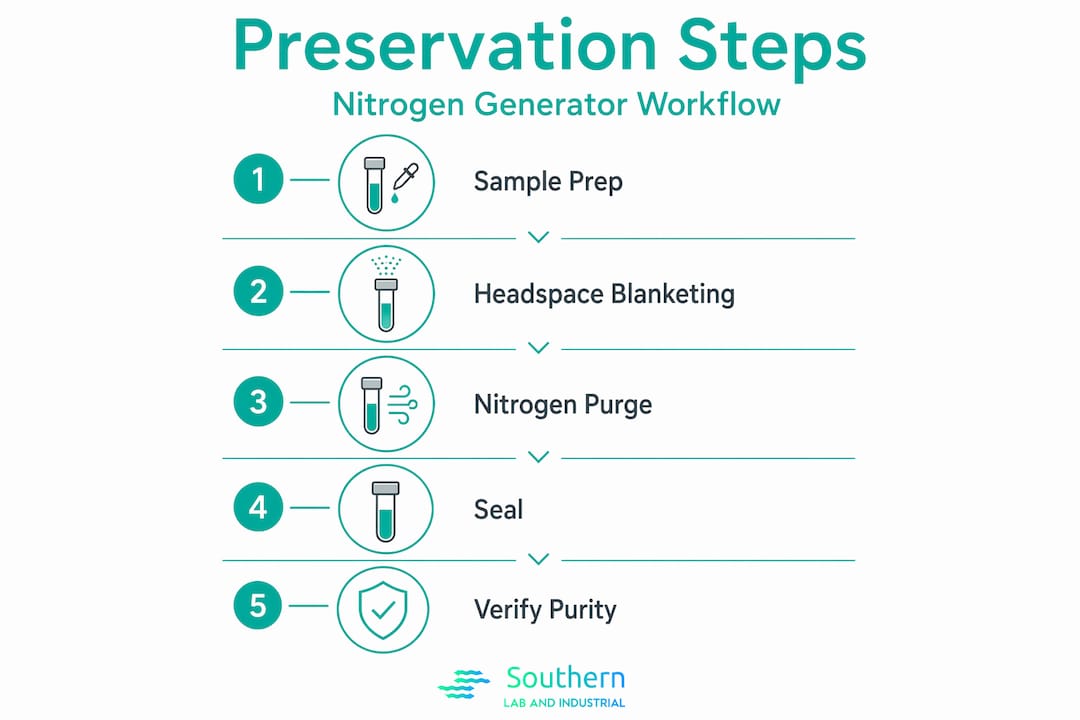
Prepare sample containers. Select containers appropriate to your matrix: glass vials for volatile organics, PTFE-lined closures for reactive compounds, and cryovials rated for liquid nitrogen temperature exposure in cryogenic applications. Ensure containers are clean and dry. Labware purity standards directly affect whether your nitrogen blanket can do its job or gets undermined by container contamination.
Purge the generator and delivery lines. Before connecting to samples, run the nitrogen generator for the manufacturer’s recommended warm-up period. Purge delivery lines to exhaust residual air. Confirm purity and dew point at the point of use before any sample exposure.
Select your preservation technique. The right approach depends on the sample type and analytical goal. See the comparison table below for guidance.
Apply nitrogen blanketing or purging. For headspace blanketing, position the nitrogen inlet at the top of the sample container and displace air at a slow, controlled flow rate to avoid turbulence that could introduce contamination. For reactive or easily oxidized samples, purge the container before sealing. For cryogenic samples, purge the storage vessel with nitrogen vapor before transfer.
Seal and label immediately. Once the nitrogen atmosphere is established, seal containers without delay. Label with the preservation timestamp, technique used, and nitrogen purity applied. This documentation becomes part of your chain of custody and method validation record.
Store at the target temperature without interruption. Temperature transitions are where cryogenic samples suffer the most damage. Samples stored at −80 °C should transfer to liquid nitrogen storage within 24 hours to prevent ice recrystallization that compromises cell viability and molecular integrity.
| Technique | Best Application | Key Nitrogen Parameter |
|---|---|---|
| Headspace blanketing | Reactive reagents, analytical standards | ≤1000 ppm O₂, low dew point |
| Purging | Volatile organic samples, sensitive solvents | High purity, controlled flow rate |
| Vapor phase layering | Cryogenic sample vials in LN₂ dewars | Purity ≥99.5%, minimal moisture |
| Sparging | Dissolved gas removal from liquid matrices | Consistent flow, analytical-grade purity |
Pro Tip: For nitrogen purge applications in FTIR and NIR spectroscopy, set flow rates low enough to avoid sample evaporation while still maintaining a positive-pressure inert atmosphere inside the instrument purge volume.
Common mistakes and troubleshooting in sample preservation
Even well-equipped labs make recurring mistakes in nitrogen-based preservation. Knowing them in advance saves you from discovering them through compromised data.
The most common oversight is treating nitrogen purity as a fixed, verified specification rather than a variable that drifts. Generator performance changes with compressor condition, filter loading, and ambient temperature. Nitrogen purity instability in LC-MS workflows causes signal suppression and background contamination that can be mistaken for sample matrix effects. The source of the problem is rarely the instrument. It is usually the gas supply.
A second frequent error is ignoring method-specific holding times. EPA guidance on preservation is explicit: analyte properties, sample matrix, and project Data Quality Objectives dictate preservation rules. For example, nitrate speciation requires analysis within 48 hours regardless of how well the sample is blanketed. Nitrogen blanketing extends stability, but it does not override analyte-specific degradation chemistry.
Thermal history in cryostorage is an underappreciated failure mode. Uncontrolled transitions through intermediate temperatures allow ice crystals to form and recrystallize, causing irreversible cell membrane and macromolecule damage. Slow or delayed transfers from −80 °C to vapor-phase liquid nitrogen storage are a primary cause. Your protocol should specify maximum transfer time, not just target storage temperature.
Key principle: Nitrogen blanketing controls the chemical environment around your sample. Temperature management controls the physical structure within it. Both require active monitoring and documented controls to protect sample integrity across the full storage period.
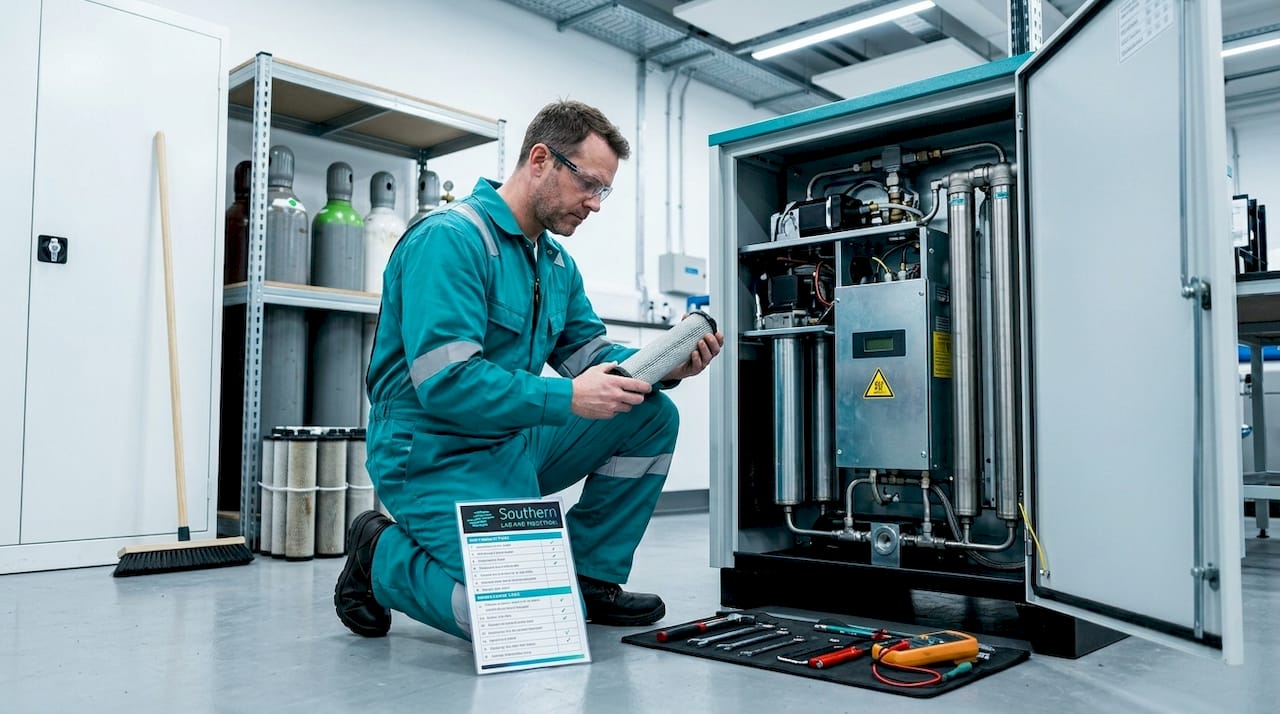
Maintenance gaps in the generator create subtle, intermittent purity problems that are difficult to trace. Compressed air filters should be inspected on a schedule tied to actual usage hours, not calendar months. PSA molecular sieve beds have finite adsorption capacity and require periodic regeneration or replacement. Membrane modules degrade over time with exposure to oil carryover from poorly maintained compressors.
Pro Tip: Run a baseline purity and dew point check at the start of each analytical sequence, not just during routine maintenance. This takes two minutes and catches generator drift before it affects your samples rather than after.
Verification checkpoints and workflow integration
Preservation is not complete at the point of sealing. Verification that the nitrogen atmosphere held, and that sample integrity was maintained, requires a structured confirmation process that becomes part of your laboratory sample management system.
- Confirm nitrogen purity and dew point at point of use at least weekly, or before any critical analytical sequence.
- Conduct headspace oxygen measurements on sealed samples for high-stakes workflows where oxygen ingress is a failure risk.
- Review sample stability data against historical analytical results or reference standards to catch drift early.
- Integrate generator alarms and digital monitoring into your lab’s quality management system so deviations trigger documented corrective actions.
- Use nitrogen generator applications logs to maintain traceability between gas supply parameters and specific sample preservation events.
| Verification Checkpoint | Recommended Frequency | Method |
|---|---|---|
| Generator purity check | Weekly or before critical runs | Inline oxygen analyzer |
| Dew point measurement | Monthly or after maintenance | Calibrated dew point meter |
| Headspace O₂ in sealed vials | Per batch for high-value samples | Headspace oxygen analyzer |
| Sample stability assessment | Per method hold time | Comparison to reference standard |
| Compressor filter inspection | Per usage hours per manufacturer | Visual and pressure drop check |
| Generator maintenance log review | Quarterly | Internal SOP audit |
Incorporating these checkpoints into your standard operating procedures is what separates a preservation workflow from a preservation system. The difference shows in data reproducibility, audit readiness, and the ability to trace any analytical anomaly back to a specific process variable.
Aligning your nitrogen generator maintenance schedule with instrument qualification cycles is a practical way to reduce administrative overhead. Many labs already perform quarterly instrument performance verification. Attaching a nitrogen quality audit to that same schedule means nothing falls through.
What I have learned from years of nitrogen-based preservation work
I have reviewed enough preservation failures to know that the root cause is almost never the generator itself. It is the assumption that a validated setup stays validated indefinitely without active monitoring or maintenance.
The insight that took me longest to fully appreciate is that nitrogen specifications should be derived from your analytical method requirements, not inherited from a general lab standard. When I see a lab using 99.999% purity nitrogen for reagent blanketing that only requires ≤1000 ppm oxygen, I see wasted energy and compressed air demand with no analytical benefit. Overspecifying nitrogen purity adds operating cost without adding protection. Right-size the specification to the actual need.
The thermal history problem in cryostorage is something most researchers understand in principle but underestimate in practice. I have seen protocols that specify transfer within “as soon as possible” rather than within a defined time window. That ambiguity is where samples get compromised. Write the 24-hour transfer limit into the SOP. Make it non-negotiable.
My broader recommendation is to treat your nitrogen supply as an analytical variable with formal acceptance criteria, the same way you would treat a reagent lot or a column lot. Include nitrogen quality parameters in your method validation documentation. That single practice closes more gaps in research sample storage reliability than any equipment upgrade.
— Kris
How Getsli supports your preservation workflows
Research labs along the Gulf Coast face specific operational pressures: heat and humidity accelerate compressor wear, supply chain delays make cylinder dependency a real risk, and instrument sensitivity demands gas quality that never wavers.
Getsli provides on-site nitrogen generators designed for exactly these conditions. The NG Series nitrogen generators are configured for LC-MS, ICP, and UHPLC workflows, delivering the purity levels and dew point performance your most sensitive instruments require. For labs managing sample evaporation and blow-down workflows, Getsli offers systems matched to your actual flow demand rather than oversized for worst-case cylinder replacement. Every installation includes local technical support, maintenance planning, and the documentation your lab needs for SOPs and compliance records. If you are ready to move from cylinder dependency to continuous, verified nitrogen supply, explore Getsli’s full laboratory gas generator solutions and contact the team for a site-specific consultation.
FAQ
What nitrogen purity do I need for sample preservation?
Purity requirements depend on your application. LC-MS and UHPLC workflows require ≥99.9% purity with a −40 °C dew point, while general reagent blanketing typically requires only ≤1000 ppm residual oxygen, achievable with a PSA generator at lower purity settings.
What is the difference between nitrogen blanketing and purging?
Blanketing maintains a nitrogen atmosphere above a sealed sample to prevent oxygen and moisture contact. Purging actively displaces air from a container or instrument enclosure before sealing. Both are inert gas preservation techniques, but purging is more aggressive and suited to highly reactive or volatile samples.
How often should I verify my nitrogen generator output?
Check purity and dew point at the point of use at least weekly, and always before any critical analytical sequence. Headspace oxygen measurements on sealed high-value samples should be performed per batch. Generator maintenance logs should be audited quarterly.
Do nitrogen blankets override EPA-specified holding times?
No. EPA preservation guidance is analyte- and matrix-specific. Nitrogen blanketing slows oxidative degradation but does not replace method-specified hold times. Nitrate speciation, for example, still requires analysis within 48 hours regardless of storage atmosphere.
Can I use the same nitrogen generator for sample preservation and LC-MS operation?
Yes, provided the generator meets the purity and dew point specifications for your instrument. A single PSA generator with sufficient flow capacity can supply both functions. Confirm that simultaneous demand does not cause pressure drops that degrade gas quality to either application.
Comments are closed.