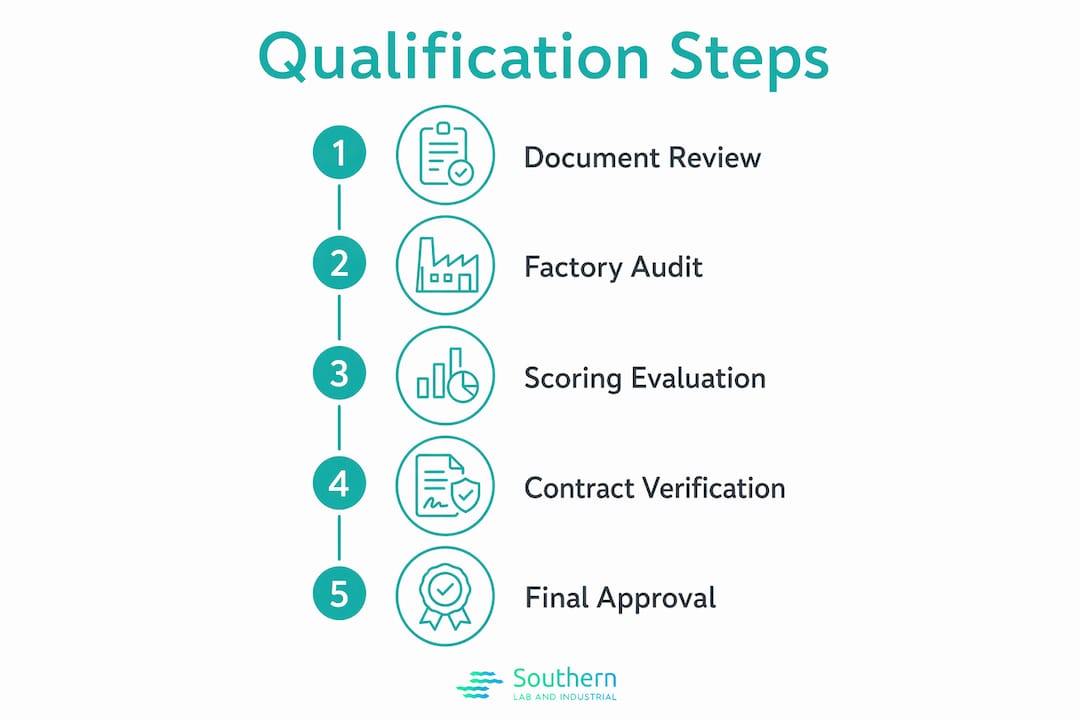
Gas generator supplier qualification is the structured process of assessing and validating vendors to confirm they can deliver compliant, reliable equipment for mission-critical operations. A structured qualification process can reduce procurement-related supplier risks by up to 40% compared to ad-hoc selection methods. That figure matters because unplanned downtime in analytical labs and industrial facilities carries costs far beyond the replacement unit. The gas generator supplier qualification steps covered in this guide apply directly to procurement officers and facility managers sourcing hydrogen, nitrogen, zero air, or backup power generators for GC, LCMS, ICP, and similar instrument-dependent environments.
What are the essential preliminary requirements for gas generator supplier qualification?
Supplier qualification in the gas generator context begins with document collection, not price negotiation. Before a vendor reaches your shortlist, you need verified evidence of legal standing, manufacturing authority, and quality system scope. Skipping this stage is the single most common reason procurement teams inherit a supplier problem rather than a supplier solution.
The four documents that carry the most weight at this stage are a current business license, an ISO 9001 certificate with explicit scope language, engine OEM authorization letters, and export compliance records. ISO 9001 certification scope must explicitly include generator set design, manufacture, and testing. A certificate that covers only trading or sales activity tells you nothing about production quality controls.
Engine OEM authorization letters from brands like Cummins, Perkins, or Kohler confirm the supplier is an authorized assembler rather than a gray-market reseller. Request at least three verifiable customer references with contact details, and cross-check export records against the claimed delivery volumes. Discrepancies between stated capacity and actual shipment history are a reliable early warning sign.

| Document | What to verify |
|---|---|
| Business license | Legal registration, active status, and business scope |
| ISO 9001 certificate | Scope covers design, manufacture, and testing of generator sets |
| Engine OEM authorization | Issued directly by the engine brand, current year |
| Export records | Volume and destination consistency with stated capacity |
| Customer references | Minimum three, with verifiable contact details |
Pro Tip: Request the ISO certificate number and verify it directly through the issuing certification body’s online registry. Counterfeit certificates are common enough that visual inspection alone is insufficient.
How do you conduct factory audits and inspections of gas generator suppliers?
A factory audit is the most reliable method for distinguishing a genuine manufacturer from a trading company that assembles components purchased from third parties. Remote live video factory audits can effectively substitute for physical visits when executed with continuous, unedited walkthroughs and real-time verification. The key word is unedited. A supplier who requests time to prepare the camera feed before walking the floor is already showing you something important.
During a physical or live video audit, focus your inspection on these areas:
- Production equipment and assembly lines: Confirm the facility has dedicated CNC machining, winding, or fabrication capacity appropriate to the generator type being sourced.
- Load bank testing station: A permanent load bank station is necessary to verify each unit’s rated output and operational stability. A portable load bank indicates the facility lacks permanent testing infrastructure.
- Factory acceptance test (FAT) reports: Each report must carry the unit-specific serial number. Generic test reports shared across multiple units are a clear red flag.
- Bill of materials (BOM) transparency: Request a sample BOM for the model you are evaluating. Verify that named components match the OEM authorization letters on file.
- Component traceability records: Confirm the supplier can trace each major component back to its origin. This matters for warranty claims and failure analysis later.
Transparency in factory testing is the strongest indicator of a reliable supplier. Marketing materials describe what a supplier wants you to believe. A serial-numbered FAT report and a permanent load bank describe what they actually do.
Pro Tip: During a remote video audit, ask the supplier to pan the camera slowly across the serial number plate of the unit currently on the load bank, then cross-reference that number against the FAT report they send afterward. This single check catches the majority of documentation fraud.
For facilities managing gas generator integration challenges, audit findings at this stage directly inform how much commissioning support you will need to negotiate into the contract.
What scoring criteria and weighting models best evaluate gas generator vendors?
Weighted scoring models remove the subjectivity that causes procurement teams to default to the lowest bid. Lead times for industrial-grade generators generally range between 25 and 60 days, and procurement emphasis on service SLA, lead times, and fuel efficiency each carry roughly equal weight in a well-constructed scorecard. The model only works if the weights reflect your site’s actual risk profile.
A research laboratory running GC instruments on hydrogen has a different risk profile than an industrial facility using a natural gas backup generator. The lab prioritizes purity consistency, instrument compatibility, and rapid technical response. The industrial site prioritizes uptime guarantee, fuel supply compatibility, and total cost of ownership over a five-year horizon. Your weighting model must reflect that distinction.
The table below shows a sample comparison of two vendors scored across five criteria for an industrial facility context:
| Criterion | Weight | Vendor A score (1-5) | Vendor B score (1-5) | Notes |
|---|---|---|---|---|
| Service SLA and response time | 25% | 4 | 3 | Vendor A has regional dispatch; Vendor B is centralized |
| Lead time reliability | 20% | 3 | 4 | Vendor B confirmed 30-day delivery; Vendor A quoted 55 days |
| Fuel efficiency and lifecycle cost | 20% | 4 | 3 | Vendor A provided verified fuel consumption data |
| Warranty terms and coverage | 20% | 3 | 4 | Vendor B offers 18-month warranty; Vendor A offers 12 months |
| Remote diagnostics capability | 15% | 5 | 2 | Vendor A includes telematics; Vendor B offers none |
| Weighted total | 100% | 3.75 | 3.25 | Vendor A preferred on service and diagnostics |
Documenting evidence for each criteria rating reduces unconscious bias and creates an auditable record for internal review boards. The most common scoring mistake is assigning equal weights to all criteria by default, which effectively treats remote diagnostics as equally important as service response time. That is rarely true in practice.
Pro Tip: Run your scorecard twice: once weighted for your current operational priorities, and once weighted for a worst-case scenario such as a key technician departure or a supply chain disruption. If the same vendor wins both scenarios, your selection is defensible under scrutiny.
Which contractual and SLA elements should be verified during supplier qualification?
Contract review during the gas generator vendor evaluation process is where procurement teams most often leave risk on the table. Standard warranty coverage is typically one year or 1,000 operating hours, but it excludes consumables and wear parts. That exclusion can represent a significant portion of your first-year operating cost if it is not negotiated upfront.
The SLA is equally important. A strong SLA distinguishes between phone response, remote triage, and on-site dispatch, with explicit commitments for both regular and after-hours support. Vague language like “best efforts” or “as soon as practicable” has no place in a contract for mission-critical equipment.
Key contractual terms to confirm before signing:
- Warranty scope: Confirm exactly which components are covered and which are excluded. Ask for a written list of excluded parts.
- Response time commitments: Separate phone acknowledgment time from remote triage time and on-site dispatch time. All three should carry defined maximums.
- Escalation protocols: Define what happens if the first-level technician cannot resolve the issue within the committed window.
- Emissions compliance responsibility: Contracts should clearly state who bears the ongoing emissions compliance and reporting burden. Vendor bids often shift these costs to the facility owner without explicit language.
- Commissioning and training: Confirm that installation, commissioning, and operator training are included in scope, not billed separately.
- Documentation delivery: Specify that as-built drawings, operation manuals, and maintenance schedules are delivered at commissioning, not months later.
| Contract element | What to confirm |
|---|---|
| Warranty duration | Length, hour cap, and exclusion list in writing |
| SLA response tiers | Phone, remote, and on-site response times with defined maximums |
| Compliance responsibility | Emissions reporting and permitting assigned to a named party |
| Commissioning scope | Installation, startup, and training included or itemized |
| Documentation delivery | Delivery date and format specified in the contract |
What are common pitfalls in qualifying gas generator suppliers?
The most expensive mistakes in the gas generator supplier evaluation process share a common pattern: they are all avoidable with the steps already outlined, but they occur when procurement teams compress timelines or prioritize speed over rigor.
- Overweighting initial purchase price. High failure risk occurs when buyers overweight initial capital expenditure and neglect lifecycle costs. A unit that costs 15% less at purchase but requires monthly service calls costs more over three years.
- Accepting certificates without verification. Fake ISO certificates and generic FAT reports are common enough to treat every document as unverified until confirmed through the issuing body.
- Ignoring fuel supply compatibility. A gas generator’s reliability depends heavily on accurate fuel quality data including pressure, methane content, and contaminants. Mismatched gas treatment systems cause recurring downtime regardless of generator quality. Understanding fuel and flow rate characteristics before finalizing a supplier selection prevents this category of failure entirely.
- Accepting vague SLA language. “Reasonable response time” is not a service commitment. If the contract does not define hours, it does not exist as an obligation.
- Skipping the service network check. A supplier with a single national service center may quote excellent response times but cannot physically deliver them to a Gulf Coast facility during a weather event. Request a map of authorized service locations and verify technician coverage in your region.
Key takeaways
A rigorous gas generator supplier qualification process requires verified documentation, scored factory audits, weighted vendor evaluation, and contract terms that assign accountability before any purchase order is issued.
| Point | Details |
|---|---|
| Document verification first | Confirm ISO 9001 scope, OEM authorization, and export records before shortlisting any vendor. |
| Audit with serial-number checks | Match FAT report serial numbers to units on the load bank to detect documentation fraud. |
| Weight criteria to your site profile | Assign scoring weights based on your facility’s actual risk priorities, not generic industry defaults. |
| Lock SLA tiers in writing | Define phone, remote, and on-site response times with explicit maximums in the contract. |
| Verify fuel compatibility early | Confirm gas pressure, methane content, and treatment system compatibility before finalizing selection. |
What I’ve learned from watching qualification processes succeed and fail
I have reviewed enough supplier qualification outcomes to say with confidence that the process fails in predictable ways. The most common failure is not a bad supplier. It is a procurement team that ran a thorough paper review and then accepted verbal assurances during the audit stage. A supplier who says “our load bank is being serviced this week” during a factory visit is telling you something. The right response is to reschedule, not to proceed.
The second pattern I see consistently is misaligned scoring weights. A facility manager who weights initial price at 40% because budget pressure is real this quarter will almost always regret that decision by year two. The hidden costs of poor service coverage and inadequate diagnostics accumulate quietly until a critical instrument goes down on a Friday afternoon and the nearest authorized technician is four hours away.
What actually works is treating the qualification process as a risk management exercise rather than a procurement formality. Every step in the process, from document verification to SLA negotiation, exists to answer one question: will this supplier perform when it matters most? Suppliers who are genuinely confident in their operations welcome the scrutiny. Those who resist it are telling you the answer.
Post-qualification relationship management matters as much as the initial selection. Schedule a formal performance review at six months and twelve months. Track actual response times against contracted SLA commitments. If a supplier is consistently missing their own targets, you have documented grounds for renegotiation or transition before a critical failure occurs.
— Kris
How SLI supports your gas generator procurement process
SLI works directly with procurement officers and facility managers across the Gulf Coast to evaluate, specify, and integrate on-site gas generation systems from partners including LNI Swissgas and Nel Hydrogen. Whether you are qualifying suppliers for a new hydrogen generator installation or replacing a cylinder-based nitrogen supply for GC or LCMS instruments, SLI provides the technical consultation and local support that makes the qualification process faster and more defensible.
SLI’s team brings hands-on experience with real-world integration challenges that surface after a purchase order is signed, from fuel compatibility issues to commissioning gaps that vendors leave unresolved. If you are building a vendor evaluation checklist or need a second opinion on a supplier’s factory audit documentation, SLI is the local partner that knows what to look for. Explore SLI’s full range of laboratory gas generator solutions or contact the team directly to discuss your procurement timeline.
FAQ
What documents are required to qualify a gas generator supplier?
The core documents are a current business license, an ISO 9001 certificate with manufacturing scope, engine OEM authorization letters, and verifiable customer references. Each document should be confirmed through the issuing authority, not accepted at face value.
How long does the supplier qualification process take?
A thorough qualification process for high-stakes industrial equipment typically takes around six months to complete. Compressing this timeline increases the risk of selecting a supplier whose capabilities do not match their documentation.
What is the most common reason gas generator supplier qualification fails?
The most frequent cause is overweighting initial purchase price while underweighting service SLA quality and fuel compatibility. Buyers who neglect fuel supply validation often experience recurring downtime that no amount of warranty coverage can offset.
How do you verify a factory audit remotely?
Request a continuous, unedited live video walkthrough and ask the supplier to display the serial number plate of the unit currently on the load bank. Cross-reference that number against the FAT report submitted afterward. This method effectively substitutes for physical visits when executed without interruption.
What SLA terms matter most in a gas generator contract?
The contract must define separate response time commitments for phone acknowledgment, remote triage, and on-site dispatch, with explicit maximums for both standard and after-hours scenarios. Vague language like “best efforts” provides no enforceable protection for operational continuity.