Choosing the right gas generation system is one of the most consequential infrastructure decisions an industrial facility can make. The types of industrial gas generation systems available today span a wide range of technologies, each with distinct trade-offs in purity, capacity, energy consumption, and total cost of ownership. Whether you are evaluating options for a Gulf Coast chemical plant, a precision manufacturing line, or an analytical laboratory, the selection criteria remain consistent: reliability, safety, purity targets, and the realistic operational burden your team can sustain. This guide breaks down each major technology with enough specificity to support a real engineering decision.
Table of Contents
- Key takeaways
- 1. Types of industrial gas generation systems: an overview of how to evaluate them
- 2. Pressure swing adsorption nitrogen and oxygen generators
- 3. Membrane gas generators
- 4. Cryogenic air separation units for high-purity gas production
- 5. Hydrogen generation: SMR, electrolysis, and what is changing in 2026
- 6. Gas-fired power generation technologies integrated with industrial gas systems
- 7. Comparing industrial gas generation systems: the decision matrix
- My honest take on system selection after years in this field
- Getsli gas generation systems for industrial and laboratory facilities
- FAQ
Key takeaways
| Point | Details |
|---|---|
| PSA suits mid-range purity needs | Pressure swing adsorption delivers nitrogen at 95–99.999% purity with scalable capacity for most industrial users. |
| Cryogenic ASUs dominate high-volume applications | Cryogenic air separation is the only practical option when simultaneous production of high-purity oxygen, nitrogen, and argon is required at scale. |
| SMR still leads hydrogen production | Steam Methane Reforming accounts for 50% of global hydrogen output, but regulatory pressure is accelerating the shift to blue and green alternatives. |
| Captive generation trades cost for complexity | On-site gas generation reduces logistics costs but places a significant operational and safety management burden on the facility team. |
| System selection drives long-term efficiency | Matching technology to actual purity, volume, and uptime requirements avoids oversizing capital expenditure and hidden operating costs. |
1. Types of industrial gas generation systems: an overview of how to evaluate them
Before selecting a technology, you need a clear framework. The major variables that separate one industrial gas system from another are gas purity, production volume, energy intensity, maintenance complexity, safety profile, and capital cost versus operating cost balance. No single technology wins on all dimensions. PSA nitrogen generators, for example, deliver excellent purity at moderate cost but cannot match the throughput of a cryogenic air separation unit. Membrane generators are compact and inexpensive but cannot reach the purity levels required for most analytical or chemical applications. Understanding where your facility sits on the volume and purity matrix is the first step before evaluating any individual system.
2. Pressure swing adsorption nitrogen and oxygen generators
PSA is the workhorse of on-site industrial gas production methods for nitrogen and oxygen. The technology works by passing compressed air through a bed of adsorbent material, typically carbon molecular sieve for nitrogen or zeolite for oxygen. The adsorbent captures one component of the air while the other passes through as product gas. Two beds alternate under pressure cycling so that while one bed adsorbs, the other regenerates. This gives you a continuous supply without the interruptions you would associate with batch processes.
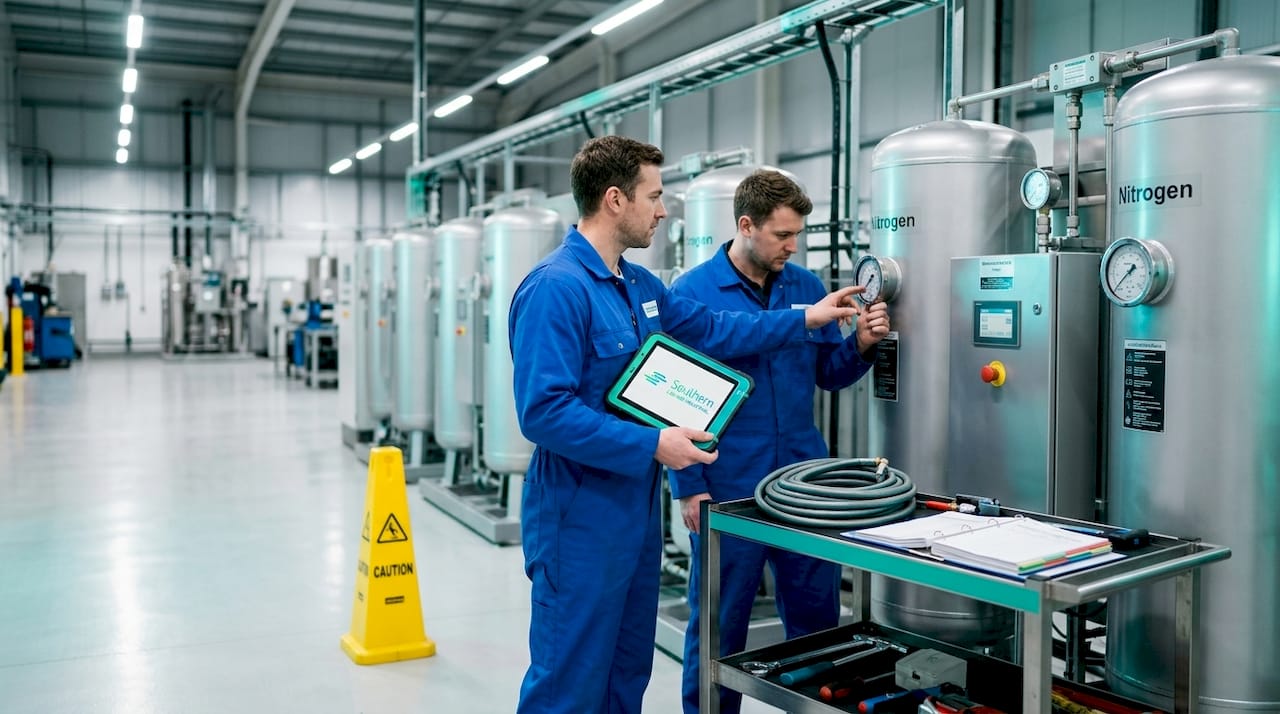
PSA nitrogen generators produce gas in a purity range of 95% to 99.999%, depending on the adsorbent specification and cycle tuning. PSA oxygen generators typically reach 90–95% purity, which covers most industrial combustion and wastewater treatment applications but falls short of medical-grade requirements. Scalability is a genuine strength. You can configure modular PSA banks to grow capacity in step with production demand, which avoids the sunk-cost problem of over-specified cryogenic infrastructure at a smaller facility.
Key operational considerations for PSA systems:
- Compressed air quality is critical. Oil, moisture, and particulates degrade the adsorbent bed and shorten service life significantly.
- Energy consumption is moderate, driven primarily by the air compressor. Variable speed compressors reduce this materially.
- Maintenance intervals center on adsorbent bed inspection, valve servicing, and compressor upkeep.
- Footprint is manageable for most industrial facilities, typically fitting in a standard equipment room.
- PSA systems reach steady-state purity quickly after startup, making them well-suited to facilities with variable demand.
Pro Tip: Invest in a dedicated compressed air dryer and filtration train upstream of any PSA generator. The adsorbent bed is the highest-cost consumable in the system, and moisture contamination is the most common cause of premature replacement.
3. Membrane gas generators
Membrane technology separates gases by exploiting differential permeation rates through hollow fiber polymer membranes. Smaller, more permeable molecules pass through the membrane wall faster than larger ones. For nitrogen generation, oxygen and water vapor permeate rapidly out of the compressed air stream, leaving a nitrogen-enriched product gas on the bore side. The process requires no moving parts beyond the upstream compressor, which gives membrane generators their well-known reliability advantage.
The practical limitations are equally clear. Membrane systems for nitrogen top out around 99.5% purity under favorable conditions, and output volume drops sharply as you push toward higher purity because the flow rate trade-off becomes punishing. For facilities requiring nitrogen above 99.9%, PSA or cryogenic technology is the better fit.
Where membrane generators make sense:
- Applications with moderate purity requirements, such as tank blanketing, purging, or fire suppression systems
- Remote locations where maintenance access is restricted and mechanical simplicity is a priority
- Facilities needing a compact, low-installation-cost unit with fast deployment
- Operations with lower throughput requirements where a PSA system would be significantly oversized
The strengths here are real. No valve switching, no adsorbent beds to replace, and a form factor that fits in tight spaces. The NG Series nitrogen generators from Getsli, for example, address exactly this kind of application within laboratory and light industrial environments where purity and footprint requirements intersect.
4. Cryogenic air separation units for high-purity gas production
Cryogenic distillation is a fundamentally different category of gas generation technology. Where PSA and membrane systems work at near-ambient temperatures, cryogenic air separation units cool atmospheric air to roughly negative 185 degrees Celsius, at which point the mixture liquefies. The liquid is then distilled in a column that exploits the different boiling points of oxygen, nitrogen, and argon to separate them into high-purity product streams simultaneously.
This is the only technology that simultaneously produces oxygen at 99.5%+ purity, nitrogen at 99.9999% purity, and argon at 99.999% purity in commercially significant volumes. For industries such as steel manufacturing, glass production, electronics fabrication, and large-scale chemical processing, cryogenic ASUs are not one option among many. They are the only viable option.
Typical applications and gas products from cryogenic ASUs:
- Oxygen at 99.5% or higher for basic oxygen steelmaking furnaces
- Nitrogen at 99.9999% for electronics wafer fabrication and semiconductor processing
- Argon for welding shield gas and specialty metallurgy
- Liquid products that can be stored on-site and vaporized as backup supply
The trade-offs are substantial. Capital expenditure for a cryogenic plant is orders of magnitude higher than a PSA system. Energy intensity is significant, and the infrastructure requirements, including cold boxes, distillation columns, and storage vessels, demand serious site preparation. Modular cryogenic units have reduced the minimum economic scale in recent years, but this technology still favors high-volume, continuous-production environments.
Pro Tip: If your facility also needs a liquid nitrogen backup for critical processes, sizing your cryogenic ASU with a small liquefier section is almost always more cost-effective than purchasing merchant liquid nitrogen under a long-term supply contract.
5. Hydrogen generation: SMR, electrolysis, and what is changing in 2026
Hydrogen production sits at the center of the industrial energy transition, and the technology options are genuinely evolving faster than almost any other area of gas generation technology. As a facility manager evaluating hydrogen supply in 2026, you face a decision that is as much about regulatory exposure as it is about engineering.
SMR accounts for about 50% of global hydrogen production today. In SMR, natural gas reacts with steam over a catalyst at high temperature to produce hydrogen and carbon dioxide. The process is cost-effective at scale and produces hydrogen at very high purity after purification, but it carries a significant carbon footprint unless paired with carbon capture. Blue hydrogen adds carbon capture and storage to SMR, reducing net emissions substantially. Green hydrogen uses electrolysis powered by renewable electricity to split water, producing hydrogen with no direct carbon emissions.
| Production Method | Purity | Carbon Intensity | Relative Cost | Best Fit |
|---|---|---|---|---|
| Steam Methane Reforming (SMR) | 99.999% after PSA | High | Low to moderate | Large-scale industrial hydrogen demand |
| Blue Hydrogen (SMR + CCS) | 99.999% | Low to moderate | Moderate | Facilities under carbon regulation |
| Green Hydrogen (Electrolysis) | 99.999% | Near zero | Currently high | Decarbonization mandates, renewable-rich sites |
| Autothermal Reforming (ATR) | 99.9%+ | Moderate with CCS | Moderate | Large-scale blue hydrogen projects |
Feedstock quality critically determines the efficiency and catalyst life of any reforming-based system. When using biogas or other impure feedstocks in SMR, gas upgrading to remove sulfur, siloxanes, and other catalyst poisons is not optional. Skipping this step accelerates catalyst deactivation and reduces hydrogen yield, which converts to direct operating losses. The shift toward green hydrogen via on-site PEM electrolysis is gaining traction, particularly in facilities that have access to renewable power and are facing tightening carbon reporting requirements.
6. Gas-fired power generation technologies integrated with industrial gas systems
For many industrial facilities, gas generation and power generation are not separate decisions. Reciprocating internal combustion engines (RICE), combined cycle gas turbines (CCGT), and simple cycle gas turbines (SCGT) each represent a different efficiency and flexibility profile when integrated with captive gas systems.
Electrical efficiency for these systems ranges from 33% for simple-cycle turbines to 60% for combined cycle configurations, with combined heat and power cogeneration reaching 90% when waste heat is fully recovered. That 90% figure is not theoretical. It reflects real-world RICE installations where exhaust heat is recovered for process steam, space heating, or absorption cooling.
Pro Tip: Underestimating heat recovery integration during the design phase is one of the most common and costly engineering mistakes in gas-fired plant projects. If you are specifying a RICE or CCGT system, engage a cogeneration specialist during the front-end engineering phase, not after the equipment is selected.
Lead times for new gas-fired power plants range from 12 to 48 months, which has direct implications for capital planning. Quadgeneration systems that integrate power, heat, cooling, and CO₂ recovery go a step further. Quadgeneration systems can operate on natural gas, biogas, biomethane, or hydrogen blends, and when CO₂ recovery is added, the captured carbon dioxide can meet beverage-grade or process-grade purity specifications for on-site use. For facilities managing both gas supply and energy costs simultaneously, this level of integration materially improves the total resource efficiency picture.
7. Comparing industrial gas generation systems: the decision matrix
Once you have a working knowledge of each technology, the selection decision comes down to matching your specific operational profile against the genuine trade-offs in this table.
| System Type | Typical Purity | Capital Cost | Operating Cost | Maintenance Burden | Scalability |
|---|---|---|---|---|---|
| PSA Nitrogen/Oxygen | 95–99.999% | Low to moderate | Moderate | Moderate | High |
| Membrane Nitrogen | Up to 99.5% | Low | Low | Very low | Moderate |
| Cryogenic ASU | 99.5–99.9999% | Very high | High | High | Very high |
| SMR Hydrogen | 99.999% | Moderate to high | Low to moderate | High (catalyst) | High |
| PEM Electrolysis | 99.999% | High | Moderate (power) | Low | Moderate to high |
Captive on-site generation reduces logistics costs and supply chain exposure, but it requires your team to absorb the operational and safety management responsibilities that a merchant gas supplier would otherwise carry. Facilities with limited engineering depth often underestimate this burden. Merchant providers achieve higher resource efficiency and emission performance through networked assets, which is a meaningful consideration for facilities with intermittent or variable gas demand. The practical recommendation: use captive generation where your demand is consistent, your team has the expertise, and the payback period on capital investment is under five years.
My honest take on system selection after years in this field
I have watched facilities make expensive mistakes in both directions. Some over-engineer by installing a cryogenic ASU when a mid-size PSA system would have met their nitrogen purity requirements at a fraction of the capital cost. Others under-specify and then live with a membrane generator that cannot hold the purity target their process actually needs, which means they are back to cylinder supply within eighteen months of commissioning.
The pattern I see most often is that the purity specification gets set conservatively by engineering, the volume estimate is based on peak demand rather than average demand, and the maintenance burden gets assessed based on the manufacturer’s ideal-case scenario. All three of those habits push the decision toward a larger, more complex system than the facility can realistically operate.
What I have found actually works is starting with the process specification first and working backward to the technology. If you need nitrogen at 99.995% for electronics assembly, a PSA system with a quality adsorbent and a well-specified air feed gets you there reliably. If you need hydrogen for fuel cell testing and your site has access to solar or wind generation, green hydrogen via PEM electrolysis is worth the current cost premium, especially with the regulatory trajectory clearly pointing toward carbon pricing. The laboratory safety checklist for gas handling environments is also worth reviewing alongside your engineering specifications. Safety compliance adds real constraints to how a system gets sited, ventilated, and monitored.
The integration question is the one most facility managers leave until too late. If you are specifying a RICE-based cogeneration system alongside a captive gas plant, the heat and CO₂ recovery synergies need to be engineered in from the start. Retrofitting them adds cost and almost always delivers less value than a coordinated design would have.
— Kris
SLI gas generation systems for industrial and laboratory facilities
SLI works directly with industrial facilities and analytical laboratories along the Gulf Coast to specify, supply, and commission on-site gas generation systems that replace cylinder dependency with a continuous, high-purity supply. Whether your requirement is nitrogen for LC-MS or ICP instruments, hydrogen for GC carrier gas or fuel cell applications, or zero air for combustion analysis, Getsli’s product lines through LNI Swissgas and Nel Hydrogen cover the specification range most facilities actually need. The lab gas generator portfolio includes systems sized from single-instrument support to full-facility supply, with turnkey installation and local technical support included. For larger industrial hydrogen requirements, Getsli’s industrial hydrogen generation solutions based on Nel PEM electrolyzers address both current production needs and the decarbonization requirements facilities are planning for now.
FAQ
What is the most common type of industrial gas generation system?
Pressure swing adsorption is the most widely deployed technology for on-site nitrogen and oxygen generation in industrial facilities. It balances purity, capacity, and total cost of ownership for the broadest range of applications.
How do cryogenic ASUs differ from PSA generators?
Cryogenic air separation units cool air to liquefaction and distill it, producing oxygen, nitrogen, and argon at very high purities and large volumes. PSA systems use adsorbent beds at near-ambient temperature and are better suited to mid-volume, single-gas applications.
What is green hydrogen and why does it matter for industrial users?
Green hydrogen is produced by electrolyzing water using renewable electricity, generating no direct carbon emissions. With tightening carbon regulations in 2026, facilities that lock into SMR-based hydrogen supply without a decarbonization plan face increasing regulatory and cost exposure.
How do I choose between captive on-site generation and merchant gas supply?
On-site generation lowers logistics costs and improves supply security for facilities with consistent, high-volume demand. Merchant supply is more practical for facilities with variable demand or limited engineering resources to manage operational and safety compliance requirements.
What efficiency levels do industrial gas-fired power systems reach?
Electrical efficiency ranges from 33% for simple-cycle turbines to 60% for combined cycle plants, with cogeneration systems recovering waste heat to reach overall efficiency approaching 90%.