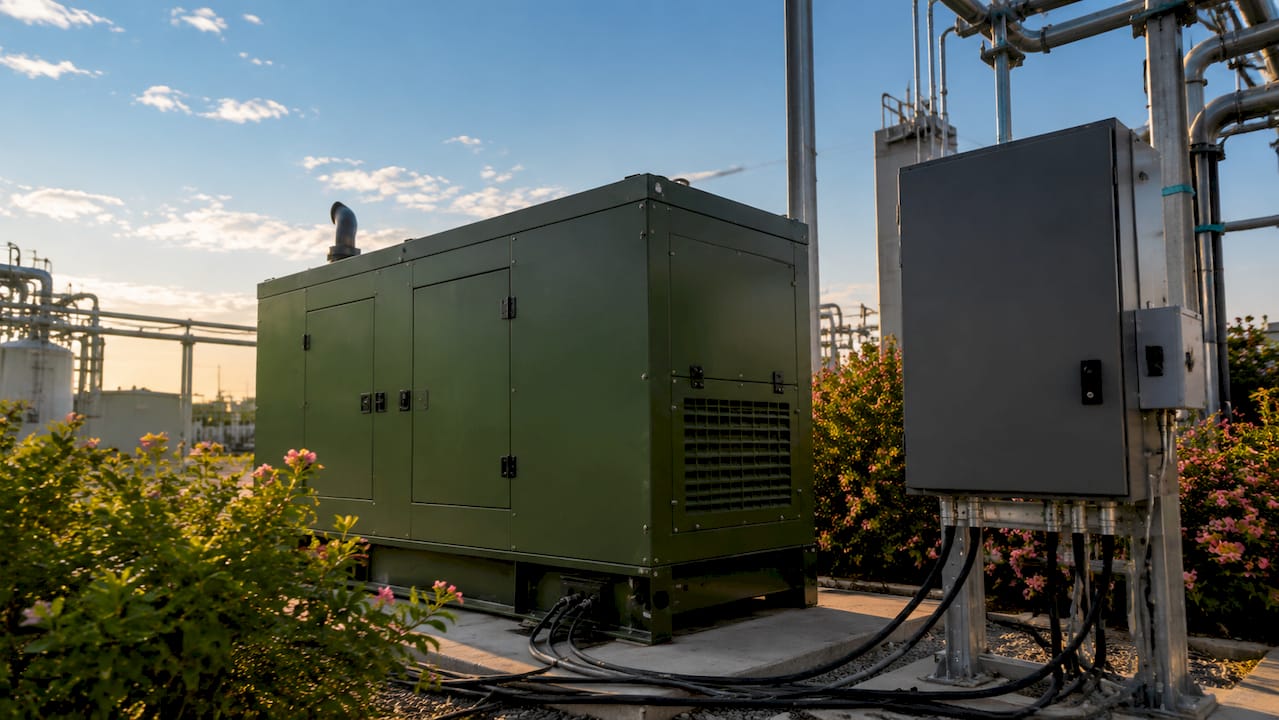
Generator automatic switchover is defined as the ATS-controlled process that detects utility power failure and automatically transfers electrical load to a standby generator, restoring power without manual intervention. The device at the center of this process is the Automatic Transfer Switch (ATS), a code-governed component that continuously monitors utility power for voltage and frequency anomalies. Standards like NEC Article 700, NEC Article 702, and UL 1008 define how these systems must perform. For facility managers and engineers running power-critical operations, understanding this process is the difference between a controlled outage response and unplanned downtime that costs real money.
How does generator automatic switchover work step by step?
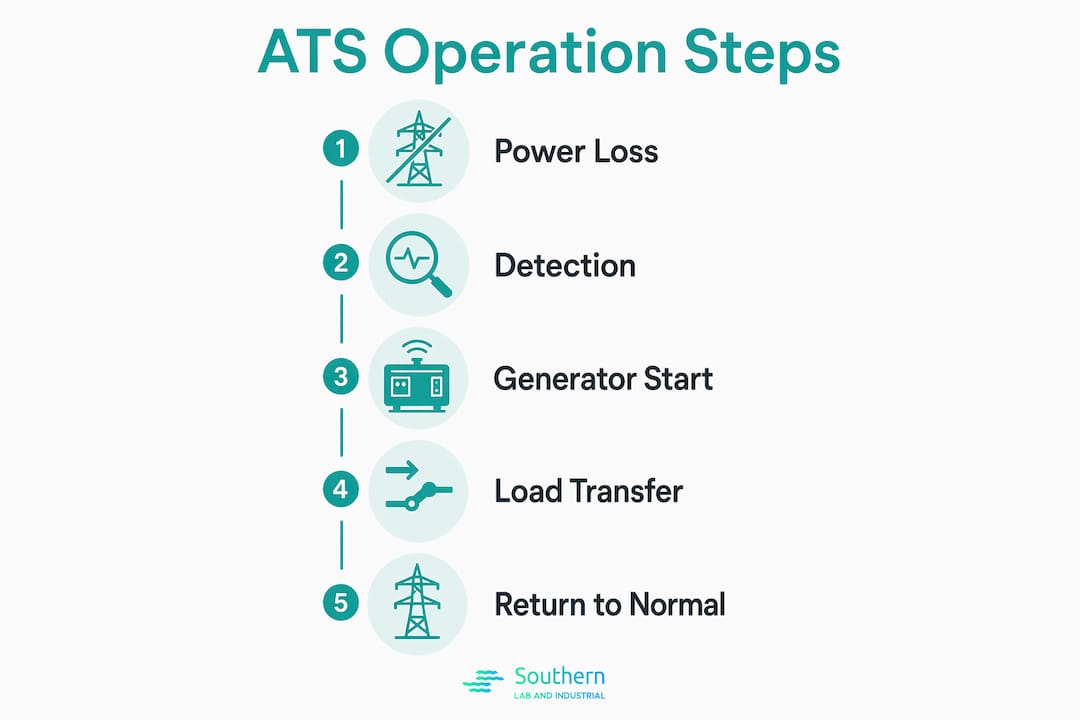
The generator switch over process follows a precise, repeatable sequence governed by the ATS controller. Each step is timed and conditional, not arbitrary. Here is the standard sequence:
- Utility monitoring. The ATS continuously samples incoming utility voltage and frequency. When readings fall outside preset thresholds, the controller registers a failure condition.
- Start signal. The ATS sends a start command to the generator engine. A configurable time delay, typically 2–10 seconds, filters out momentary voltage dips that would otherwise cause nuisance starts.
- Generator stabilization. The engine runs up to rated speed. The ATS waits until generator output reaches stable voltage and frequency, confirming the source is ready to accept load.
- Load transfer. The ATS opens the utility contactor and closes the generator contactor. This break-before-make sequence prevents the two sources from connecting simultaneously.
- Utility return monitoring. When utility power returns and stabilizes, the ATS waits through a retransfer delay, typically 5–30 minutes, before switching load back.
- Cool-down and shutdown. After retransfer, the generator runs unloaded for a cool-down period, then shuts down automatically.
NEC Article 700 requires emergency power to be available within 10 seconds of normal power failure. That 10-second ceiling is not a guideline. It is a code mandate that directly shapes how ATS controllers are programmed and how generators are sized.
Pro Tip: Set your engine start delay to at least 3 seconds. Most utility disturbances resolve within that window, and you will avoid unnecessary generator cycling that accelerates engine wear.
What are the different types of transfer switches?
Not all automatic transfer switches behave the same way. The transition mode determines how much interruption your loads experience and how complex the installation becomes.
| Transfer Switch Type | Transition Mode | Power Interruption | Source Synchronization Required | Best Application |
|---|---|---|---|---|
| Open Transition ATS | Break-before-make | Milliseconds to sub-second | No | Standard standby systems |
| Closed Transition ATS | Make-before-break | None (no-break) | Yes | Mission-critical facilities |
| Manual Transfer Switch | Operator-initiated | Variable | No | Optional standby, NEC 702 |
Open transition is the standard in generator standby systems. The ATS opens the utility connection before closing the generator connection. This brief interruption is acceptable for most industrial loads and avoids any risk of paralleling two unsynchronized sources. Open transition remains standard because of its operational simplicity and inherent safety.
Closed transition allows a no-break transfer by briefly paralleling both sources during the switchover. This requires the ATS controller to verify that utility and generator are synchronized in voltage, frequency, and phase angle before closing. The added complexity is justified for facilities running sensitive analytical instruments, continuous process lines, or data systems where even a sub-second interruption causes problems.
Key considerations when selecting a transfer switch type:
- Load sensitivity: Does your equipment tolerate a brief interruption, or does it require truly uninterrupted power?
- Generator capability: Closed transition requires a generator with synchronizing controls, which adds cost.
- UL 1008 certification confirms the switch meets endurance, reliability, and short-circuit withstand requirements up to 1,000 V.
- Manual transfer switches are permitted under NEC Article 702 for optional standby systems, but they must prevent simultaneous connection of both sources.
Pro Tip: For facilities running GC, LCMS, or ICP instruments on generator backup, specify a closed transition ATS. The synchronization cost is far lower than the cost of a failed analytical run or instrument recalibration after a power bump.
What are the code compliance requirements for ATS installations?
Code compliance for an automatic generator switching system is not optional, and the requirements vary based on how your system is classified.
NEC Article 700 vs. Article 702 is the first distinction to get right. Article 700 covers emergency systems, which are life-safety circuits like egress lighting and fire pumps. These require automatic transfer and must meet the 10-second availability mandate. Article 702 covers optional standby systems, which serve loads like production equipment and HVAC. NEC distinguishes emergency from standby because the consequences of failure differ, and so do the design requirements.
Core compliance requirements for ATS installations include:
- Source isolation. The ATS must prevent any condition where utility and generator are connected simultaneously. This is the primary safety function of the device.
- UL 1008 listing. Transfer switches must be listed under UL 1008, which evaluates switch performance under endurance cycling, overload, and short-circuit conditions.
- Protective device coordination. Upstream breakers and fuses must be coordinated with the ATS to avoid nuisance tripping during transfer transients.
- Transfer thresholds. Voltage and frequency dropout thresholds must be set to reflect actual utility power quality at your site, not generic defaults.
- Commissioning verification. Every ATS installation requires a witnessed transfer test under load to confirm timing, sequencing, and interlock behavior before the system is placed in service.
The electrical requirements for gas generation systems in industrial facilities add another layer. When a gas generator is part of the backup power chain, the ATS must account for the generator’s startup characteristics and the downstream load profile of analytical instruments.
What are the benefits and challenges of automatic generator switchover?
The benefits of automatic switchover are direct and measurable. The challenges are real but manageable with proper engineering.
Core operational benefits
Automatic power restoration removes the human variable from the outage response. There is no waiting for a technician to arrive, no manual interlock to operate, and no risk of connecting sources out of sequence. Reliable ATS performance depends on system-level coordination, but when that coordination is done correctly, the switch operates the same way every time, regardless of when the outage occurs.
For facilities running continuous processes or sensitive instruments, the consistent transfer sequence protects equipment from the irregular voltage profiles that occur during manual switching. On-site generation paired with a properly programmed ATS delivers a level of power continuity that manual systems cannot match.
Common operational challenges
- Nuisance transfers. Without proper programming of utility failure thresholds and timing delays, brief voltage dips trigger unnecessary generator starts. Each unnecessary start adds engine hours and fuel cost.
- Load inrush at transfer. Large motor loads create inrush currents when power is restored. The ATS must be sized to handle this, and load sequencing may be needed to stage reconnection.
- Generator wear from short runs. Frequent short-duration generator runs caused by nuisance transfers accelerate engine wear more than long runs do. Proper delay tuning is the fix.
- Programmable controller complexity. Advanced controllers like the Woodward DTSC-200A offer programmable transfer schemes including open and closed transition, timed neutral, and fast switching under 100 milliseconds. That flexibility requires a qualified engineer to configure correctly.
Pro Tip: Log every generator start event from your ATS controller for the first 90 days after commissioning. If you see starts triggered by events shorter than your configured delay, your threshold settings need adjustment.
Key takeaways
A properly engineered automatic generator switchover system depends on ATS selection, code-compliant configuration, and system-level commissioning, not just the transfer switch device itself.
| Point | Details |
|---|---|
| ATS governs the full sequence | The switch monitors utility, starts the generator, transfers load, and manages retransfer automatically. |
| NEC sets the timing floor | Emergency systems must restore power within 10 seconds under NEC Article 700. |
| Transition mode affects load impact | Open transition causes a brief interruption; closed transition requires synchronization but delivers no-break transfer. |
| Nuisance transfers are preventable | Correct delay and threshold programming eliminates unnecessary generator starts and reduces engine wear. |
| System-level integration is required | ATS sizing, protective device coordination, and field commissioning determine real-world reliability. |
Why facility engineers underestimate ATS commissioning
Most of the ATS failures I have seen in industrial facilities were not equipment failures. They were commissioning failures. The switch was listed, installed, and wired correctly, but nobody ran a full transfer test under actual load conditions before signing off.
The gap between a bench-tested ATS and a field-commissioned one is significant. Utility power quality at your specific site, the startup characteristics of your generator, and the inrush profile of your connected loads all interact in ways that factory defaults do not anticipate. I have watched facilities spend considerable money on a quality ATS controller, then configure it with generic threshold values that triggered nuisance transfers every time the utility had a momentary sag.
The other thing engineers consistently underestimate is the retransfer sequence. Everyone focuses on the outage response, but the return to utility is where I have seen the most equipment stress. A poorly timed retransfer, before the utility has fully stabilized, can expose sensitive instruments to a second disturbance worse than the original outage.
My recommendation is to treat ATS commissioning as a separate project phase with its own acceptance criteria. Coordinate directly with your generator vendor and your utility representative to understand the actual power quality characteristics at your service entrance. Then tune your ATS parameters to match. The long-term cost benefit of getting this right, in reduced generator wear and avoided equipment damage, is substantial.
— Kris
How SLI supports gas generator and power protection integration
SLI works with industrial facilities and analytical laboratories along the Gulf Coast on exactly the kind of power reliability challenges described in this article. When a gas generator is part of your backup power system, the ATS configuration and the generator’s startup behavior must be matched to the downstream instrument load.
SLI’s experience with gas generator integration challenges covers the full range of real-world scenarios, from nuisance transfer troubleshooting to closed-transition ATS specification for GC and LCMS systems. For facilities that also need power protection for industrial equipment, SLI offers NXT Power conditioning solutions that complement ATS-based backup systems. Contact SLI to discuss your facility’s power continuity requirements and get a configuration recommendation grounded in field experience.
FAQ
What is a generator automatic switchover?
A generator automatic switchover is the process where an Automatic Transfer Switch detects utility power failure and transfers electrical load to a standby generator without manual intervention. The ATS manages the full sequence from generator start to load transfer and retransfer.
How does an automatic generator transfer switch work?
The ATS continuously monitors utility voltage and frequency. When readings fall outside set thresholds, it signals the generator to start, waits for stable output, then opens the utility connection and closes the generator connection in a break-before-make sequence.
What is the NEC requirement for emergency generator switchover timing?
NEC Article 700 requires emergency power to be available within 10 seconds of normal power failure. This requirement applies to life-safety systems and directly determines how ATS controllers and generators must be sized and programmed.
What is the difference between open and closed transition transfer switches?
Open transition briefly interrupts power during the switch to prevent paralleling two sources. Closed transition briefly parallels both sources for a no-break transfer but requires source synchronization, adding system complexity and cost.
What causes nuisance transfers in automatic switchover systems?
Nuisance transfers occur when ATS delay and voltage threshold settings are too sensitive, causing the system to start the generator in response to brief utility voltage dips. Correct threshold and timing configuration eliminates most nuisance transfer events.