Industrial power conditioning is defined as the process of modifying electrical supply to meet the quality requirements of sensitive industrial equipment, covering voltage regulation, harmonic filtering, noise suppression, and transient protection. The recognized industry term for this discipline is power quality management, and understanding both terms helps you communicate accurately with utilities, equipment vendors, and standards bodies. For facility operators and engineering teams, industrial power conditioning explained in practical terms means the difference between predictable uptime and recurring, unexplained equipment failures. This article covers the core disturbances, the technologies that address them, and the financial case for acting before a failure forces your hand.
What are the common power quality disturbances in industrial facilities?
Power quality disturbances are not random events. They follow predictable patterns tied to your facility’s load profile, equipment mix, and utility feed characteristics.
Voltage sags are the most economically damaging disturbance in industrial settings. Voltage sags cost the U.S. industrial sector between $119 billion and $188 billion annually. A sag reduces rms voltage to 10%–90% of nominal for anywhere from half a cycle to one minute, which is long enough to trip PLCs, reset drives, and abort batch processes.
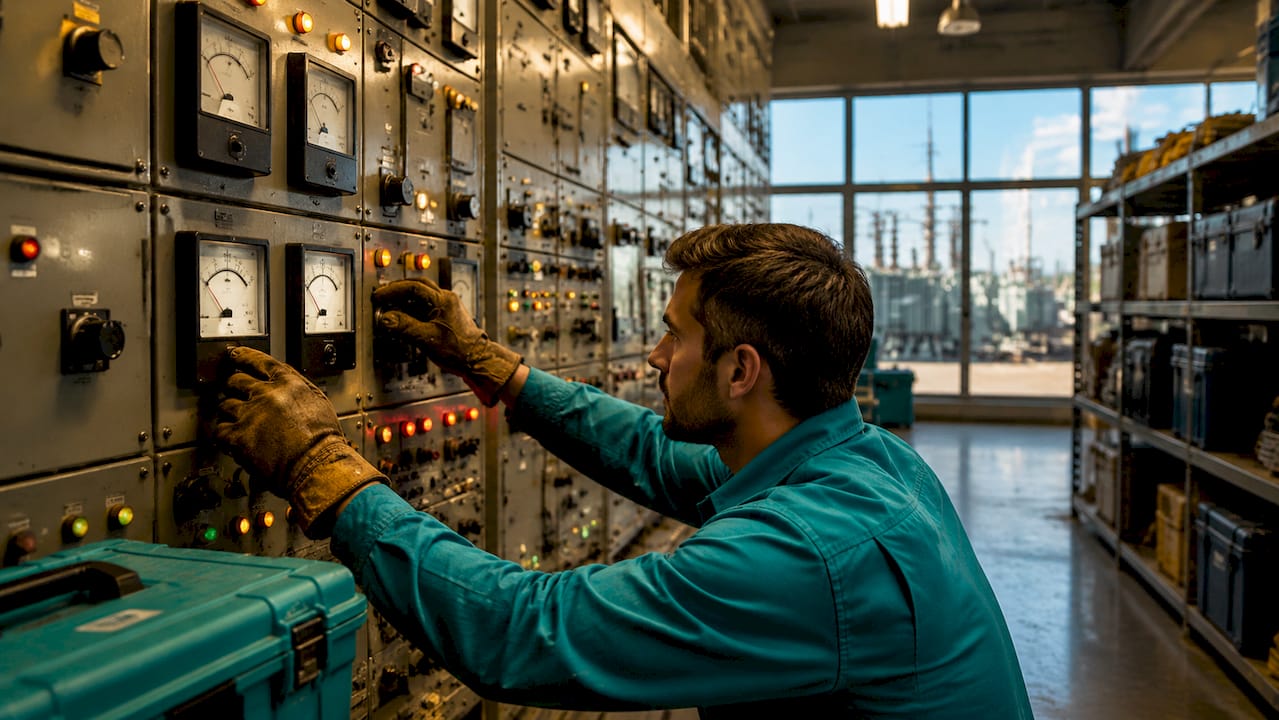
Harmonic distortion is generated by non-linear loads such as variable frequency drives (VFDs), rectifiers, and switch-mode power supplies. These loads draw current in pulses rather than smooth sine waves, injecting harmonic currents back into the distribution system. The result is overheated transformers, nuisance breaker trips, and accelerated insulation degradation across the facility.
Electrical transients are often misunderstood because most engineers assume they originate from the utility. 80% of electrical transients are generated inside industrial facilities, driven by motor starts, capacitor switching, and breaker operations. These low-magnitude, high-frequency events cause cumulative damage to PLCs and drives that shows up as intermittent faults with no obvious cause.
The four disturbances that most facility teams need to track are:
- Voltage sags and swells: Duration and magnitude determine equipment compatibility thresholds.
- Total harmonic distortion (THD): IEEE 519 sets limits for both current and voltage harmonics at the point of common coupling.
- Transient surges: Ring Wave and impulse transients bypass standard surge protectors and cause latent failures.
- Power factor: A power factor below 0.90 typically triggers utility demand charges, adding direct cost to every billing cycle.
Power factor correction using capacitors typically pays back in 8–14 months by reducing penalties and system losses. That payback period is short enough to justify the investment on financial grounds alone, before you factor in the equipment protection benefit.
How do industrial power conditioning systems improve power quality?
The technologies used in power quality management fall into two broad categories: passive and active. Passive systems use fixed components like capacitors, inductors, and transformers. Active systems use power electronics to measure disturbances in real time and inject corrective signals.
| Technology | Response Time | Best Application | Efficiency |
|---|---|---|---|
| Passive harmonic filter | Not applicable | Fixed harmonic loads | Moderate |
| Active harmonic filter | Less than 10 ms | Variable, mixed loads | High |
| IGBT static stabilizer | 5–10 ms | Voltage regulation | Up to 98.5% |
| Power factor correction capacitor bank | Switched (seconds) | Reactive power compensation | High |
| Industrial UPS with isolation transformer | Milliseconds | Noise isolation, ride-through | High |
Active harmonic filters can reduce total harmonic distortion of current (THDi) to below 5% with response times under 5 milliseconds. That speed matters because harmonic currents change as your load mix shifts throughout a production shift. A passive filter sized for one operating condition becomes a liability when the load changes.
IGBT-based static stabilizers achieve up to 98.5% efficiency with millisecond reaction times, outperforming older electromechanical stabilizers by a significant margin. Facilities running precision CNC equipment, analytical instruments, or automated assembly lines benefit most from this class of device because voltage excursions that last only a few cycles are enough to cause process errors.
Surge protective devices (SPDs) address transient impulses but do not filter high-frequency conducted noise or Ring Wave transients. High-frequency Ring Wave transients bypass standard surge protectors and cause latent equipment failures that are difficult to trace. Dedicated power line filters installed at the branch circuit level are required to stop this class of disturbance.
Pro Tip: Deploy active harmonic filters at the main distribution panel and passive filters at individual drive panels. This layered approach addresses both facility-wide harmonic injection and load-specific distortion without oversizing either solution.
What best practices ensure effective power conditioning implementation?
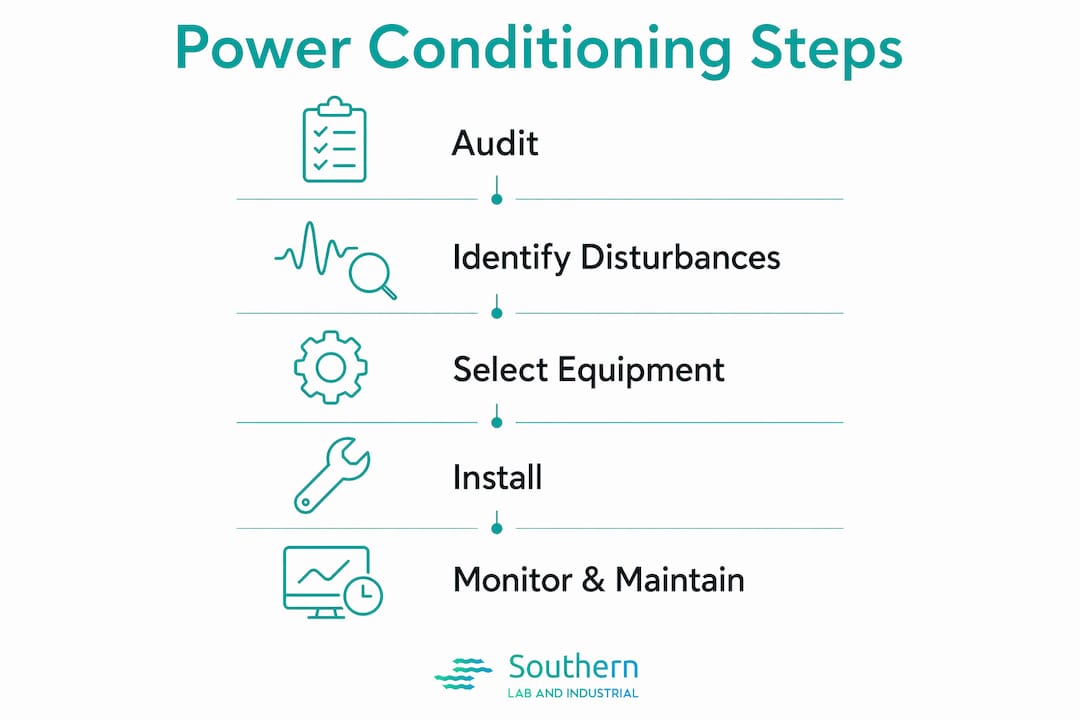
Effective implementation of power conditioning in industrial settings starts with measurement, not purchasing. Facilities that skip the audit phase frequently install equipment that addresses the wrong disturbance or is sized incorrectly for the actual load.
Conduct a power quality audit with specialized analyzers. Standard panel inspections cannot detect high-frequency transients or Ring Wave phenomena. Dedicated power quality audits using instruments like Fluke 435-II or Dranetz HDPQ establish an accurate baseline that drives equipment selection.
Separate supply characterization from equipment compatibility analysis. Confusing these two assessments leads to installing conditioning equipment that either fails under the actual disturbance profile or provides no benefit to the connected loads. Supply characterization maps what the utility delivers. Equipment compatibility analysis defines what your loads require.
Apply a layered protection strategy. Industrial workflows with automation require protection at the service entrance, distribution panel, and branch circuit levels. No single device addresses all disturbance types across all three levels.
Select industrial-grade UPS units with isolation transformers. Industrial-grade UPS systems with isolation transformers provide galvanic separation that stabilizes grounding references and reduces electrical noise propagation in automation environments. Standard IT-grade UPS units fail prematurely in factory settings due to heat and vibration. Lithium-based industrial UPS units offer longer service life and lower maintenance requirements.
Monitor continuously and verify IEEE 519 compliance. IEEE 519 sets harmonic limits at the point of common coupling. Compliance is not a one-time event. Load changes, new equipment additions, and utility feed modifications all affect your harmonic profile.
Avoid relying on visual panel inspections alone. Embedded high-frequency transients leave no visible evidence. Intermittent PLC faults and unexplained drive resets are the symptom. Only a power quality analyzer reveals the cause.
Pro Tip: Schedule a power quality audit after any major equipment addition, such as a new VFD bank or large motor installation. These additions change the harmonic profile of the entire facility, not just the circuit they connect to.
What is the ROI case for industrial power conditioning?
The financial case for power quality management rests on four measurable categories: downtime reduction, utility penalty avoidance, energy savings, and equipment life extension.
The scale of the problem sets the baseline. U.S. industrial power disturbances cost between $119 billion and $188 billion annually, with voltage sags as the primary driver. That figure represents lost production, scrap, restart costs, and equipment repair across the sector.
At the facility level, the numbers are equally direct:
- Downtime reduction: Advanced power conditioning strategies reduce downtime by up to 80% compared to standard surge protection alone. For a facility running three shifts, even a 50% reduction in unplanned stops translates to hundreds of production hours recovered per year.
- Utility penalty avoidance: Facilities that exceed IEEE harmonic limits can face penalties exceeding $100,000 per month. Active harmonic filters that bring THDi below 5% eliminate this exposure entirely.
- Power factor correction payback: Capacitor banks that correct power factor to above 0.95 typically pay back in 8–14 months. After payback, the savings on demand charges are pure operating cost reduction.
- Equipment life extension: Eliminating harmonic stress and transient exposure extends transformer insulation life, reduces drive failures, and lowers the frequency of PLC replacements. These are real costs that rarely appear on a single line item but accumulate significantly over a three-to-five-year capital planning cycle.
The total cost of ownership calculation for power conditioning equipment should include the avoided cost of one major unplanned outage. For most industrial facilities, a single multi-hour shutdown exceeds the installed cost of a complete power quality management system.
Key takeaways
Industrial power conditioning is the most cost-effective way to reduce unplanned downtime, avoid utility penalties, and extend equipment life in facilities running sensitive automation and process control systems.
| Point | Details |
|---|---|
| Audit before you buy | Use specialized analyzers to identify actual disturbances before selecting conditioning equipment. |
| Active filters outperform passive for variable loads | Active harmonic filters respond in under 10 ms and adapt to changing load profiles. |
| Internal transients cause most failures | 80% of damaging transients originate inside the facility, not from the utility feed. |
| Layered protection is required | Service entrance, distribution, and branch circuit protection each address different disturbance types. |
| ROI is measurable and fast | Power factor correction pays back in 8–14 months; harmonic filter investment avoids penalties exceeding $100,000 per month. |
The ghost in your electrical system is real
After working with industrial facilities across the Gulf Coast, the pattern I see most often is this: a facility has invested in surge protection at the service entrance, the utility feed is clean by any standard meter reading, and yet drives reset, PLCs fault intermittently, and nobody can explain why. The culprit is almost always internal transients and conducted noise that standard protection never addresses.
The rise of VFDs and IoT-connected sensors has made this worse, not better. Every VFD you add to a facility is a harmonic source. Every networked sensor is a potential victim of conducted noise. The two trends are on a collision course in most modern plants, and the facilities that recognize this early are the ones that avoid the expensive diagnostic cycles that follow unexplained equipment failures.
What I have found actually works is a measurement-first discipline combined with industrial-grade equipment selected for the specific environment. A Fluke 435-II or equivalent analyzer run for a full production week reveals the real disturbance profile. That data drives equipment selection. Without it, you are guessing. And in a facility where a single unplanned shutdown costs more than a complete power quality system, guessing is an expensive habit.
The other point worth making directly: IT-grade equipment does not belong in a factory. The temperature swings, vibration, and mixed load environments that are normal in industrial settings destroy IT-grade UPS units and filters in months. Industrial-grade equipment costs more upfront and pays back that premium in service life and reliability. You already know this from your experience with other equipment categories. Power conditioning is no different.
— Kris
How SLI supports industrial power conditioning needs
SLI works with industrial facilities and engineering teams along the Gulf Coast to specify, supply, and support power protection systems that match the actual demands of industrial environments.
SLI’s power protection portfolio includes static voltage stabilizers, active harmonic filters, and industrial-grade UPS units from NXT Power, each selected for performance in harsh facility conditions. The focus is on matching the right technology to the disturbance profile identified in your power quality audit, not on selling a one-size-fits-all solution. If your facility is dealing with harmonic penalties, unexplained drive failures, or voltage instability affecting process control, the 2026 industrial power protection guide is the right starting point. SLI also provides turnkey installation and ongoing support, so the system performs as specified from day one.
FAQ
What is industrial power conditioning?
Industrial power conditioning is the process of modifying electrical supply to meet the voltage, harmonic, and noise requirements of sensitive industrial equipment. It includes voltage regulation, harmonic filtering, transient suppression, and power factor correction.
How does power conditioning differ from surge protection?
Surge protection addresses only high-voltage impulse transients. Power conditioning covers a broader range of disturbances including voltage sags, harmonic distortion, conducted noise, and power factor issues that surge protectors do not address.
What is IEEE 519 and why does it matter?
IEEE 519 is the U.S. standard that sets harmonic distortion limits at the point of common coupling between a facility and the utility. Facilities that exceed these limits can face utility penalties exceeding $100,000 per month.
How long does power factor correction take to pay back?
Power factor correction using capacitor banks typically pays back in 8–14 months through reduced utility demand charges and lower system losses, making it one of the fastest-returning investments in power quality management.
Do i need a power quality audit before installing conditioning equipment?
A power quality audit is required to identify the specific disturbances present in your facility. Visual inspections and standard meters miss high-frequency transients and Ring Wave phenomena that cause the majority of intermittent equipment faults.