Gas generation regulatory compliance procurement is the structured process of aligning gas generation project requirements with all applicable safety, environmental, and operational regulations from project initiation through contract execution. For compliance officers and procurement managers in manufacturing and research facilities, this process now involves NFPA 37, NFPA 54, the National Electrical Code (NEC), and digital submission mandates like the BCNSW eCert portal. Getting it wrong means permit delays, insurance gaps, and costly post-contract redesigns. Getting it right means predictable timelines, defensible contracts, and systems that pass inspection the first time.
What are the core regulatory requirements for gas generation projects?
Gas generation projects in manufacturing and research settings require four distinct permit categories: electrical, gas and mechanical, building, and environmental. Each carries its own lead time and inspection protocol, and missing any one of them can halt a project entirely.
Commercial installations typically require 8–16 weeks from permit submission to final approval. Electrical and gas permits generally clear in 2–4 weeks, while environmental permits for larger industrial units routinely take 8–12 weeks or more. That timeline is not a suggestion. It is the planning baseline your project schedule must reflect.

NFPA 37 governs the installation and use of stationary combustion engines and gas turbines. NFPA 54 covers national fuel gas codes, including piping, pressure requirements, and appliance connections. The NEC sets the electrical installation standards that inspectors use during final walkthrough. All three apply simultaneously on most commercial gas generation projects, and your vendor’s equipment documentation must reference compliance with each.
As of march 2026, certificate submissions via online portals are mandatory within 5 business days of work completion. Jurisdictions like New South Wales now require BCNSW eCert portal submissions exclusively. Paper certificates and emailed PDFs are invalid and can void safety certification for the entire installation.
- Electrical permit: Required for generator connections, transfer switches, and load panels. Inspections follow NEC Article 445 and Article 700 for emergency systems.
- Gas and mechanical permit: Covers fuel supply lines, pressure regulators, and appliance connections under NFPA 54 and local mechanical codes.
- Building permit: Required when structural modifications support generator placement, including concrete pads, enclosures, or ventilation systems.
- Environmental permit (air quality): Triggered by generator size and fuel type. Large industrial units burning natural gas may require Title V or minor source permits under the Clean Air Act.
Pro Tip: Start your environmental permit application before finalizing equipment selection. Air quality permit conditions sometimes restrict fuel input rates or require specific aftertreatment equipment, which directly affects which generators qualify for your project.
How do energy procurement regulations affect gas generation sourcing?
The EU Utilities Directive 2014/25/EU is the primary procurement regulation governing energy sector entities in Europe, and its thresholds directly shape sourcing strategy for gas generation equipment. Understanding where your organization falls within this framework determines how much flexibility you have in vendor selection.
The Utilities Directive sets thresholds at 443,000 EUR for supplies and services and 5,538,000 EUR for works contracts. Above these thresholds, energy sector entities may use pre-approved vendor qualification systems instead of running repetitive open tenders. That distinction matters because it allows procurement teams to build and maintain a vetted supplier list rather than restarting the qualification process for every project.
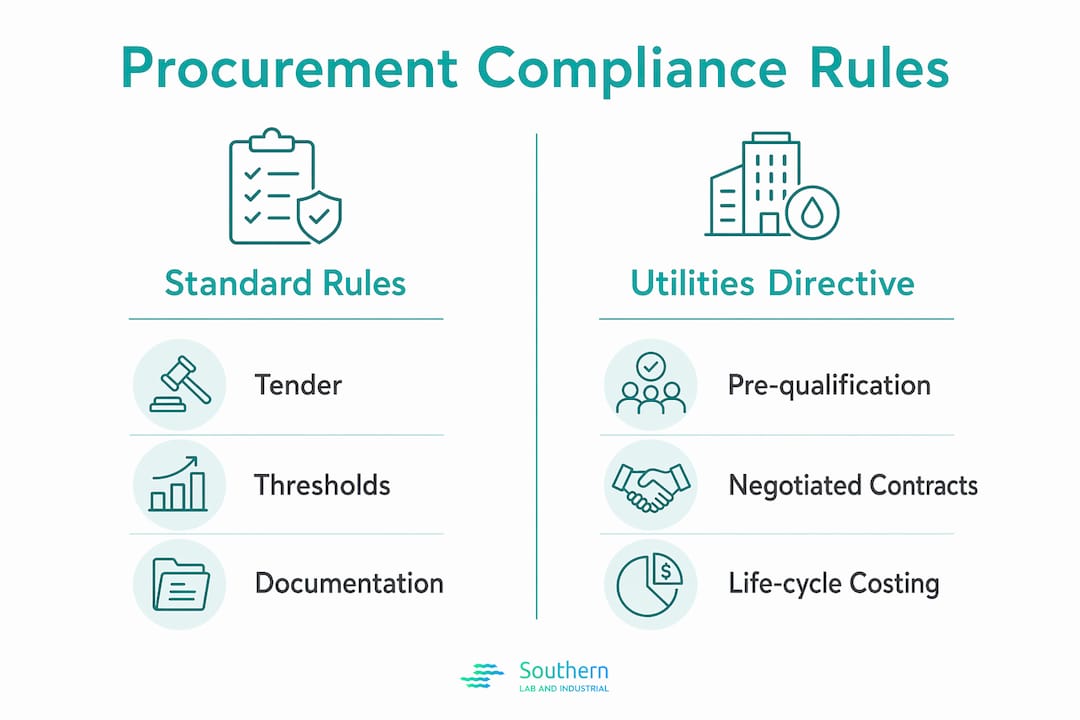
The table below compares standard public procurement rules against the energy sector allowances under the Utilities Directive:
| Procurement Aspect | Standard Public Rules | Utilities Directive Allowance |
|---|---|---|
| Tender requirement | Open tender for most contracts | Negotiated procedure permitted above threshold |
| Vendor selection | Competitive bidding required | Pre-qualified vendor lists allowed |
| Contract flexibility | Rigid scope and pricing | Framework agreements with call-off options |
| Sustainability criteria | Encouraged but optional | Life-cycle cost and carbon pricing integrated |
| Threshold for works | Varies by jurisdiction | 5,538,000 EUR |
Green Public Procurement now integrates life-cycle cost including carbon pricing, recyclability, and sustainability certifications as mandatory criteria in many energy-related procurements. This means the lowest bid price is no longer the deciding factor. A generator with a lower purchase price but no documented end-of-life management plan can fail procurement evaluation entirely.
Pro Tip: When building your vendor qualification system under the Utilities Directive, include a mandatory field for carbon pricing documentation. Suppliers who cannot provide this data will create compliance gaps during contract audits.
How should engineering, compliance, and procurement teams coordinate?
Cross-functional coordination is the single most effective way to prevent cost overruns in gas generation projects. Early collaboration among engineering, procurement, and compliance teams is the primary factor in preventing redesigns and compliance failures. Starting that collaboration after equipment selection is already too late.
The following sequence reflects best practice for coordinating these teams from project initiation through contract award:
- Define mandatory compliance features before issuing the RFQ. Engineering and compliance teams must agree on which control technologies, emissions aftertreatment systems, and monitoring hardware are non-negotiable. These items belong in the technical specification, not the negotiation phase.
- Build a compliance matrix before vendor engagement. The matrix should list every applicable standard (NFPA 37, NFPA 54, NEC, local air quality rules), the responsible team member, the submission deadline, and the citation source. This document becomes the audit trail.
- Include regulatory pass-through clauses in every contract. Explicit pass-through clauses and force majeure definitions protect buyers when air quality or emissions standards change mid-contract. Standard commercial contracts rarely include this language by default.
- Require complete vendor packages at bid submission. Vendor packages that omit required aftertreatment or monitoring hardware cause expensive post-contract redesigns. The lowest upfront cost equipment frequently carries the highest total cost of ownership when compliance hardware is missing.
- Link a regulatory watch system to your contract management workflow. Automated alerts for emissions, safety standards, and customs rules integrated into contract workflows allow teams to activate contingency clauses before regulatory changes become financial liabilities.
Pro Tip: Assign one named compliance owner per contract, not a team or department. Shared ownership of compliance deliverables is the fastest path to missed deadlines.
How can procurement teams qualify gas generation suppliers?
Supplier qualification for gas generation equipment goes beyond price and delivery lead time. The compliance credentials of your supplier directly affect your facility’s legal standing, insurance coverage, and inspection outcomes.
A critical distinction exists between Gas Work Licences (GWL) and Gas Work Authorisations (GWA). Only a GWA legally permits issuing compliance certificates, even when a contractor holds a valid installation license. A supplier or installer who holds a GWL but not a GWA cannot legally certify the work. That gap creates direct liability for the facility owner and can invalidate insurance claims tied to the installation.
Use the following checkpoints when qualifying gas generation suppliers:
- Certification of conformity: Supplier must provide documentation showing equipment meets NFPA 37, NFPA 54, NEC, and any applicable EPA or state air quality standards.
- Gas Work Authorisation verification: Confirm the installing contractor holds the correct authorization level to issue compliance certificates in your jurisdiction.
- Documented end-of-life management: Suppliers should provide a written plan for equipment disposal, refrigerant recovery, and component recycling. This is now a scored criterion under Green Public Procurement frameworks.
- Emissions compliance documentation: Request test reports showing the generator meets applicable NOx, CO, and VOC limits for your permit category.
- Ongoing compliance monitoring capability: Preferred suppliers offer remote monitoring, calibration records, and maintenance logs that support annual permit renewals and insurance audits.
- References from comparable facilities: A supplier qualified for residential installations is not automatically qualified for a research lab or manufacturing facility with continuous-duty gas generation requirements.
Reviewing why certified lab suppliers matter for research environments reinforces why documentation depth, not just price, drives supplier selection in regulated settings.
What emerging trends are reshaping gas compliance procurement?
Regulatory compliance in gas generation procurement is not static. Three converging forces are reshaping how compliance officers and procurement managers must operate in 2026 and beyond.
Digital submission mandates are eliminating paper-based workflows. The BCNSW eCert requirement is one example of a broader shift toward mandatory digital compliance reporting. Procurement contracts must now specify which digital submission platforms the supplier will use, who holds the portal credentials, and what happens if a submission deadline is missed. These are contract terms, not administrative details.
Carbon pricing and lifecycle assessments are entering procurement scoring. Compliance in gas generation procurement is evolving beyond baseline safety to include sustainability measures such as carbon pricing and full lifecycle assessments under Green Public Procurement. Procurement teams that have not updated their evaluation criteria to include these factors are already behind the regulatory curve in jurisdictions that have adopted Green Public Procurement standards.
Automation and AI are changing contract monitoring. Integrated compliance platforms now connect regulatory databases directly to contract management systems. When an emissions standard changes, the platform flags every active contract that references that standard. This capability reduces the manual review burden on compliance officers and shortens the response window from weeks to days. Facilities using platforms like SAP Ariba, Coupa, or purpose-built compliance tools are better positioned to manage this in real time.
The combination of digital mandates, sustainability scoring, and automated monitoring means that gas generation procurement programs built on manual processes and static vendor lists will face growing audit exposure. Proactive teams are already building these capabilities into their procurement infrastructure.
Key takeaways
Effective gas generation regulatory compliance procurement requires early cross-functional alignment, complete vendor documentation, and contracts that explicitly address regulatory change.
| Point | Details |
|---|---|
| Plan for 8–16 week permit timelines | Build environmental and electrical permit lead times into every project schedule from day one. |
| Mandate complete vendor packages | Require aftertreatment hardware and monitoring systems in the technical spec, not as post-award options. |
| Include regulatory pass-through clauses | Protect your facility from mid-contract standard changes with explicit contractual language. |
| Verify Gas Work Authorisations | Confirm suppliers hold the correct authorization level to issue legally valid compliance certificates. |
| Integrate sustainability scoring | Add life-cycle cost, carbon pricing, and end-of-life documentation to supplier evaluation criteria. |
Where most procurement programs fall short
The compliance officers I work with most closely are technically sharp and genuinely motivated to get this right. The gap I see most often is not knowledge. It is timing.
Teams engage compliance review after the vendor shortlist is already set. By that point, the equipment specs are locked, the budget is approved, and any compliance-driven change triggers a redesign conversation that nobody wants to have. The cost of that sequence is real. Post-contract modifications to add required aftertreatment hardware or monitoring systems routinely run 15–30% of the original equipment cost.
The second pattern I see is treating supplier qualification as a one-time event. A supplier who passed your qualification audit two years ago may have changed their subcontractor network, lost a key certified installer, or shifted their product line to equipment that no longer meets your current permit conditions. Annual requalification is not bureaucratic overhead. It is risk management.
The third issue is contract language. Most procurement teams inherit standard commercial templates that were never designed for regulated gas generation projects. Those templates do not include regulatory pass-through clauses. They do not define force majeure in terms of new environmental standards. And they do not specify digital submission requirements. Fixing that requires one conversation with legal before the contract is issued, not a dispute after the permit is denied.
The facilities that manage this well share one habit: they treat compliance as a design input, not a final checkpoint. That shift in sequencing changes everything downstream.
— Kris
How SLI supports compliant gas generation procurement
SLI works with manufacturing facilities and research labs along the Gulf Coast that need gas generation systems to meet strict regulatory and operational requirements. Whether you are qualifying suppliers for a new installation or managing compliance documentation for an existing system, SLI provides the technical depth and local support that procurement teams need to move forward with confidence.
SLI’s gas generator integration resources document real-world compliance challenges and the solutions that resolved them. For teams building out their 2026 supplier qualification process, SLI’s supplier qualification steps provide a structured framework aligned with current regulatory requirements. SLI partners with LNI Swissgas, Nel Hydrogen, and NXT Power to deliver certified equipment backed by documented compliance packages. Visit getsli.com to connect with the SLI team directly.
FAQ
What permits are required for a commercial gas generator installation?
Most commercial installations require electrical, gas and mechanical, building, and environmental (air quality) permits. Permit processing timelines typically run 8–16 weeks depending on unit size and jurisdiction.
What is the difference between a gas work licence and a gas work authorisation?
A Gas Work Licence permits installation work, but only a Gas Work Authorisation legally allows the contractor to issue compliance certificates. Using a contractor without the correct authorisation creates insurance and liability gaps for the facility owner.
How does the EU utilities directive affect gas generation procurement?
The Utilities Directive 2014/25/EU allows energy sector entities to use pre-qualified vendor lists and negotiated procedures for contracts above 443,000 EUR for supplies and services. This reduces the need for repetitive open tenders on recurring gas generation procurements.
What should a regulatory pass-through clause include?
A regulatory pass-through clause should define which party absorbs costs when new emissions or safety standards take effect during the contract term. It should also specify the notice period, the applicable regulatory bodies, and the process for contract modification.
How often should gas generation suppliers be requalified?
Annual requalification is the standard practice for suppliers involved in regulated gas generation projects. Requalification should verify current certifications, installer authorizations, equipment compliance documentation, and any changes to subcontractor networks.