Nitrogen purging is the controlled displacement of oxygen, moisture, and reactive gases from industrial vessels and pipelines using inert nitrogen gas to create a safe, dry, and non-reactive atmosphere. The process is the primary defense against combustion, internal corrosion, and product contamination in petrochemical plants, pharmaceutical manufacturing, food processing, and pipeline operations. Industry standards require oxygen concentration below 1% to 2% and a dew point below -40°C before a vessel is considered safely purged. Meeting those two targets simultaneously is what separates a compliant nitrogen purging industrial process setup from one that creates hidden liability.
What purging method is right for your nitrogen purging industrial process setup?
Choosing the wrong purging method wastes nitrogen, extends downtime, and can leave dangerous oxygen pockets in your system. Four primary gas purging techniques apply to industrial settings, and each suits a different system geometry and operational constraint.
Displacement purging pushes oxygen out by introducing nitrogen at one end and venting at the other. It works best in simple pipelines and vessels with no internal baffles. Laminar flow between 2 and 5 ft/sec is mandatory to prevent turbulent mixing that defeats the purpose of displacement. This method uses only 1.2 to 1.5 times the vessel volume in nitrogen, making it the most gas-efficient option when geometry allows it.
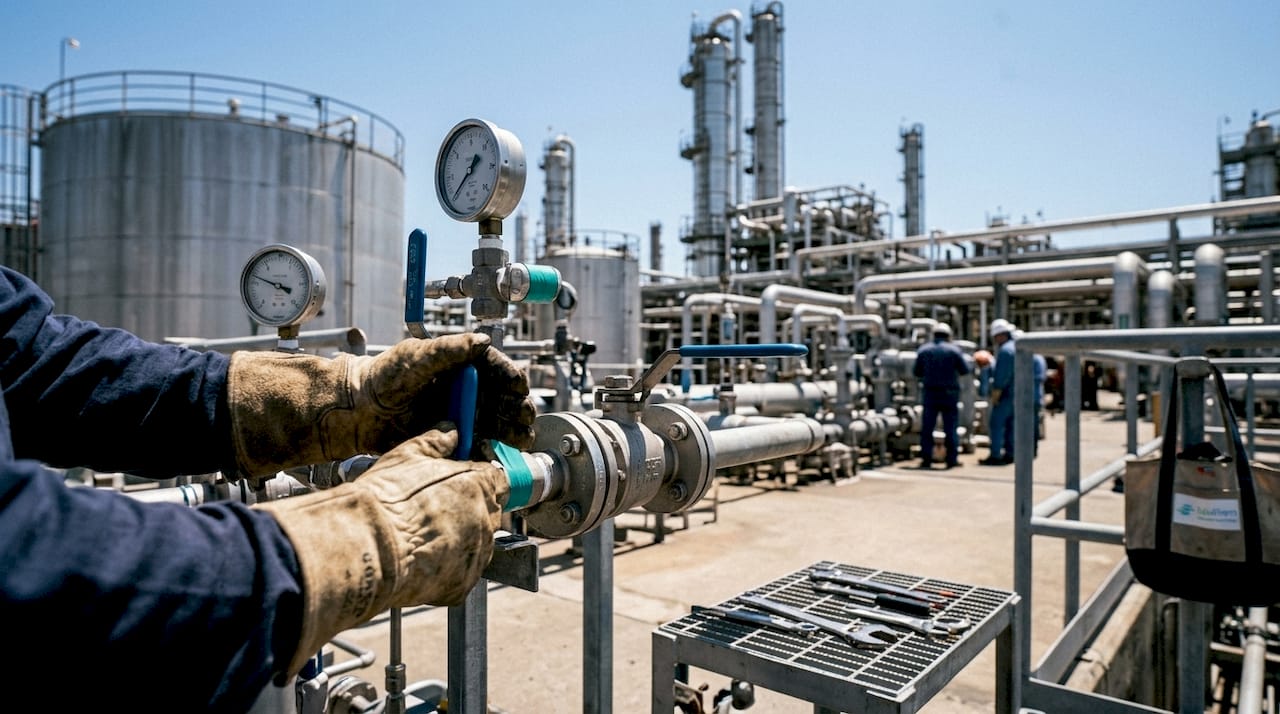
Dilution purging introduces nitrogen throughout the vessel to mix with and dilute the existing atmosphere, then vents the mixture. It requires 3 to 5 times the vessel volume and is the standard choice for complex geometries where laminar flow cannot be maintained. Complex systems with internal baffles routinely require this higher volume to achieve thorough gas removal. The tradeoff is nitrogen consumption, not effectiveness.
Pressure swing purging pressurizes the vessel with nitrogen, then vents to atmosphere, repeating the cycle. It suits smaller, sealed vessels where continuous flow is impractical. Vacuum purging removes the existing atmosphere before backfilling with nitrogen, achieving the lowest residual oxygen levels of any method. Vacuum purging requires vessels rated for negative pressure, which limits its application but makes it the preferred choice when oxygen targets below 0.1% are specified.
| Method | Best for | Nitrogen volume factor | Key limitation |
|---|---|---|---|
| Displacement | Simple pipelines, unbaffled vessels | 1.2x to 1.5x vessel volume | Requires laminar flow control |
| Dilution | Complex vessels with baffles | 3x to 5x vessel volume | High nitrogen consumption |
| Pressure swing | Small sealed vessels | Varies by cycle count | Slower for large volumes |
| Vacuum purging | High-purity applications | 1x to 2x vessel volume | Vessel must be vacuum-rated |
Pro Tip: Never assume displacement purging works in a vessel you have not internally inspected. A single internal baffle or dead-leg pipe section converts a displacement scenario into a dilution scenario, doubling or tripling your nitrogen requirement.
How to calculate nitrogen volume and cycle requirements
Accurate nitrogen volume calculations prevent both under-purging and excessive gas waste. The exponential dilution formula governs how oxygen concentration drops with each purge cycle: O₂ final = O₂ initial × e^(−n), where n is the number of vessel volumes of nitrogen introduced.
For pressure swing purging, the math is more direct. Three to five cycles at 2 to 5 psig reduces oxygen to approximately 0.3%, which meets the threshold for safe storage and shipping preparation. Each additional cycle reduces residual oxygen by roughly one order of magnitude, so a fifth cycle at 5 psig brings most vessels well below 0.1% O₂.
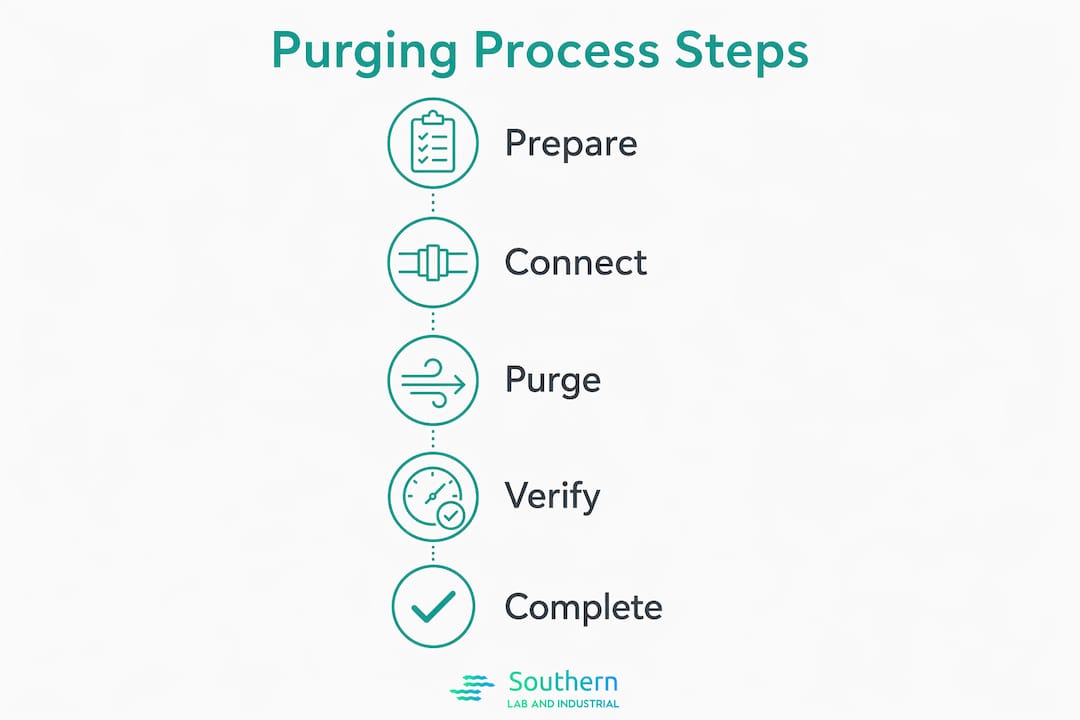
Here is how the calculation scales across common vessel sizes and target oxygen levels:
| Vessel volume | Target O₂ | Method | Nitrogen required | Cycles |
|---|---|---|---|---|
| 500 gallons | < 1% | Displacement | 750 gallons | 2 to 3 |
| 500 gallons | < 0.3% | Pressure swing | 2,500 gallons | 5 |
| 2,000 gallons | < 1% | Dilution | 8,000 gallons | 4 to 5 |
| 2,000 gallons | < 0.1% | Vacuum + backfill | 2,000 gallons | 2 to 3 |
Follow this sequence when calculating your nitrogen gas setup process requirements:
- Measure the internal volume of the vessel or pipeline section, including all connected dead legs.
- Identify the target oxygen concentration and dew point from your process specification or applicable standard.
- Select the purging method based on vessel geometry and available venting points.
- Apply the volume factor for your chosen method (1.2x to 5x depending on method and complexity).
- Add a 10% to 15% buffer for line losses, regulator dead volume, and connection purges.
- Verify your nitrogen supply can deliver the required flow rate to complete the purge within your maintenance window.
Pro Tip: Always calculate nitrogen volume for the worst-case dead-leg configuration, not the nominal vessel volume. Unaccounted dead legs are the most common reason a purge fails its final oxygen verification test.
Essential equipment and setup checklist for industrial nitrogen purging
A nitrogen purge system is only as reliable as its weakest component. The minimum hardware list for a compliant industrial setup includes pressure regulators, needle valves or ball valves rated for the service pressure, calibrated flow meters, fixed or portable O₂ sensors, pressure gauges at both inlet and vent, and a relief valve sized for the maximum supply pressure.
Nitrogen supply selection directly affects both cost and operational continuity. The three options are high-pressure cylinders, liquid nitrogen dewars, and on-site pressure swing adsorption (PSA) generators. Cylinders suit low-volume or infrequent purging but carry delivery lead time risk and higher per-unit cost. Liquid nitrogen provides higher volume at lower cost per unit but requires cryogenic handling procedures and specialized storage. On-site PSA nitrogen generation delivers 95% to 99.99% purity continuously, eliminates supply chain dependency, and reduces total cost of ownership for facilities with regular purging schedules. For a detailed cost comparison, the nitrogen generator vs. cylinders analysis from SLI quantifies the payback period for most industrial use cases.
Inlet and vent placement determines whether you achieve full displacement or create dead zones. Short-circuiting occurs when the nitrogen inlet and vent are positioned too close together, allowing nitrogen to exit before displacing the full vessel volume. Place the nitrogen inlet at the lowest point of a horizontal vessel or at the top of a vertical vessel, and position the vent at the opposite end to maximize sweep distance.
Pre-purge setup verification checklist:
- Confirm vessel isolation from process lines and utilities
- Verify all valves are in the correct position before introducing nitrogen
- Install and zero-calibrate O₂ sensors at the vent outlet and operator breathing zone
- Check regulator set point against the vessel’s maximum allowable working pressure
- Confirm relief valve installation and set pressure
- Establish communication with the site safety team and confirm exclusion zone boundaries
- Document starting oxygen concentration and ambient dew point
What safety protocols are required during nitrogen purging?
Nitrogen is an asphyxiant, not a toxic gas, which makes it more dangerous in practice because operators receive no sensory warning before incapacitation. Operators must wear air-pack respirators and maintain exclusion zones around all vent outlets and vessel openings during active purging. Continuous O₂ monitoring at operator breathing zones is not optional. It is the primary life-safety control.
Critical safety fact: Nitrogen is slightly lighter than air under standard conditions, but this density difference is not reliable protection against accumulation. Nitrogen accumulates in low-lying confined spaces such as pits, trenches, and below-grade equipment rooms, creating silent asphyxiation hazards that fixed overhead monitors will not detect.
Post-purge integrity verification requires a pressure hold test. Maintaining 5 psig with no more than a 1 psi drop over five minutes confirms vessel integrity before the system is returned to service. Any pressure drop exceeding this threshold indicates a leak that must be located and repaired before the vessel is considered purged and sealed.
Additional safety practices that belong in every site procedure:
- Coordinate with the site emergency response team before starting any purge on a vessel larger than 500 gallons
- Post visible nitrogen hazard signage at all access points within the exclusion zone
- Never rely on visual or olfactory cues to assess nitrogen concentration
- Verify O₂ sensor calibration within 24 hours of each purge operation
- Maintain a written emergency response plan specific to nitrogen asphyxiation scenarios
Common pitfalls when setting up nitrogen purging processes
Most purge failures trace back to a small set of recurring mistakes. Recognizing them before commissioning saves nitrogen, protects equipment, and prevents failed compliance checks.
- Over-pressurization of atmospheric tanks. Atmospheric tanks can deform and weld seams can fail at pressures exceeding approximately 1.8 inches of water column. Always install a relief valve and never use a high-pressure nitrogen supply directly on an atmospheric vessel without a properly sized regulator.
- Turbulent flow during displacement purging. Exceeding 5 ft/sec nitrogen velocity creates turbulence that mixes the nitrogen and air rather than displacing air cleanly. The result is a dilution purge consuming displacement-level nitrogen volume, which typically fails the final O₂ check.
- Ignoring dew point. Neglecting dew point monitoring causes hydrate formation and internal corrosion even when oxygen levels meet specification. A vessel can read 0.5% O₂ and still corrode internally if the dew point is above -40°C.
- Improper inlet and vent placement. Dead zones form when nitrogen bypasses sections of the vessel. Nitrogen stratification in vertical vessels can trap air at lower levels if injection points are not positioned to force full circulation.
- Skipping the final verification. Completing the calculated number of purge cycles does not guarantee the target O₂ level was reached. Always measure residual oxygen and dew point at the vent outlet before declaring the purge complete.
Pro Tip: If your final O₂ reading is higher than calculated, check for leaking isolation valves before adding more nitrogen. A passing valve leak continuously reintroduces air and makes the purge appear ineffective regardless of nitrogen volume applied.
Key takeaways
A compliant nitrogen purging industrial process setup requires matching the purging method to vessel geometry, calculating nitrogen volume with dead-leg allowances, and verifying both oxygen concentration and dew point before sign-off.
| Point | Details |
|---|---|
| Method selection drives volume | Displacement uses 1.2x to 1.5x vessel volume; dilution requires 3x to 5x for complex geometries. |
| Cycle count targets O₂ below 0.3% | Three to five pressure swing cycles at 2 to 5 psig reliably achieve safe storage oxygen levels. |
| Dew point is a co-equal target | Achieving low O₂ without hitting dew point below -40°C still leaves the vessel vulnerable to corrosion. |
| Safety requires active monitoring | Continuous O₂ monitoring and air-pack respirators are mandatory, not precautionary, during active purging. |
| On-site generation reduces supply risk | PSA nitrogen generators deliver 95% to 99.99% purity continuously, eliminating cylinder delivery dependencies. |
Why nitrogen purging deserves more engineering rigor than most facilities give it
I have reviewed purge procedures at facilities where the entire protocol fit on a single laminated card: “open nitrogen valve, wait 30 minutes, close valve.” That approach works until it does not, and when it fails, the failure mode is either a corrosion-driven vessel failure months later or an asphyxiation incident that no one anticipated because the O₂ monitor was mounted six feet off the floor in a room with a below-grade trench.
Modern nitrogen purging is a precision engineering process, not a ventilation task. The facilities that treat it as such, with documented volume calculations, calibrated sensors, and method selection tied to actual vessel geometry, consistently pass third-party audits and avoid the rework costs that follow a failed purge. The ones that do not are usually the same facilities calling for emergency cylinder deliveries at 2 a.m. because their supply ran out mid-purge.
The shift toward on-site PSA nitrogen generation is the single most operationally significant change I have seen in industrial nitrogen applications over the past decade. Cylinder dependency introduces a supply chain variable that has no place in a safety-critical process. When your purge schedule is tied to a delivery truck, your process integrity is tied to a delivery truck. On-site generation removes that variable entirely and typically pays back within 18 to 36 months at facilities running more than two purge operations per week.
The other underrated factor is dew point discipline. Most operators check oxygen religiously and treat dew point as a secondary concern. The corrosion data says otherwise. A vessel that passes its O₂ check but sits at a dew point of -20°C will show internal rust within months. Both numbers matter equally.
— Kris
How SLI supports your industrial nitrogen purging setup
SLI specializes in on-site nitrogen generation systems for industrial facilities along the Gulf Coast, providing PSA generators that deliver continuous, high-purity nitrogen without cylinder logistics or supply interruptions.
For facilities running regular purge operations, on-site generation eliminates per-cylinder costs, removes delivery scheduling from your critical path, and gives you precise purity control from 95% to 99.99%. SLI provides turnkey installation, local technical support, and ongoing maintenance, so your nitrogen purge system stays compliant and operational. Explore SLI’s industrial gas generation solutions or review the gas generator flow rate guidance to size your system accurately before commissioning. Contact SLI directly to discuss custom integration for your specific vessel configuration and purge schedule.
FAQ
What oxygen level is required for a completed nitrogen purge?
Industry standards require oxygen concentration below 1% to 2% for a vessel to be considered safely purged, with dew point below -40°C as a co-equal requirement.
How many purge cycles does a pressure vessel typically need?
Three to five pressure swing cycles at 2 to 5 psig reduce residual oxygen to approximately 0.3%, which meets most safe storage and shipping specifications.
What is the biggest safety risk during nitrogen purging?
Asphyxiation is the primary hazard. Nitrogen displaces oxygen without any detectable odor or color, and accumulation in low-lying confined spaces creates silent incapacitation risk that requires continuous O₂ monitoring to detect.
When does on-site nitrogen generation make more sense than cylinders?
On-site PSA generation becomes cost-effective for facilities running more than two purge operations per week, where cylinder delivery costs and lead times create operational risk and higher total cost of ownership.
How do you verify a nitrogen purge is complete?
Measure residual oxygen at the vent outlet and confirm dew point below -40°C, then perform a pressure hold test at 5 psig with no more than a 1 psi drop over five minutes to confirm vessel integrity.